
IRIDEX Advances Ophthalmic Laser Solutions Amid Evolving Reimbursement and Commercial Dynamics
IRIDEX’s latest quarterly filing reveals significant deferred revenue from exclusive licensing deals, underscoring a turning point in revenue recognition and market traction for its tissue-sparing laser therapies.
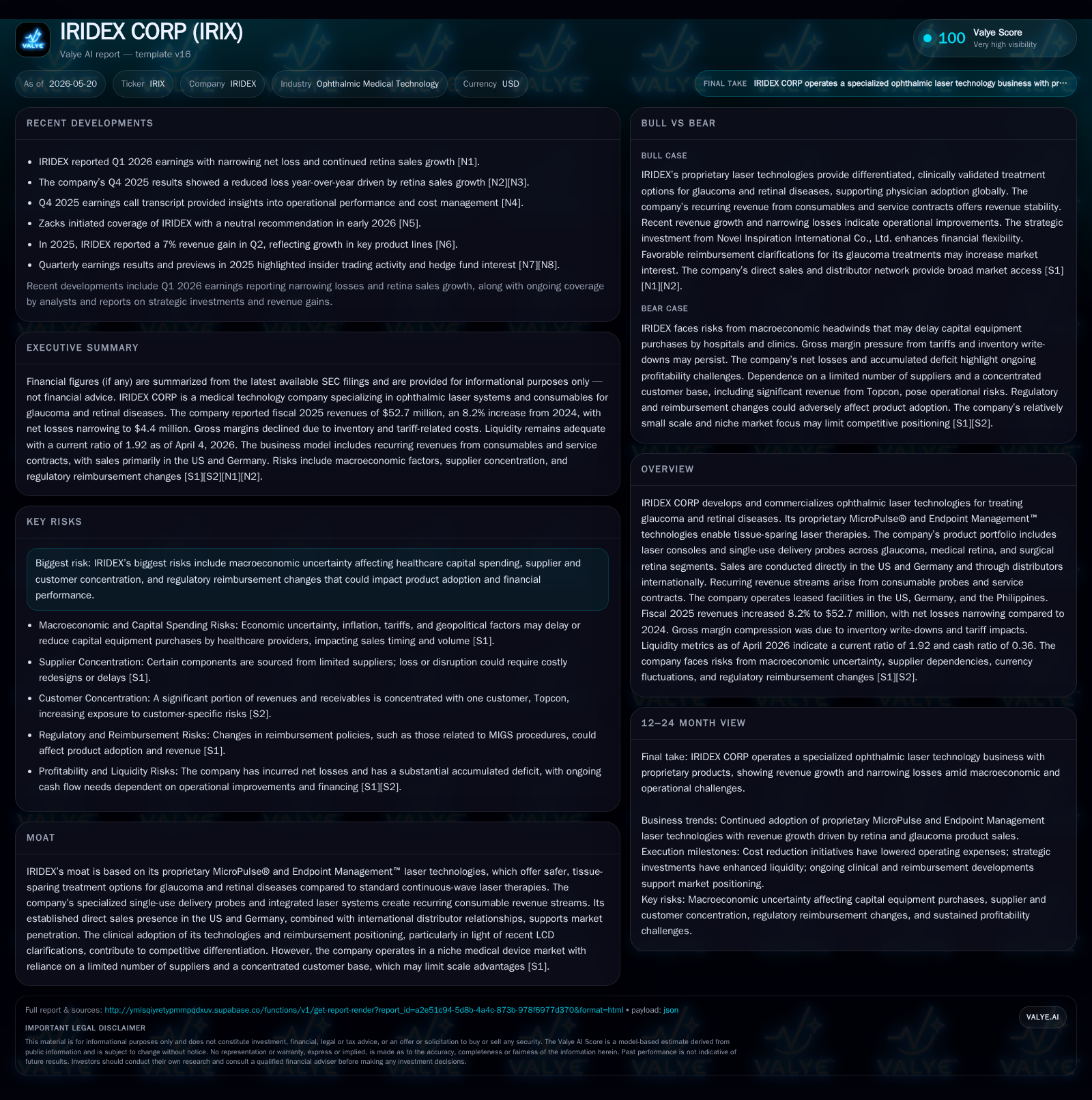
In its Q1 2026 filing, IRIDEX disclosed approximately $6.4 million in non-current and $1.5 million in current deferred revenue related to exclusive distribution rights, highlighting growing commercial adoption under sales-based license agreements with delayed revenue recognition. The company’s proprietary MicroPulse® and Endpoint Management™ technologies provide clinically safer alternatives to conventional continuous-wave lasers for glaucoma and retinal disease treatment, supported by recurring consumables sales and direct distribution in key markets. While IRIDEX operates within a niche with supply chain and customer concentration challenges, recent reimbursement clarifications and expanded distribution offer growth levers. The balance sheet shows prudent liquidity management with a current ratio near 2 and low debt relative to cash reserves.
Latest Quarterly Operating Highlights and Revenue Recognition Shifts
The Q1 2026 10-Q filed May 19 reveals IRIDEX recognizes revenue from two major exclusive licensing arrangements based on actual sales reported by licensees one quarter in arrears [S2]. Consequently, approximately $6.4 million of deferred non-current revenue alongside $1.5 million current deferred revenue remained unrecognized as of April 4, 2026. This reflects the point-in-time nature of ASC 606 guidance applied to sales-based intellectual property licenses where variability estimation is constrained due to unpredictability in licensee reporting.
This sizable deferred revenue balance signals progress toward monetizing its exclusive distribution rights agreements—a potentially durable source of near-term revenue visibility and cash flow stability. Concurrently, IRIDEX maintains warranty accruals corresponding to its two-year full product warranty policy; these costs are expensed upon shipment, influencing gross margins [S2]. This dynamic underscores the balance between upfront product sales and ongoing service obligations within its business model.
Business Model and Product Portfolio: Differentiation Through Proprietary Laser Technologies
IRIDEX's portfolio centers on clinically differentiated laser technologies for ophthalmic applications that address glaucoma and retinal diseases [S1]. The company's proprietary MicroPulse® Technology emits microsecond pulsed laser energy allowing retinal tissue cooling between pulses to avoid collateral thermal damage common in traditional continuous-wave (CW) lasers. Similarly, Endpoint Management™ employs an energy delivery algorithm that finely titrates laser dosage allowing precise treatment endpoints with reduced tissue injury.
The combination of laser consoles integrated with disposable single-use delivery probes forms the foundation of IRIDEX's recurring revenue streams—consumables typically drive higher-margin sales relative to capital equipment [S1]. These proprietary delivery devices also raise switching costs for users adopting IRIDEX’s system.
Geographically, IRIDEX primarily executes direct selling in the US and Germany while leveraging distributor networks internationally [S1]. This hybrid model balances localized clinical support with scalable global reach in specialized ophthalmology centers.
Competitive Dynamics and Industry Positioning in Ophthalmic Medical Devices
Within the ophthalmic device niche, IRIDEX occupies a defensible position owing to its patent-protected MicroPulse® and Endpoint Management™ technologies that provide safer alternatives to standard continuous-wave lasers [S1]. Clinical outcomes with reduced vision loss risk have fostered reimbursement acceptance—a key barrier given historically conservative payer attitudes toward novel laser therapies.
While competitors exist offering laser solutions primarily based on conventional CW technology or alternative modalities such as MIGS (micro-invasive glaucoma surgery), IRIDEX’s product features create meaningful differentiation, particularly among retina specialists attentive to safety profiles. Its single-use probe consumables enhance recurring revenue visibility but the firm's scale is constrained by concentrated supplier relationships providing critical components [S1]. Additionally, a customer base skewed toward certain large distributors creates bargaining dynamics limiting pricing flexibility.
Barriers to rapid adoption also arise from switching costs related to physician preferences, training requirements, and reimbursement coding nuances common within medical technology adoption cycles.
Growth Drivers: Distribution Expansion, Clinical Adoption, and Recurring Consumable Sales
Emerging growth vectors explicitly track from expanding commercial footprints via exclusive licensing agreements—which yield deferred revenue as licensees grow their end-user sales reported with lag—providing leading indicators of broader market penetration [S2]. Increasing awareness among ophthalmic clinicians around the superior safety profile of MicroPulse® technology relative to CW lasers can structurally augment prescription volumes.
Endpoint Management™ upgrades offer incremental product differentiation potentially stimulating upgrade cycles within installed bases. Furthermore, probe consumption scales predictably with active cases treated—a key volume/mix lever impacting gross margins positively due to higher consumable contribution margins [S1]
Recent regulatory clarifications around local coverage determinations (LCDs) further assist third-party reimbursement acceptance—critical for procedural adoption which often requires robust insurance coverage given capital constraints in healthcare settings.
Risks and Constraints: Supply Chain Concentration, Macroeconomic Pressures, and Regulatory Reimbursement Changes
IRIDEX faces tangible constraints related to its reliance on limited suppliers for high-precision laser components; loss or disruption could require costly component redesigns delaying production [S1]. Customer concentration compounded by dependence on a few large distributor partners limits negotiation power potentially capping pricing flexibility.
Macroeconomic uncertainty affecting healthcare capital expenditures remains an overarching risk; investment cycle volatility can directly suppress purchasing activity for elective or semi-elective ophthalmic procedures reliant on capital equipment acquisition [S1]. Moreover, shifting reimbursement policies or tightening coverage criteria threaten adoption momentum.
Warranties involve two-year full product coverage accruing cost burdens upfront which may compress gross margins especially under tariff-induced cost pressures observed recently—a headwind accentuating operating leverage challenges during scaling phases [S2].
Key Upcoming Milestones and Areas to Monitor
Near-term catalysts include progressive recognition of deferred revenues tied directly to licensee quarterly sales reports—monitoring sequential revenue trends will indicate pace of monetization under exclusive contracts [S2]. Watch for announcements or data releases on additional clinical studies endorsing efficacy or FDA labeling expansions supporting use cases beyond current indications.
Operationally, probe consumable sales volumes are meaningful markers reflecting active case growth coupled with potential pricing strategy shifts impacting profitability metrics [N1]. Additionally, any commentary concerning channel shifts in geographic markets or distributor agreements will bear on competitive positioning.
Brief Financial Profile: Liquidity, Profitability, and Deferred Revenue Impact
As of April 4, 2026, IRIDEX maintains healthy liquidity with $4.6 million cash alongside current assets totaling approximately $24.6 million against current liabilities near $12.8 million yielding a current ratio of 1.92—indicating reasonable short-term financial flexibility [F1][S2]. Total debt was moderate at about $1 million relative to cash levels implying net cash positive status bolstering balance sheet strength [F1].
Net losses have narrowed year-over-year aligning with incremental top-line expansion; however gross margin pressure persists owing partly to warranty cost provisions established upon shipment as well as tariff headwinds affecting input costs [S2]. Deferred costs related to commissions are amortized over multi-year periods smoothing expense recognition consistent with contract terms.
Overall financial positioning supports ongoing R&D investment while funding commercialization efforts without immediate external capital dependence.
This analysis synthesizes SEC filings including the latest quarterly 10-Q dated May 19, 2026 [S2][S3], annual Form 10-K dated April 2, 2026 [S1], supplemented with observable market commentary [N1] without offering investment research views.
Disclaimer: This is research-only, informational analysis and not investment advice. It may include AI-generated interpretation and general industry context. Always verify important details using primary sources.

Comments