
Invesco Ltd: Navigating Asset Management in a Competitive, Regulated Environment
Invesco Ltd. leverages diversified investment capabilities and broad distribution networks amid market volatility and regulatory challenges.
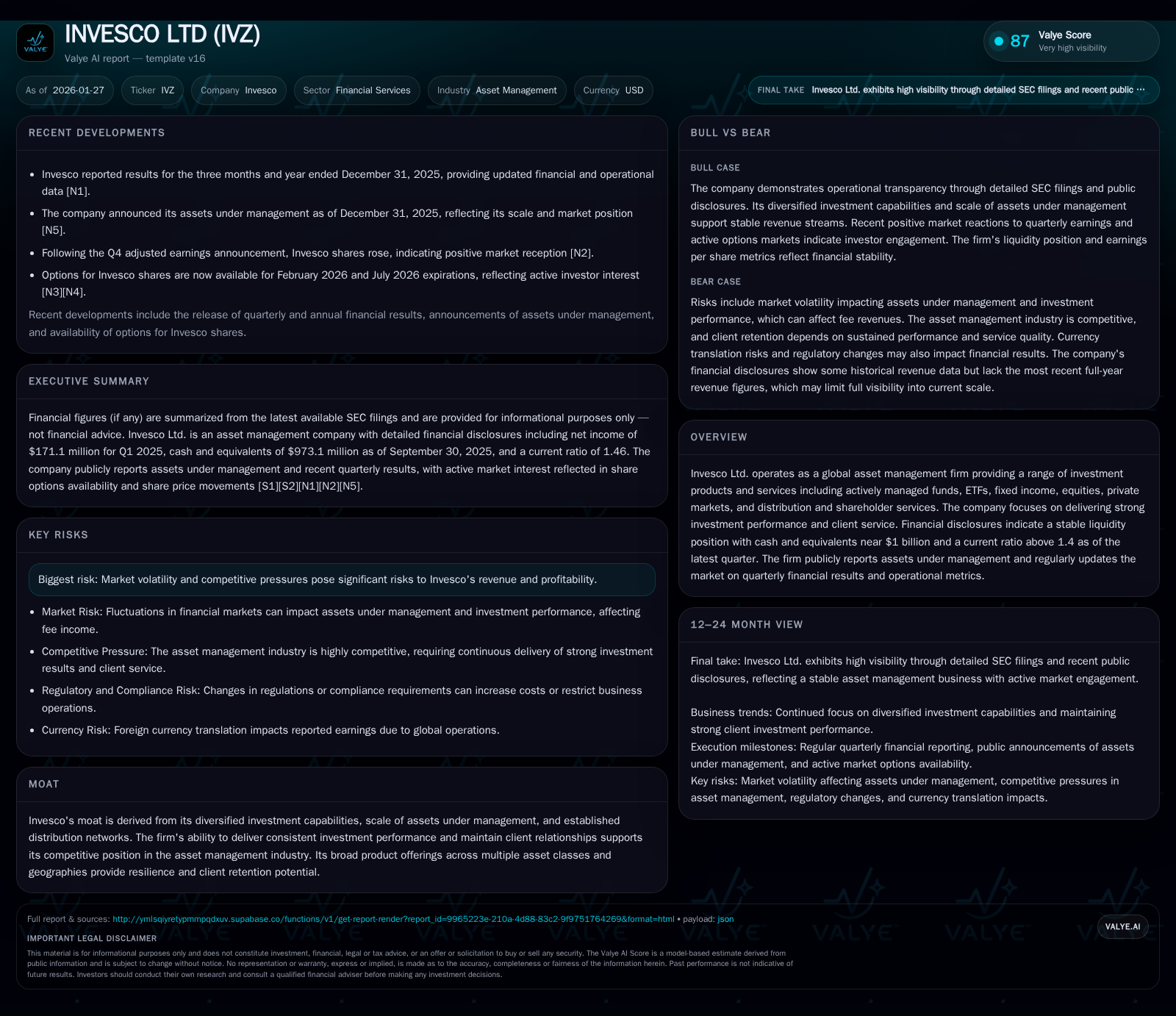
Invesco Ltd., a global asset manager, reported solid fourth-quarter 2025 adjusted earnings that exceeded expectations, supported by stable assets under management (AUM) and diversified investment offerings. The company’s business model integrates multiple asset classes with a global distribution framework, aiming to deliver consistent performance and client retention. However, Invesco faces industry headwinds including market volatility, regulatory risks, and competitive pressures that influence fee revenue and operational resilience.
What Changed Recently
Invesco Ltd. reported its financial results for Q4 and full-year 2025 on January 27, 2026. The firm beat adjusted earnings expectations, driving positive market reactions to its stock [N1][N2]. Concurrently, the company announced its assets under management as of December 31, 2025, confirming stability in client assets amid challenging market conditions [N5]. Options for February and July 2026 were also introduced, reflecting increased investor interest and liquidity in the stock [N3][N4]. These developments suggest operational resilience and investor confidence in the near term.
Business Model as a System
Invesco operates as a global asset management platform offering a comprehensive suite of investment products including actively managed mutual funds, exchange-traded funds (ETFs), fixed income and equity strategies, private markets (including real estate and private credit), as well as distribution and shareholder services [S1][S6]. The firm’s revenue model primarily depends on management fees calculated as a percentage of AUM, supplemented by performance fees and transactional income.
The company's product diversification mitigates concentration risk and caters to various investor needs across geographies and asset classes [S6]. Investment capabilities are categorized by strategy and include fundamental fixed income, fundamental equities, ETFs and indexed strategies, and private markets, enabling tailored client solutions [S6]. This modular approach allows Invesco to cross-sell products and maintain engagement across client segments.
Distribution is a critical lever, leveraging global networks spanning institutional, retail, and intermediary channels to access a broad client base [S1]. This also entails significant investments in client service, technology, and regulatory compliance. The firm's organizational structure supports integration of acquisitions and operational efficiencies, as evidenced by transaction and integration charges noted in filings [S1].
Industry Map & Competitive Battlefield
The asset management industry is characterized by intense competition among global asset managers, boutique firms, and passive product providers. Fee compression driven by the rise of low-cost ETFs and index funds pressures traditional active managers like Invesco [S22]. Clients increasingly demand transparency, performance, and digital engagement, requiring firms to innovate in product development and operational efficiency.
Invesco competes on multiple fronts: investment performance to retain and attract assets, cost management to improve margins, and distribution reach for scale advantages. The presence of large competitors with scale advantages and niche players with specialized strategies heightens competitive dynamics. Regulatory frameworks globally impose compliance costs and operational constraints, influencing product design and market entry [S20].
Technological advancements, including AI and data analytics, present both opportunities for enhanced investment insights and operational risks related to system reliability and cybersecurity [S21]. The firm's ability to adapt to these changes while maintaining client trust is a key differentiator.
Where the Economics Become Real
Invesco’s economics hinge on assets under management, which directly drive fee revenue. Market volatility influences AUM fluctuations, creating revenue variability. The firm reported operating revenues and net income reflective of fee income sensitivity to market conditions [N1][S9]. Operating leverage exists due to relatively fixed costs in technology, compliance, and distribution, making asset growth and retention critical to profitability.
Transaction and integration expenses, while not substantial, reflect ongoing strategic activities and impact operating margins [S1]. Capital and liquidity positions are robust, with cash and equivalents near $1 billion and a current ratio of approximately 1.46, providing a cushion against market dislocations [S13].
Fee structures vary by product, with active management typically commanding higher fees than passive strategies. The mix of products affects margin profiles, and performance outcomes influence client retention and potential performance fees [S9][S22]. The firm also manages risk through diversification across investment capabilities and geographies.
Diligence Questions / Disconfirming Signals
- How resilient is Invesco’s AUM base to sustained market downturns and potential investor outflows?
- What is the company’s strategy and track record in maintaining investment performance relative to peers?
- How effectively does Invesco manage regulatory compliance costs and evolving legal risks?
- To what extent can the firm leverage technology and AI to enhance operational efficiency without incurring material risks?
- How does Invesco balance the pressure from passive product growth with its active management offerings?
- Are there any material exposures or risks in private markets or real estate investments that could affect liquidity?
- How does the firm’s distribution network adapt to changing client behaviors and digital engagement trends?
- What are the implications of transaction and integration charges on free cash flow and capital allocation?
- Does Invesco have sufficient scale and differentiation to defend against fee compression?
- Are there any emerging reputational risks linked to data management or regulatory investigations?
This analysis is based on publicly available information and recent disclosures as of January 2026, including regulatory filings and news releases. It aims to provide a comprehensive understanding of Invesco Ltd.’s business structure, industry context, and economic drivers without offering investment advice or recommendations.
Disclaimer: This is research-only, informational analysis and not investment advice. It may include AI-generated interpretation and general industry context. Always verify important details using primary sources.

Comments