
Jaguar Health’s Dual-Track Strategy Drives Growth Amid Narrow Revenue Base
Latest quarterly filings highlight Jaguar Health's AI adoption for crofelemer development, licensing reliance on Woodward Specialty, and emerging animal health initiatives amid liquidity constraints.
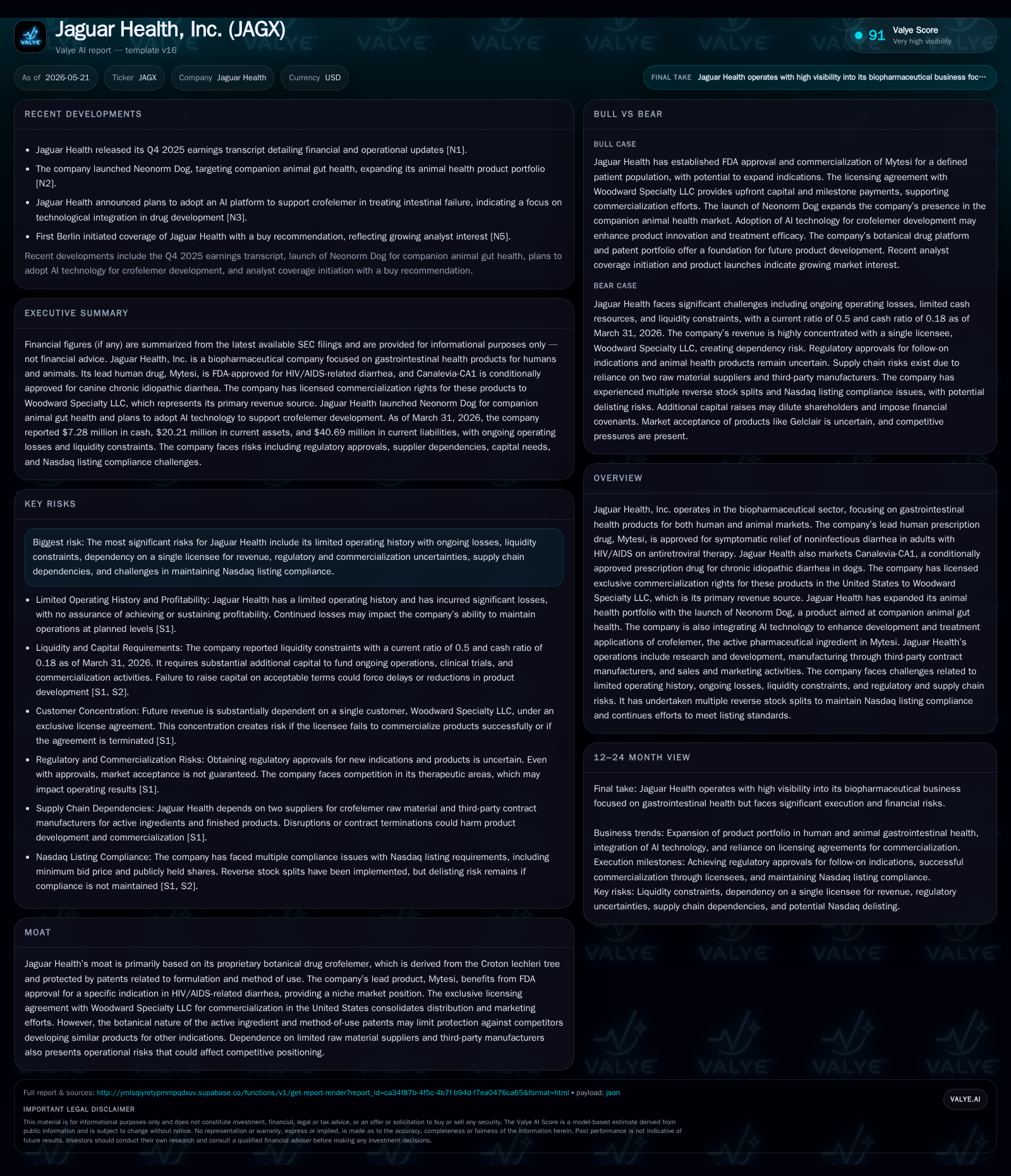
Jaguar Health is advancing its biopharmaceutical portfolio through a dual-track approach: leveraging AI to enhance its flagship botanical drug crofelemer's clinical development and expanding its companion animal health offerings. The company depends heavily on its exclusive licensee Woodward Specialty LLC for revenue generation tied to Mytesi and Canalevia-CA1 products. While AI integration aims to improve drug development efficiency, supply chain dependencies and Nasdaq listing compliance remain key risk factors. Financially, Jaguar maintains limited liquidity with ongoing operating losses, and current liabilities exceed assets, underscoring the importance of strategic execution and capital management going forward.
Quarterly Operating Update: AI Integration and Licensing Dynamics
Jaguar Health’s latest quarterly filings dated May 20, 2026 ([S2], [S3]) highlight key operational developments that are shaping the company’s near-term outlook. The firm plans to implement an artificial intelligence (AI) platform focused on optimizing clinical development pathways for crofelemer—the active pharmaceutical ingredient in its lead drug Mytesi—targeting new indications such as intestinal failure ([N2]). This reflects a strategic shift toward leveraging advanced computational tools to improve drug development efficiency and reduce timelines.
The company continues to rely heavily on Woodward Specialty LLC as its exclusive licensee for commercialization of Mytesi (for HIV/AIDS-related diarrhea in adults) and Canalevia-CA1 (for chronic idiopathic diarrhea in dogs) within the U.S. ([S1], [S2]). This centralized licensing model concentrates Jaguar’s revenue risks around Woodward’s commercial execution capabilities. Complementing this, Jaguar has launched Neonorm Dog, a non-prescription companion animal gut health supplement aimed at diversifying its portfolio beyond prescription therapeutics ([N3]).
This combination of AI adoption and licensing dependency underscores Jaguar’s operational pivot balancing innovation with partnership reliance. Progress updates from Woodward regarding sales performance and regulatory milestones will be pivotal to Jaguar’s revenue visibility.
Business Model and Product Differentiation: Botanical Drugs in Human and Animal Health
Jaguar Health’s business centers on research, development, patenting, and licensing of botanical drugs derived from extracts of the Croton lechleri tree—principally crofelemer ([S1]). Rather than direct sales, Jaguar monetizes through exclusive licenses granting commercialization rights primarily within the U.S., receiving upfront payments, milestones, and royalties tied to sales volumes.
Mytesi holds FDA approval for symptomatic relief of noninfectious diarrhea in HIV/AIDS patients under antiretroviral therapy. Its botanical origin provides differentiation supported by formulation patents covering method-of-use claims which afford a moderate competitive moat ([S22]). However, these patents may not block competitors exploiting crofelemer analogs or alternate indications, limiting exclusivity scope.
In veterinary medicine, Canalevia-CA1 has conditional FDA approval targeting chronic idiopathic diarrhea in dogs—a niche market segment. The launch of Neonorm Dog supplements expands Jaguar’s footprint into companion animal gut health with products facing less rigorous regulatory scrutiny but more ambiguous classification ([N3], [S23]).
Revenue streams thus depend significantly on licensing economics structured around partner sales performance rather than direct market penetration.
Industry Positioning: Competitive Landscape and Regulatory Environment
Within gastrointestinal pharmaceuticals focused on botanical therapies, Jaguar occupies a specialized niche with limited approved indications. Competitors addressing HIV-associated diarrhea generally offer chemically distinct symptomatic treatments ([S17]).
The FDA’s botanical drug pathway presents both opportunity—through differentiated safety profiles—and challenges due to stringent efficacy documentation requirements ([S19]). Patent protections provide some barrier; however, pursuing orphan or follow-on indications entails further regulatory complexities that could delay approvals or require additional costly trials ([S16]).
In veterinary markets, conditional approvals limit immediate profit potential while necessitating ongoing data submissions to maintain market access ([S19]). Non-prescription animal gut health products operate in an evolving regulatory landscape where increased oversight could impose new constraints ([S23]).
Jaguar’s dependence on a single commercial licensee concentrates operational risk yet benefits from niche formulation patents that create switching costs uncommon in botanical extract therapies.
Growth Drivers: Expanded Indications, AI Applications, and Animal Health Expansion
Jaguar’s growth strategy includes:
Expanded Indications: Pursuing FDA approvals for additional uses of crofelemer beyond HIV/AIDS-related diarrhea—including intestinal failure indications—with clinical programs potentially accelerated by AI platforms ([N2], [S16]). Successful approvals would broaden market opportunities.
AI-Driven Development: Adoption of machine learning aims to enhance trial design efficiency and identify responder subgroups faster; this technological integration aligns with industry trends but requires robust validation to mitigate bias risks ([S14]).
Animal Health Expansion: Launching Neonorm Dog taps into growing consumer spending on pet wellness supplements. This segment offers incremental revenues less encumbered by prescription drug regulations ([N3]). Further geographic or licensing expansions could amplify growth if executed effectively.
These drivers hinge on measurable milestones such as FDA supplemental approvals timing, clinical success rates, licensed partner sales volumes, and distribution channel growth.
Risks and Watchpoints: Single-Licensee Dependency, Supply Chain Vulnerabilities, Listing Compliance Challenges
Key risks include:
Single Licensee Revenue Dependence: Jaguar’s near-term revenues rely exclusively on Woodward Specialty LLC’s ability to commercialize Mytesi and Canalevia-CA1 under exclusive licenses ([S8], [S25]). Disruptions or poor commercial performance could materially impact cash flows.
Supply Chain Risks: Dependency on two main suppliers for raw materials alongside contract manufacturers creates vulnerability to disruptions that could affect production continuity ([S21]).
Nasdaq Listing Compliance: The company faces ongoing challenges related to Nasdaq bid price requirements due to multiple reverse stock splits restricting remedial options. Recent hearings emphasize the need for sustained compliance efforts to avoid delisting risk ([S2], [S25], [S26]).
Additional concerns include sustained operating losses requiring future capital raises potentially dilutive to shareholders; uncertainties over veterinary product regulation; intellectual property enforcement costs; geopolitical risks affecting clinical trials or supply chains ([S13], [S22], [S29]).
Monitoring Priorities: Regulatory Milestones, Commercial Execution Metrics, Financial Stability
Critical upcoming events include:
FDA Decisions: Supplemental indication approvals—especially related to breast cancer responder analyses from OnTarget trials involving crofelemer—will be instrumental in validating pipeline progress ([S16]).
Woodward Commercial Performance: Tracking licensee sales volumes for Mytesi/Canalevia provides insight into real-world demand given the single-licensee structure ([S1], [S2]).
Nasdaq Compliance Outcomes: Listing status post-hearings impacts stock liquidity and financing options long term ([S2], [S25]).
Liquidity Management: Maintaining adequate cash reserves (~$7.3 million as of Q1 2026) against liabilities will be essential given current ratio near 0.5 signaling working capital constraints ([F1],[S2]).
Unexpected supply interruptions or adverse regulatory rulings would represent significant negative inflection points.
Financial Summary: Liquidity Constraints Amid Operating Losses
As of March 31, 2026, Jaguar held approximately $7.3 million in cash against current liabilities totaling about $40.7 million resulting in a current ratio around 0.5—a clear indication of short-term liquidity pressure ([F1],[S2]). Total debt was roughly $6.2 million as per mid-2023 data; net debt appears modestly negative when accounting for cash but may not fully capture recent obligations ([F1]).
The company continues to incur operating losses necessitating additional capital either through equity or strategic partnerships to support ongoing R&D including AI initiatives alongside marketing activities tied to licensed products. Recent reverse stock splits reflect efforts primarily aimed at Nasdaq compliance rather than fundamental financial restructuring ([S2],[S25]).
This profile illustrates a business balancing operational innovation with funding challenges typical for specialty biopharma firms navigating commercialization inflection points.
Analysis based solely on publicly available SEC filings through May 2026 without investment advice.
Disclaimer: This is research-only, informational analysis and not investment advice. It may include AI-generated interpretation and general industry context. Always verify important details using primary sources.

Comments