
James Hardie Advances Integration of AZEK, Expanding Sustainable Outdoor Living Solutions
The latest quarterly filing outlines James Hardie's operational progress following the AZEK acquisition, with a restructured segment framework enhancing its product mix and market reach in sustainable building materials.
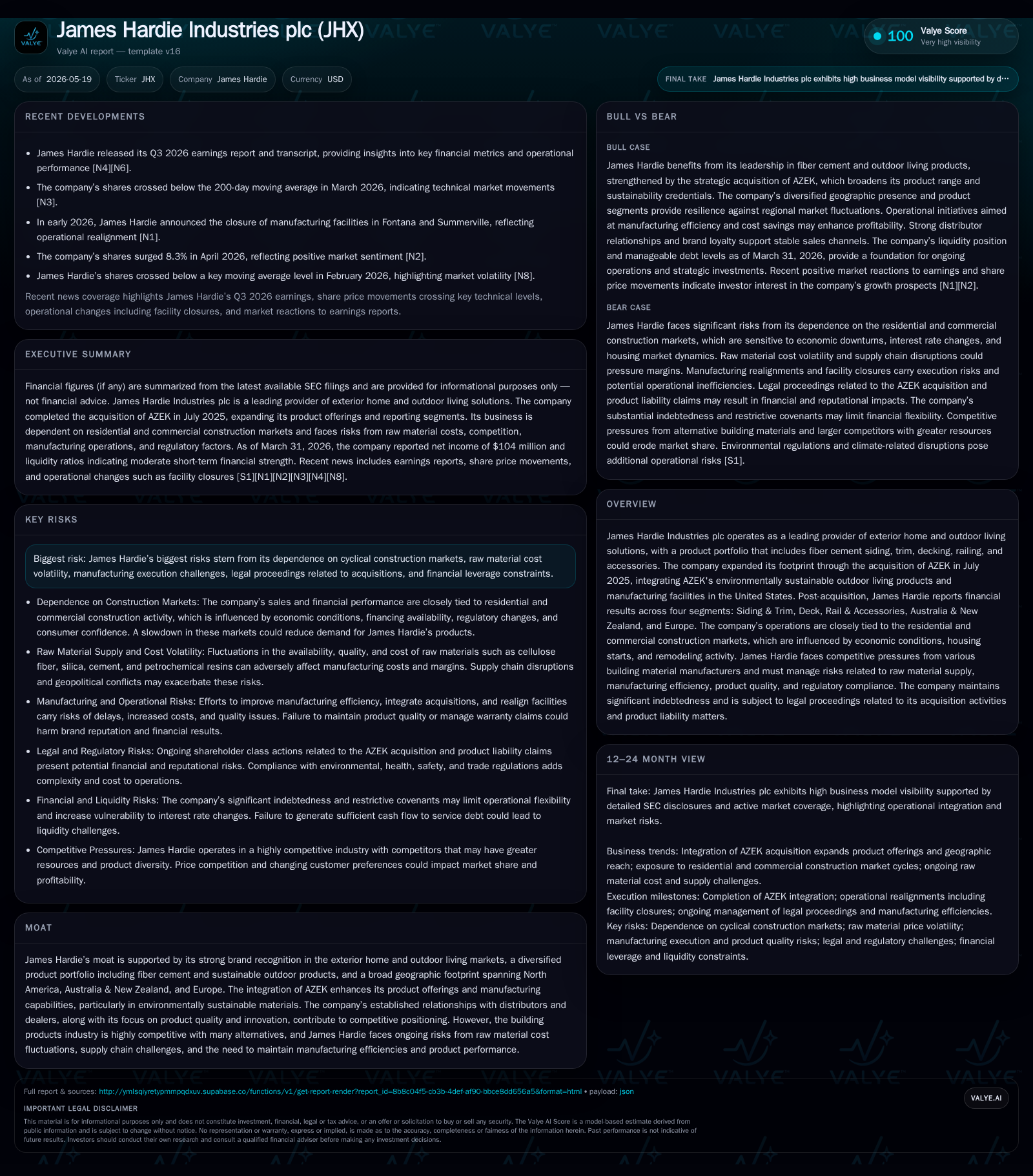
In the quarter ending March 31, 2026, James Hardie fully integrated AZEK's operations into a new four-segment structure combining fiber cement siding with sustainable outdoor living products. This strategic move broadens geographic presence and product offerings, capitalizing on trends in residential remodeling and new construction. Key growth drivers include expanding the sustainable decking portfolio and leveraging cross-segment synergies, while risks remain tied to cyclical housing markets, raw material costs, integration execution, and ongoing litigation related to the AZEK deal. Financially, the company reported operating income of $448 million and net income of $104 million, carrying $4.57 billion in total debt offset by $269 million in cash as of quarter-end, reflecting significant leverage but maintaining liquidity for growth [S2], [S3], [S1], [F1].
Q4 FY2026 Operating Update: Strategic Integration of AZEK
James Hardie's quarterly filing for the period ending March 31, 2026 ([S2]) confirms full inclusion of AZEK's operations acquired July 1, 2025. The company realigned its reporting segments into four primary groups: Siding & Trim—which combines legacy North America Fiber Cement products with AZEK's Exteriors business; Deck Rail & Accessories—reflecting AZEK’s outdoor living portfolio; Australia & New Zealand—covering legacy fiber cement sales; and Europe—encompassing fiber gypsum products and US-manufactured fiber cement sold in Europe ([S1]). This restructuring aligns manufacturing across continents and product categories to optimize synergies.
Business Model: Integrating Durable Fiber Cement with Sustainable Outdoor Products
James Hardie's revenue primarily derives from exterior home improvement products focused on residential construction and remodeling ([S1]). The addition of AZEK diversifies this base by incorporating low-maintenance decking, railing, and accessories manufactured from recycled materials. This enhances the company’s value proposition amid growing consumer demand for durable and eco-friendly building solutions.
Sales flow through a network of distributors often under exclusive regional agreements. Pricing dynamics are influenced by volume driven by new housing starts and remodeling activity coupled with product mix shifts favoring higher-margin sustainable lines ([S1]). Innovation efforts emphasize environmental sustainability while maintaining performance standards.
Industry Context: Competitive Pressures and Raw Material Dynamics
James Hardie operates in a competitive sector that includes alternatives such as natural wood, vinyl siding, stucco substitutes, gypsum panels, masonry products, and engineered composites ([S1]). Competition stresses pricing discipline alongside differentiation through durability, maintenance requirements, aesthetic appeal, and environmental impact.
Key raw materials include cellulose fiber (wood pulp), silica, cementitious components, petrochemical resins (polyethylene/PVC), recycled plastics used in decking products. Supplier contracts are typically short term (1-3 years), exposing the company to input cost volatility driven by supply chain disruptions or geopolitical factors ([S1]). Efficient procurement is critical amid industry consolidation.
Regulatory environments vary by geography—North America (post-AZEK), Australia/New Zealand, Europe—requiring adherence to local building codes and trade policies including tariffs ([S11]). Customer switching costs exist but contracts allow termination on notice.
Growth Drivers: Geographic Expansion and Sustainability-Focused Innovation
The acquisition of AZEK provides a strong growth catalyst through expanded product offerings in sustainable outdoor living solutions primarily targeting North American markets where remodeling drives significant spend ([N2], [S1]). Consumer preference for environmentally responsible materials supports demand for recycled composite decking.
Steady residential construction activity combined with remodeling trends underpin volume growth. Product mix improvements toward premium-priced sustainable lines enhance margins supported by scale efficiencies across combined manufacturing platforms ([S1]).
Continuous innovation focuses on compliance with evolving environmental regulations such as crystalline silica exposure limits ([S19]) while expanding complementary product accessories to increase wallet share per project.
Risks: Market Cyclicality, Input Cost Volatility, Integration Execution, Litigation Exposure
James Hardie is exposed to cyclical risks tied to residential construction markets influenced by macroeconomic factors like mortgage rates impacting housing affordability and remodeling budgets ([S1]). Volume fluctuations can be abrupt given short-term distributor contracts.
Raw material price swings present margin pressure risks particularly for cellulose fibers and petrochemical resins ([S1]). Integration complexities post-AZEK raise execution risk potentially affecting operational efficiency or quality.
Legal risks include multiple shareholder class actions alleging misstatements around inventory levels during the AZEK acquisition process ([S24]), introducing uncertainty although management believes claims lack merit.
Financial leverage from funding the AZEK acquisition—total debt of $4.57 billion netting about $4.3 billion after cash—limits flexibility due to restrictive covenants affecting capital allocation especially under adverse conditions ([F1], [S4], [S5]). Exposure to variable interest rates adds sensitivity to rising borrowing costs mitigated partially through interest rate swaps ([S13]).
Near-Term Watchpoints: Synergy Realization and Market Indicators
Investors should track progress against synergy targets encompassing manufacturing efficiencies and cross-selling opportunities between fiber cement siding and outdoor living segments ([S3]). Margin improvements within Deck Rail & Accessories will indicate operational integration success.
Monitoring North American housing starts data, remodeling activity indicators, distributor inventory levels, and raw material cost trends will provide insight into upcoming quarterly performance ([N1], [S3]). Fiscal year 2027 guidance updates will clarify management’s outlook on competitive dynamics and inflationary pressures.
Financial Summary: Operating Profitability Amid Elevated Leverage
For the quarter ended March 31, 2026 James Hardie reported operating income of approximately $447.6 million alongside net income near $104 million ([F1]). Total debt was approximately $4.57 billion post-acquisition financing resulting in net debt exceeding $4.3 billion after deducting cash reserves ([F1]). Credit agreements impose covenants restricting dividends and additional borrowings but presently provide sufficient runway for operational needs. Interest rate swaps partially hedge variable rate exposures helping mitigate interest cost volatility risk ([S13]). Going forward management must balance deleveraging pressures against investments in capacity expansion for sustainable product lines.
Disclaimer: This is research-only, informational analysis and not investment advice. It may include AI-generated interpretation and general industry context. Always verify important details using primary sources.

Comments