
Jones Soda’s Return to Profit: Brand Niche, Capital Needs, and the Stakes of Scaling in Premium Beverages
Jones Soda achieved a notable revenue surge and returned to modest profitability in the September 2026 quarter, but its limited equity base, persistent accumulated deficit, and capital-raising dependency underscore critical risks.
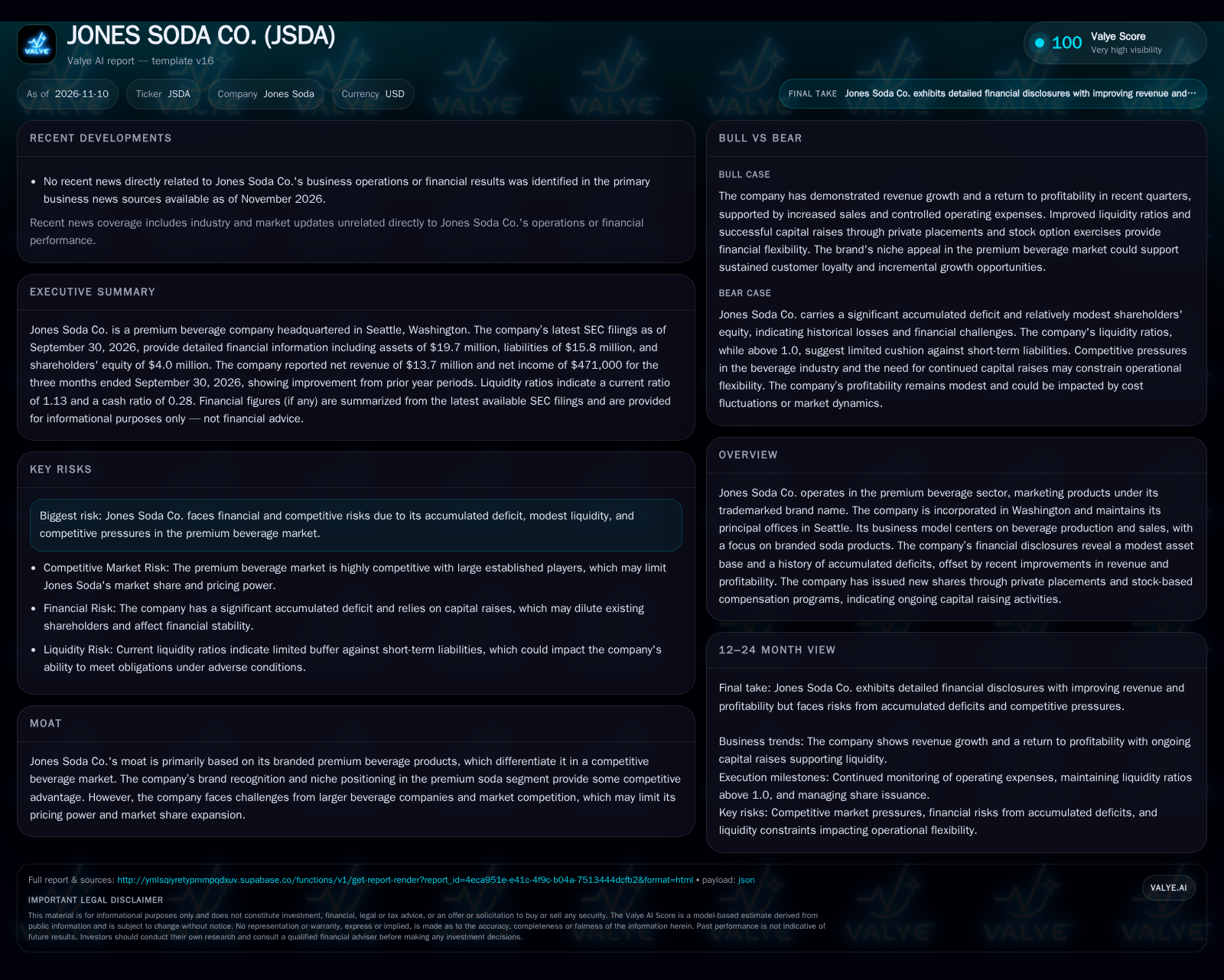
Jones Soda achieved a notable revenue surge and returned to modest profitability in the September 2026 quarter, but its limited equity base, persistent accumulated deficit, and capital-raising dependency underscore critical risks. The company’s branded niche in premium sodas provides some differentiation, yet financial and competitive pressures will shape its ability to sustain momentum and scale.
Jones Soda Co. has delivered its first profitable quarter in recent memory, driven by a sharp increase in revenue and disciplined expense management. Yet beneath the surface of this turnaround, the company’s financial position remains delicate: a reported cash balance, thin equity cushion, and a persistent need to raise capital through share issuance hint at structural vulnerabilities. In a premium beverage market dominated by global giants, Jones’s ability to translate brand differentiation into durable economics—and to do so without diluting shareholders or overextending its balance sheet—remains the central strategic question.
Recent Profitability Gains and Capital Structure Realities
For the quarter ended September 30, 2026, Jones Soda reported net revenue of $13.7 million, a significant increase from $4.5 million in the same period the previous year. Gross profit grew to $4.7 million, with operating expenses of $4.3 million, resulting in net income of $471,000—a sharp reversal from the $1.4 million net loss in Q3 2025 [S2].
Despite this operational progress, the company’s financial foundation remains fragile. With total assets of $19.7 million and liabilities of $15.8 million, shareholders’ equity stands at only $4.0 million as of September 30, 2026. The company reported cash and liquidity metrics for the period; these figures do not by themselves establish operating runway, investment capacity, financial flexibility, or financing capacity. [S2]
To support operations and bolster liquidity, Jones Soda issued approximately 7.8 million new shares in 2026 through private placements and stock-based compensation. The company’s accumulated deficit stands at $94.8 million, highlighting its long history of losses and the ongoing challenge of building sustainable equity [S2].
Branded Premium Soda: Revenue Levers and Cost Structure
Jones Soda’s business model relies on the manufacture, marketing, and sale of premium, branded beverages. Revenue is driven by volume sold, pricing power within the niche premium segment, and product mix innovations. The company’s recent revenue surge suggests either significant volume gains, successful pricing initiatives, or both, though the specific drivers are not disclosed in the report.
Gross margin expansion from $1.3 million to $4.7 million year over year, alongside the return to profitability, indicates some degree of operating leverage as incremental revenue outpaces fixed costs. However, in the beverage industry, direct input costs (sweeteners, packaging, distribution) and marketing expenses are substantial and can be volatile. While Jones held operating expenses at $4.3 million, the sustainability of such discipline—particularly in marketing—will be tested if the company seeks to accelerate growth.
Capital needs remain a central feature of the economic model. This dynamic exposes shareholders to dilution risk and highlights the importance of scaling efficiently, maintaining gross margin, and containing fixed overhead.
Brand Differentiation versus Scale: Navigating a Crowded Beverage Market
Jones Soda’s primary competitive advantage is its distinctive brand identity and positioning in the premium craft soda segment. This niche appeal can foster customer loyalty and allow for some pricing power relative to commodity sodas. However, the beverage industry is characterized by intense competition from multinational giants, private-label offerings, and a proliferation of new entrants in specialty drinks.
Larger competitors benefit from economies of scale in procurement, manufacturing, and distribution, as well as vastly greater marketing budgets. This makes it challenging for smaller players like Jones to defend market share or expand distribution without sacrificing margin. The key question is whether Jones’s brand resonance and product innovation can carve out a defensible share of the premium segment, or whether it remains vulnerable to category encroachment and discounting.
Switching costs for consumers are low in the beverage space, and shelf space is limited and often pay-to-play, putting further pressure on margin and visibility. Jones’s ability to secure and retain distribution partnerships, innovate with new flavors or formats, and maintain relevance with core consumers will determine its long-term competitive standing.
Sustained Revenue Growth Unlocks Operating Leverage and Shareholder Value
In a constructive scenario, Jones Soda leverages its recent momentum to drive sustained revenue growth, either through deeper penetration of existing channels, successful product launches, or expanded distribution. As fixed costs are spread over a larger sales base, operating leverage could further improve profitability and reduce the need for dilutive capital raises.
Confirmation of this scenario would include several quarters of top-line growth above industry averages, stable or expanding gross margins, and positive operating cash flow. Evidence of customer retention, repeat purchasing, and increased shelf presence would suggest brand strength and pricing power.
This upside pathway would be challenged by any reversal in revenue growth or margin compression, and would be falsified if the company resumes material net losses or returns to regular equity financing as a primary funding source.
Incremental Progress amid Persistent Financial Constraints
The most plausible near-term trajectory for Jones Soda is continued modest growth and breakeven or slightly positive profitability, with periodic reliance on external financing. The company could maintain its niche within the premium segment, generating enough gross profit to cover fixed costs but lacking the scale to materially strengthen its balance sheet or eliminate the need for new equity issuance.
This base case would be confirmed by steady, but not accelerating, revenue growth; gross margins remaining stable; and only modest improvements in liquidity metrics. Operating cash flow may fluctuate around breakeven, with intermittent share issuance to support working capital or marketing needs.
If Jones can avoid material losses without significant share dilution and holds its market position against larger competitors, this scenario could persist. However, any significant increase in input costs, loss of distribution, or competitive pricing pressure could quickly erode thin margins and force further capital raises.
Margin Pressure and Funding Shortfalls Threaten Operational Viability
In a negative scenario, Jones Soda faces renewed revenue stagnation or decline due to competitive encroachment, loss of shelf space, or shifts in consumer preference. Rising input costs or increased promotional spending could compress gross margins, while fixed overhead remains largely inelastic.
If capital markets become less accessible or investor appetite wanes, operational continuity could be at risk, particularly given the thin equity base and accumulated deficit.
Downside confirmation would come from quarter-over-quarter revenue declines, shrinking gross profit, negative operating cash flow, and rapid increases in share count or debt. The scenario would be exacerbated if the company is unable to maintain minimum liquidity ratios or if it triggers covenant breaches with suppliers or lenders.
Signals That Will Define Jones Soda’s Next Phase
Quarterly revenue growth rates by channel and product line, if disclosed, to assess whether recent gains are sustainable or one-off.
Gross margin trends and the mix of input costs to monitor for cost inflation or pricing pressure.
Share count and frequency of equity raises, which will indicate continued dilution risk and reliance on external capital.
Changes in current and cash ratios to flag any deterioration in short-term liquidity.
Distribution footprint and shelf space wins/losses, if disclosed, as a proxy for competitive positioning.
Evidence of new product launches or successful marketing campaigns that could drive incremental growth.
Accumulated deficit trajectory—whether it stabilizes or continues to grow, signaling structural profitability or persistent losses.
Disclaimer: This is research-only, informational analysis and not investment advice. It may include AI-generated interpretation and general industry context. Always verify important details using primary sources.

Comments