
Jiuzi Holdings Advances Dual-Segment Growth Amid Concentration Risks and Cash Flow Challenges
Jiuzi Holdings capitalizes on its Pearl River Delta base and expanding Southeast Asia EV footprint to nearly double revenue in FY2025, while managing concentrated customer and supplier risks alongside ongoing negative cash flows.
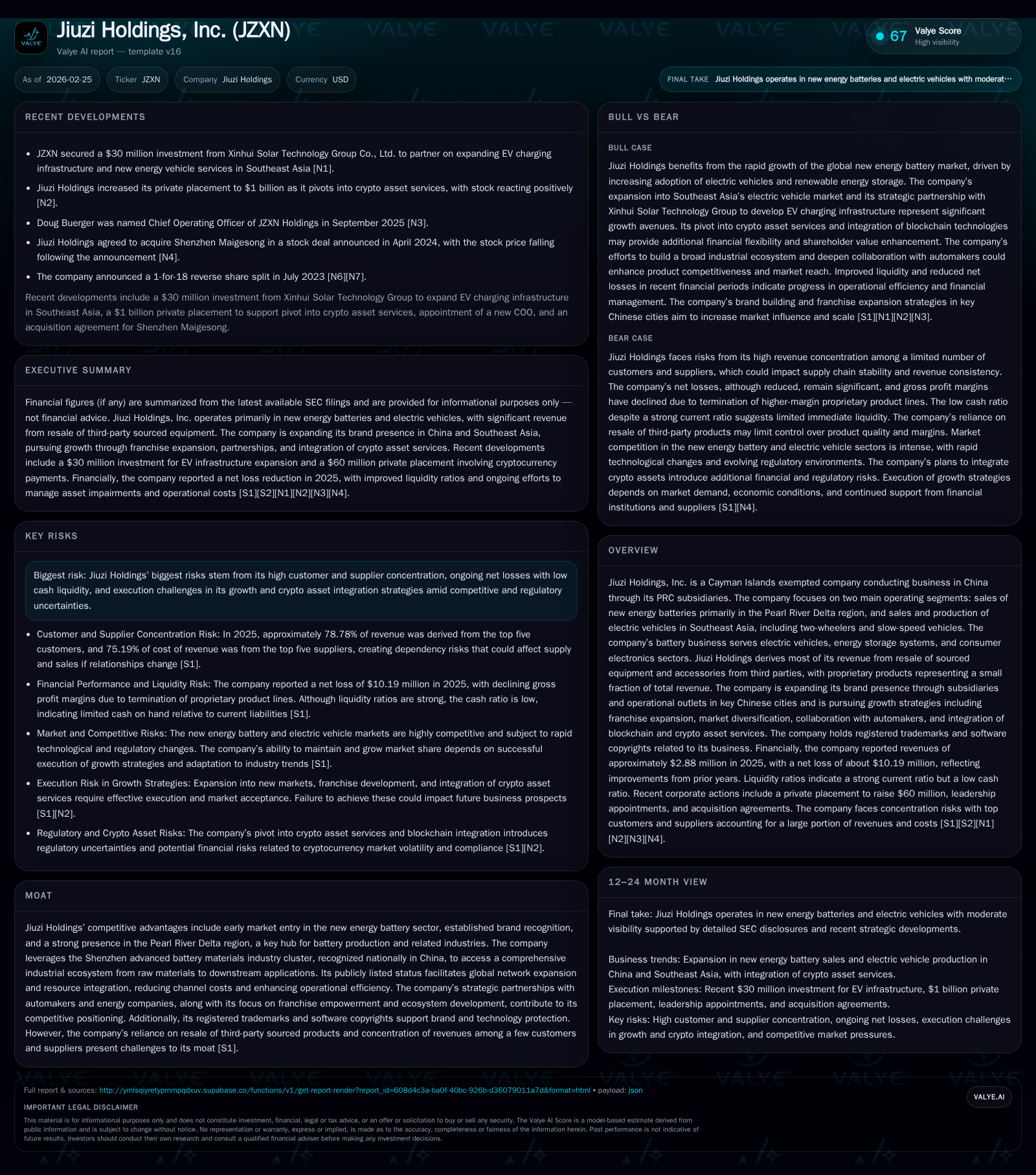
Jiuzi Holdings, Inc. operates in two main segments: new energy battery sales primarily in China's Pearl River Delta and electric vehicle production and sales in Southeast Asia. The company nearly doubled revenues from $1.4 million to $2.88 million USD between FY2024 and FY2025, driven predominantly by resales of third-party sourced equipment (99.53% of revenue). Despite this growth, Jiuzi sustained significant operating losses (-$10 million USD in FY2025), though improved from prior periods, and continued to generate negative operating cash flows. Growth strategies focus on franchise expansion across key Chinese cities, broadening EV offerings in Southeast Asia, strategic partnerships including a $30 million investment to enhance EV charging infrastructure, and a $60 million private placement expected in early 2026. High customer and supplier concentration pose margin and operational risks, while internal control weaknesses and ongoing litigation present governance challenges. Dividends and buybacks are not reported or planned given reinvestment needs.
Company Overview
Jiuzi Holdings, Inc., incorporated in the Cayman Islands, operates principally through its PRC subsidiaries focusing on new energy batteries and electric vehicles (EVs). The company’s two primary segments are sales of new energy batteries predominantly in the Pearl River Delta region — a major Chinese industrial hub — and sales plus production of electric two-wheelers, three-wheelers, and slow-speed vehicles targeting Southeast Asian markets [S1][S4].
Revenue generation derives almost exclusively from resale of third-party sourced equipment and accessories (99.53% of FY2025 revenue), with proprietary product sales contributing a negligible portion (~0.47%) [S13][F1]. This underscores Jiuzi's current business model favoring distribution over proprietary manufacturing innovation.
Historical Financial Performance
Between fiscal years 2024 and 2025, Jiuzi achieved a revenue increase of approximately 105.9%, rising from $1.40 million to $2.88 million USD largely via scaling third-party equipment resales [F1]. Despite this top-line growth, the company recorded significant operating losses reduced by 82% YoY from -$55.7 million USD to -$10 million USD in FY2025 [F1]. Net income remains negative; full-year FY2025 net income is unavailable but prior figures show persistent losses [F1]. Operating cash flow stayed negative at around -$1.01 million USD reflecting challenges in translating revenue growth into positive cash generation.
Historical performance (annual)
| FY | Rev ($mm) | Net ($mm) | CFO ($mm) | OpInc ($mm) | Rev YoY | Net YoY |
|---|---|---|---|---|---|---|
| 2025 | 3 | -1 | -10 | +105.9% | ||
| 2024 | 1 | -51 | -56 | -76.4% | ||
| 2023 | 6 | -9 | -5 | -9 | -4.6% | +44.2% |
| 2022 | 6 | -17 | -9 | -17 | -2263.4% |
Note: Omitted columns lack sufficient annual XBRL coverage in the provided tags (need ≥2 annual points): Capex, Div, Buybacks. Source: SEC companyfacts cache [F1].
Capital returns and efficiency (annual)
| FY | FCF ($mm) | ROE% |
|---|---|---|
| 2025 | -1 | |
| 2024 | ||
| 2023 | -5 | -222.0 |
| 2022 | -9 | -283.2 |
Source: SEC companyfacts cache [F1].
Note: Latest net income figure available is as of April 30, 2025.
Business Model & Market Position
Jiuzi leverages proximity to China’s Pearl River Delta battery supply ecosystem facilitating access to raw materials through downstream applications [S18]. Its regional presence spans Shenzhen, Beijing, Hangzhou, Hefei, and Chongqing supporting B2B customers such as EV manufacturers and energy integrators alongside B2C segments including EV owners [S13].
Proprietary product development is still nascent; the company mainly distributes batteries sourced from third parties under its brand [S13][S18]. Strategic partnerships aim to enhance competitiveness including a notable $30 million investment from Xinhui Solar Technology Group to expand EV charging infrastructure across Southeast Asia — a critical enabler for market expansion beyond China [N1].
Growth Outlook
Key growth drivers include:
- Franchise Expansion: Opening more outlets across China’s Tier-1/2 cities to boost direct customer engagement.
- Market Diversification: Increasing penetration into Southeast Asian EV markets aligned with rising environmental awareness.
- Strategic Partnerships: Collaborations with automotive manufacturers for co-developed battery solutions.
- Infrastructure Development: Leveraging investments for EV charging networks supportive of broader adoption.
- Blockchain/crypto exploration: Potential integration with crypto payments or blockchain-related services remains under consideration [S2].
However, growth faces headwinds from high customer concentration (79% revenue from top five customers) and supplier dependency (75% cost concentration), which may impact pricing power and operational stability [S4][S5][F1]. Reliance on resales limits proprietary differentiation.
Financial Health & Capital Allocation
Liquidity improved due to equity funding including a $5 million raise in September 2025 plus a planned $60 million private placement expected to close in Q1 2026 potentially involving fiat or cryptocurrency payments [S2][F1]. These capital infusions provide essential runway amid persistent cash burn.
Despite improving revenue:
- Operating cash flow remains negative (~-$1 million);
- Free cash flow also negative (~-$1.08 million after capex);
- Shareholders’ equity rose significantly from $8.42M to $14.05M reflecting fresh capital injections [F1].
No dividends or share repurchases were declared or planned given reinvestment priorities [S8][S20]. Share capital restructuring efforts via stock splits/consolidations aim at enhancing capital structure flexibility for future financings [S17][S19].
Return on equity is substantially negative (~-67%), consistent with ongoing net losses despite equity base growth [F1].
Risks & Challenges
Jiuzi faces multiple risks:
- Customer/Supplier Concentration: Heavy reliance on few customers/suppliers raises vulnerability to disruptions or unfavorable terms.
- Execution Complexity: Scaling franchises internationally while rolling out infrastructure demands strong operational controls.
- Internal Control Weaknesses: Management disclosed material deficiencies over US GAAP financial reporting potentially affecting investor confidence [S1].
- Legal & Regulatory Exposure: Ongoing SEC scrutiny related to China issuer disclosures plus active derivative litigation alleging governance issues create uncertainty [S9][S23].
- Limited Proprietary Product Scale: Dominance of resale business constrains margin enhancement opportunities.
- Negative Cash Flows: Continued losses necessitate further equity raises risking dilution.
Outlook & Monitoring Points
Key developments to watch include:
- Closing details and impact of the Q1 2026 private placement including crypto payment aspects.
- Progress in increasing proprietary product contribution versus third-party reliance.
- Expansion pace of franchise operations within China and Southeast Asia EV market penetration.
- Outcomes from strategic partnerships on joint product development and infrastructure projects.
- Resolution progress on SEC investigations and derivative litigation affecting governance perceptions.
- Improvements in internal controls critical for regulatory compliance and operational transparency.
Conclusion
Jiuzi Holdings is navigating a challenging transition balancing rapid revenue growth fueled primarily by resold products against significant operating losses requiring substantial funding support. Its geographic footprint positions it within dynamic EV market hubs but exposes it to execution risks tied to customer concentration, supply dependencies, product mix limitations, governance concerns, and cash flow constraints. The company’s ability to convert these early gains into sustainable profitability hinges on effective scale execution coupled with addressing internal control shortcomings.
This analysis is based solely on publicly available information including SEC filings as of February 25th, 2026. It is intended for informational purposes only and does not constitute investment advice or recommendations.
Disclaimer: This is research-only, informational analysis and not investment advice. It may include AI-generated interpretation and general industry context. Always verify important details using primary sources.

Comments