
Kaiser Aluminum’s Capacity Investments and Metal Price Pass-Through Bolster Margin Resilience
Recent volume fluctuations from planned outages and strategic hedging shape Kaiser Aluminum's near-term performance amid cyclical end markets.
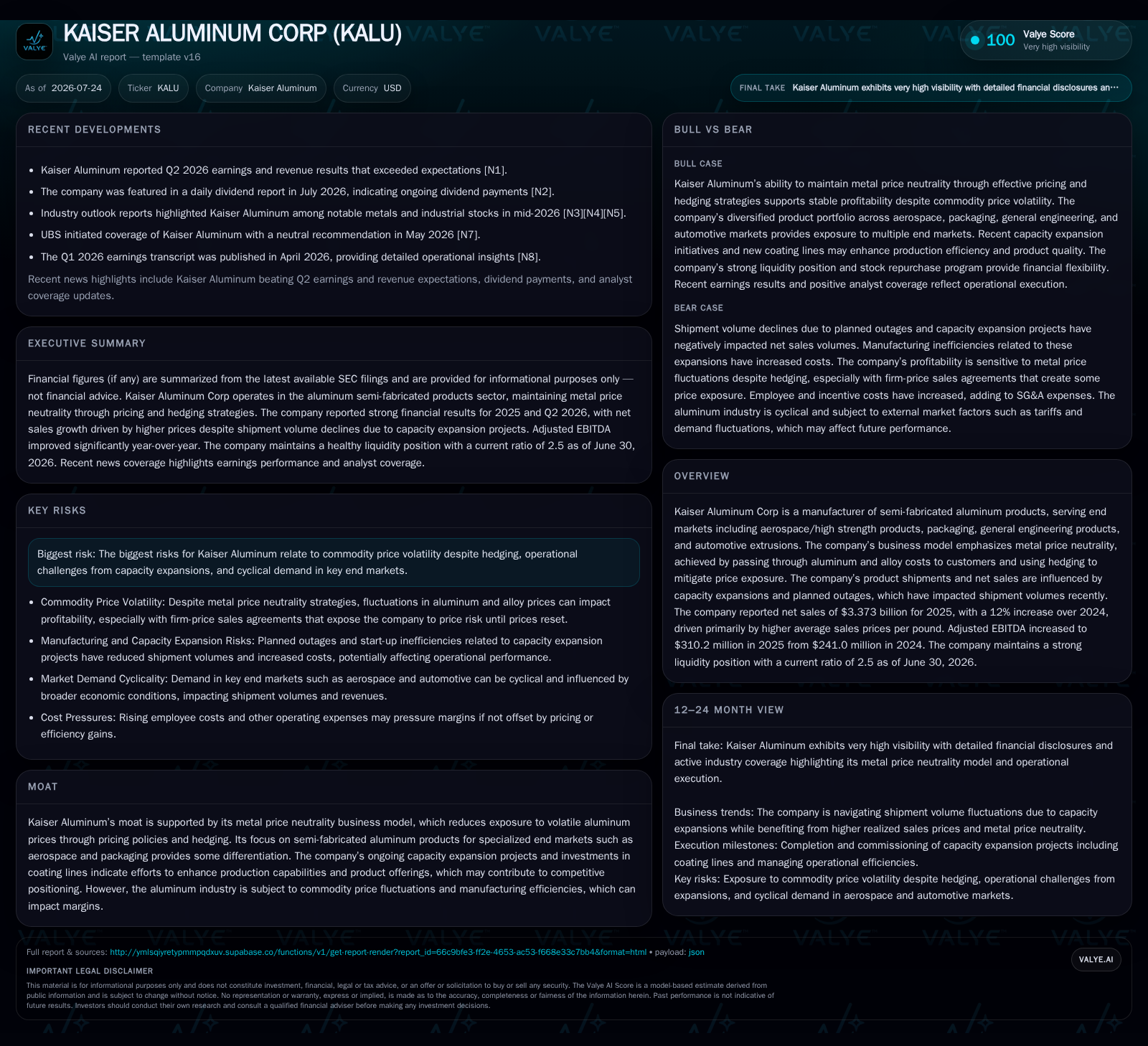
Kaiser Aluminum reported Q2 2026 results reflecting ongoing impacts from capacity expansions and planned production outages, which have temporarily constrained shipment volumes. The company’s metal price neutrality model, achieved through pricing pass-throughs and commodity hedging, continues to stabilize margins despite volatile aluminum costs. Strategic investments in coating lines and modernization target growth in specialized aerospace and packaging markets. However, operational disruptions and cyclical demand remain key risks. Kaiser’s strong liquidity and conservative leverage provide financial flexibility to fund capital projects amid industry cyclicality.
Recent Operating Update: Planned Outages Affect Q2 Volumes
In its latest quarterly filing dated July 23, 2026, Kaiser Aluminum disclosed that shipment volumes during Q2 were negatively impacted by planned production outages associated with ongoing capacity expansion efforts. These operational interruptions tempered revenue growth for the quarter despite underlying demand resilience in core end markets [S2]. The prior day’s event filing underscored this dynamic in the company’s accompanying press release reporting preliminary Q2 results, where adjusted earnings beat expectations but flagged volume softness attributable to these outages [S3], [N1]. This short-term volume pressure aligns with prior disclosures about capital investments designed to enhance manufacturing capabilities but creates cyclical noise requiring close monitoring.
Business Model: Metal Price Pass-Through Coupled with Hedging Mitigates Commodity Risks
Kaiser operates within the midstream segment of the industrial metals manufacturing value chain by semi-fabricating aluminum into extrusions, sheets, and coated products tailored for aerospace/high-strength applications, packaging solutions, automotive extrusions, and general engineering uses [S1]. A defining feature of Kaiser’s business model is its emphasis on metal price neutrality — raw aluminum and alloy input costs are largely passed through to customers via pricing contracts. To mitigate the volatility inherent in aluminum markets that can distort margins without corresponding price adjustment speed or effectiveness, Kaiser employs commodity hedging programs targeting primary metals exposures. This approach shifts the risk of price swings away from profitability toward managing contract execution and timing efficiencies.
This metal cost pass-through strategy shapes revenue mechanics whereby net sales depend on shipment volumes multiplied by average sales prices per pound minus the cost of alloyed metals (the "Conversion Revenue" concept). Volume trends reflect capacity utilization rates influenced by planned maintenance or expansion downtime as well as end-market demand variability. Pricing per unit incorporates inflationary factors but must track commodity market conditions closely.
Industry Structure: Capital Intensity Amid Cyclical Demand in Specialized End Markets
Within industrial metals manufacturing’s fabricator tier stand peers like Alcoa Corporation and Constellium SE who compete on scale integration or product breadth. However, Kaiser differentiates through targeted investments in coating lines (notably the fourth coating line at Warrick) aimed at producing higher margin coated aluminum materials critical for premium packaging markets. Their Trentwood modernization initiatives likewise aim to boost thin gauge plate production quality for aerospace/high strength product segments.
Capital intensity characterizes this sector as plants require substantial fixed assets with ongoing technology upgrades necessary to maintain efficient conversion costs. Operational efficiency improvements tend to drive adjusted EBITDA margins alongside metal price pass-through effectiveness.
Demand in key downstream sectors exhibits cyclical patterns: aerospace capital expenditure cycles influence demand for high-grade extrusions; automotive lightweighting trends provide structural growth tailwinds albeit sensitive to macroeconomic shifts; packaging markets sustain stable growth driven by consumer product needs but face competitive pressures from alternative materials.
Growth Drivers: Capacity Expansion and Technological Upgrades Underpin Future Sales Potential
Kaiser’s capital deployment strategy prioritizes expanding capacity that supports expected increases in demand for coated aluminum products used extensively in packaging applications requiring enhanced barrier properties or aesthetics. Investments at Warrick focus on a new coating line expected to enable premium product offerings commanding stronger pricing premiums.
Similarly, modernization at Trentwood targets equipment upgrades streamlining thin gauge plate outputs meeting stringent quality standards vital for aerospace OEM customers seeking lightweight yet durable components. These projects also aim to reduce conversion costs ensuring operational competitiveness.
Rising average selling prices per pound have contributed materially to recent top-line growth — up 12% year-over-year in 2025 — reflecting both favorable pricing environment shifts and incremental success selling higher-value product mixes rather than pure volume increases alone [S1], [F1].
Additionally, sustainability trends promoting recyclable aluminum usage may favor further penetration opportunities given the material’s environmental advantages relative to alternatives.
Risks and Watchpoints: Operational Disruptions and Cyclical Demand Remain Key Concerns
Despite robust hedging frameworks, residual commodity price volatility represents an ongoing risk because full pass-through is neither immediate nor guaranteed under all contract structures. This can squeeze margins if metal market moves are rapid or outpace contractual mechanisms.
Operational uncertainties derive from executing large-scale capacity expansions — planned outages can weigh heavily on shipment volumes as seen recently while unexpected downtime would exacerbate disruptions. Maintaining schedule discipline around capital projects thus becomes a critical KPI.
End-market cyclicality also poses challenges; aerospace demand can fluctuate sharply depending on aircraft production cycles while automotive sector dynamics remain subject to macroeconomic conditions impacting vehicle build rates. Packaging tends toward steadier patterns but does not fully offset these oscillations.
Environmental regulation compliance costs and supply chain constraints around raw materials or energy are latent risks requiring continuous management attention.
What to Watch Next: Execution Milestones Post-Outages and Margin Trends
Key performance indicators during upcoming quarters will include shipment volume recovery signaling successful completion of outage-related workstreams. Tracking adjusted EBITDA margins will elucidate whether pricing actions continue stabilizing profitability amid ongoing metal cost fluctuations.
Monitoring progress against capital expenditure plans—targeted between $120 million and $130 million for 2026—and resultant throughput gains will shed light on growth potential realization timelines [S1]. Additionally, evaluating hedging effectiveness metrics such as metal cost pass-through rates will clarify exposure control efficacy.
Financially, leveraging Kaiser’s sound liquidity position—marked by a strong current ratio of 2.5 supported by $58.5 million cash reserves—and low near-term debt maturities provides buffers during industry cyclicality [F1]
Financial Profile Discussion
Kaiser Aluminum's financial structure reflects prudent risk management supporting aggressive investment into capacity without overleveraging balance-sheet resources. As of June 30, 2026, the company held approximately $58.5 million in cash equivalents against current liabilities totaling roughly $642 million resulting in a comfortable current ratio of 2.5 signaling ample short-term liquidity [F1]. This liquidity supports working capital fluctuations driven by inventory built-up or receivables tied to rising metal prices.
Long-term debt principally comprises fixed-rate senior notes aggregating about $1.05 billion maturing between 2031 (4.50% notes) and 2034 (5.875% notes), providing maturity stagger that limits refinancing risk in near term [S4], [S20]. Revolving credit facility availability stands at a sizeable $575 million commitment with modest usage historically reflecting conservative drawdown practices enhancing financial flexibility [S5].
Adjusted EBITDA reached $310.2 million for full-year 2025 representing significant improvement over $241 million in prior year largely due to pricing gains outpacing cost inflation amidst stable operational execution [S1], [F1]. Capital expenditures moderated somewhat from prior elevated levels ($136.9 million vs $180.8 million in 2024) consistent with completion phases of major projects providing a foundation for future sales growth while containing cash outflows.
Overall Kaiser’s financial footing appears sound with free cash flow generation supporting investment without undue leverage stress—a notable advantage within capital-intensive industrial metals manufacturing sectors vulnerable to commodity cycles.
Disclaimer: This analysis is based solely on publicly available information from SEC filings and news sources as cited; it does not constitute investment advice or research views.
Disclaimer: This is research-only, informational analysis and not investment advice. It may include AI-generated interpretation and general industry context. Always verify important details using primary sources.

Comments