
Kraig Biocraft Laboratories Advances Spider Silk Production with BAM-1 Alpha Scale-Up
Kraig Biocraft’s latest quarterly report reveals tangible progress in scaling spider silk production through hybrid deployment and facility acquisitions, underpinning its niche biomaterials growth trajectory.
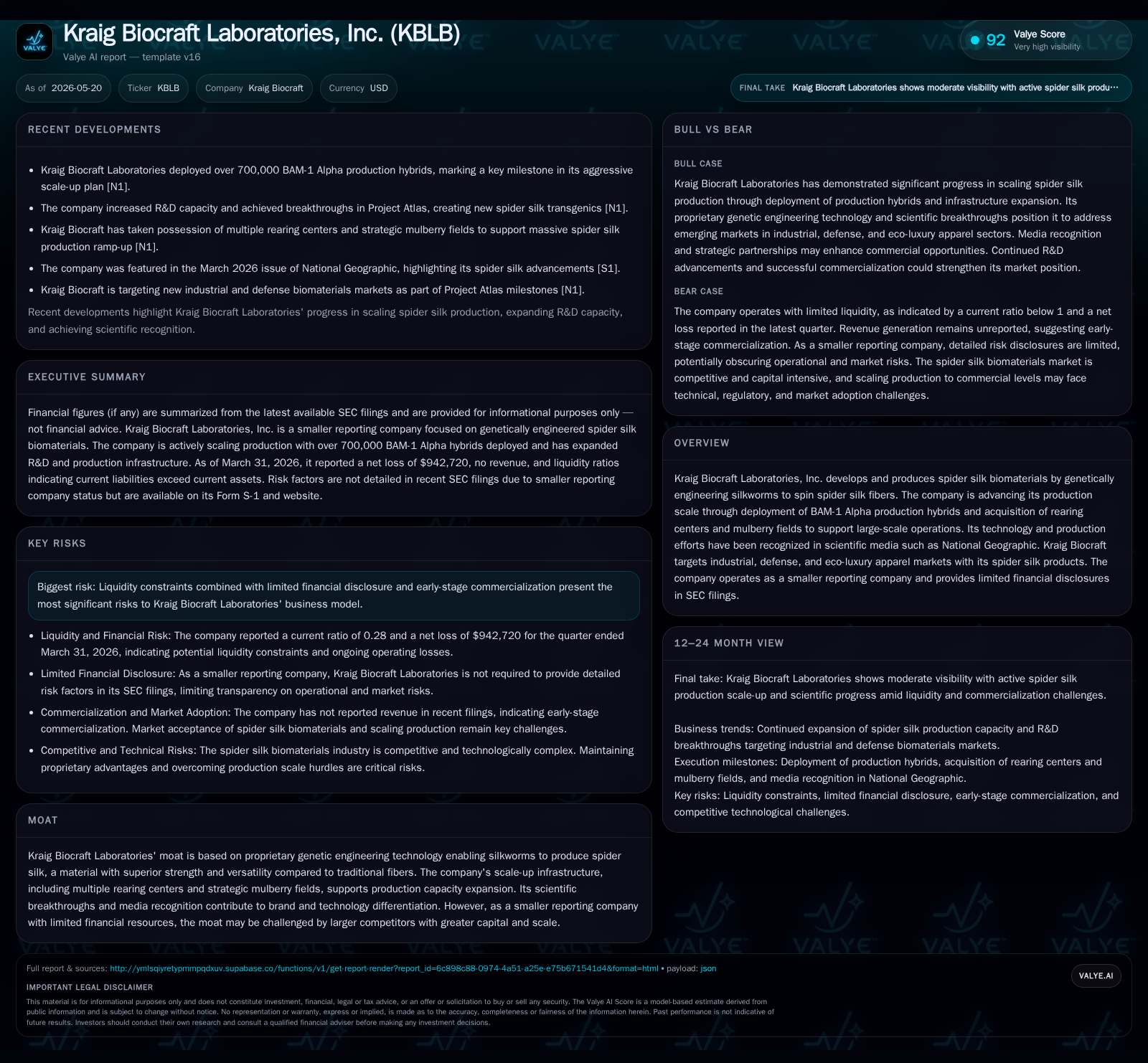
In its May 2026 10-Q filing, Kraig Biocraft Laboratories disclosed operational advances including expanded deployment of BAM-1 Alpha genetically engineered silkworm hybrids and acquisitions of rearing centers plus mulberry cultivation assets to bolster production scale. The company’s proprietary genetic engineering technology enables the creation of spider silk biomaterials with superior strength and versatility, targeting industrial, defense, and eco-luxury apparel segments. Despite strong technological differentiation and media recognition, Kraig Biocraft faces liquidity constraints and early-stage commercialization challenges due to limited financial resources. Key near-term monitorables include further scale expansion efforts, commercialization partnerships, and liquidity management.
Recent Quarterly Developments Highlighting Production Scale-Up
Kraig Biocraft Laboratories’ May 2026 quarterly report (10-Q) presents critical operational progress reflecting active scaling of its flagship spider silk production technology. The company disclosed ongoing deployment of BAM-1 Alpha genetically engineered silkworm hybrids, which represent next-generation biomaterial capabilities designed to produce spider silk fibers at industrially relevant volumes [S2]. This latest quarter also saw the strategic acquisition of additional rearing centers—facilities dedicated to silkworm cultivation—and mulberry fields necessary for sustaining silkworm feedstock. These integrated assets are vital to expanding physical production capacity beyond existing constraints.
The combined effect of hybrid deployment plus control over breeding and feed facilities directly addresses previous bottlenecks in volume scalability that limited Kraig Biocraft’s ability to move from demonstration phases toward commercial throughput. By vertically integrating key production inputs—silkworm genetics, breeding centers, and mulberry leaf supply—the company strengthens its operational backbone necessary for commercial spider silk fiber manufacturing.
This operational scaling development marks a tangible step forward compared to prior periods where product innovation was proven but largely constrained by limited output capacity. It establishes a concrete foundation needed to fulfill growing orders or partnership opportunities in targeted market segments.
Business Model and Product Innovation in Spider Silk Biomaterials
Kraig Biocraft’s business model centers around proprietary genetic engineering techniques applied to domesticated silkworms enabling them to spin fibers akin to natural spider silk—a material extensively studied for extraordinary tensile strength, elasticity, and biodegradability. Unlike synthetic fiber producers or traditional textile manufacturing relying on petrochemical derivatives or conventional silk sources, Kraig’s approach leverages biosynthetic pathways embedded at the genomic level.
Customers—comprising primarily industrial manufacturers requiring high-performance materials (including defense contractors), luxury apparel brands seeking eco-conscious superior textiles, and other specialty markets—pay for volumetric quantities of spider silk fiber or qualified biomaterials derived thereof. Pricing considerations hinge on product quality metrics such as tensile strength per unit weight, durability under environmental stresses, and compatibility with downstream textile manufacturing processes.
Crucial revenue drivers stem from volume produced (linked closely to hybrid deployment rates and feedstock cultivation), contract-based agreements with industrial clients or defense agencies committing to specified annual volumes, and product mix enhancements as newer generations of spider silk fibers are bioengineered for specific performance attributes.
Switching costs appear embedded in product quality differentiation; customers invested in high-performance applications may face technical migration hurdles if compelled to shift away from Kraig’s spider silk fibers once integrated into specialized end products. This fosters some degree of pricing tolerance despite elevated biomaterial costs relative to traditional fibers.
Competitive Positioning and Industry Structure in Bioengineered Fibers
Within the emergent biomaterial landscape focusing on spider silk alternatives, Kraig Biocraft operates as one of the pioneering smaller companies advancing genetic engineering solutions leveraging silkworm-based production versus direct recombinant protein synthesis approaches employed by some peers. The company's competitive moat principally derives from its specific DNA insertion technology enabling large-scale fiber spinning by living organisms rather than purely synthetic lab synthesis.
However, Kraig remains limited in scale compared with established industrial biotechnology firms possessing broader capital bases capable of accelerated capacity expansion. Supply chain factors such as reliable mulberry leaf availability—which is critical feed for silkworms—and effective management of rearing center capacities impose structural constraints on near-term volume growth.
Pricing power is currently nascent; while spider silk commands premium positioning due to unmatched physical properties relative to synthetic fibers like nylon or polyester, the early commercial stage means customers are still evaluating cost/benefit trade-offs amid experimental uses primarily within defense prototypes or luxury pilot collections.
Regulatory frameworks remain favorable without significant barriers as the biotechnology involves genetically modified silkworms kept within controlled environments rather than release into open ecosystems. Nonetheless, scalability hinges on successful replication of production protocols across multiple rearing sites meeting quality consistency demands.
Growth Drivers Anchored in Scalability and Market Expansion
Key growth drivers for Kraig Biocraft emanate from several interlinked vectors:
- Production Scale Expansion: Effective deployment rates of BAM-1 Alpha hybrids govern raw fiber volume availability. Increasing acreage under mulberry cultivation directly supports sustainable silkworm feed supply concurrently mitigating bottlenecks in biological cycle throughput.
- Market Penetration Into High-Growth Sectors: Industrial applications in defense textiles that require lightweight armor or high-strength composites constitute a promising vertical given governmental interest in advanced protective materials. Such contracts tend to be multi-year with recurring volume needs if initial demonstrations succeed.
- Brand Building Via Media Recognition: Publicity including the National Geographic cover article (March 2026 issue) elevates visibility among potential customers emphasizing ecological benefits paired with high performance. This aids opening doors in eco-luxury apparel markets where brand-consciousness influences textile sourcing decisions.
- Partnerships And Commercialization Deals: Progress in sealing distribution partnerships or joint ventures accelerates installed base growth potentially unlocking steady revenue streams beyond direct sale models.
These growth pathways correspond with demonstrable KPIs: number of hybrid lines actively cultivated across all rearing sites; cumulative square footage or acreages dedicated to mulberry fields; registered pilot orders or letters-of-intent from key market vertical clients; ongoing R&D efforts enhancing fiber properties.
Risks Centered on Liquidity and Early-Stage Commercialization
The most salient risks facing Kraig Biocraft originate from entrenched liquidity constraints amplified by the early-stage nature of its business model:
- Cash Constraints: Data as of March 31, 2026 shows cash & equivalents approximating $2.9 million against current liabilities exceeding $10 million—a current ratio near 0.28 indicating acute short-term coverage deficits [F1]. Despite very low recorded debt (~$8,755), the imbalance underscores urgent funding needs to sustain operational cadence without disruption.
- Limited Financial Transparency: As a smaller reporting company exempt from certain SEC disclosure requirements [S2], comprehensive visibility into risk exposures or future capital plans remains constrained for outside analysts.
- Commercialization Execution: Scaling biological processes reliably while converting technological promise into repeatable manufacturing workflows involves intrinsic uncertainties typical of novel biotechnologies. Moreover, customer adoption curves can be extended when switching from traditional fibers entails integration complexities.
- Competitive Pressures: Larger peers or future synthetic fiber innovations may erode Kraig’s advantage if they achieve improved cost structures or overcome materials performance gaps first.
Caution hence rests on balancing aggressive scale-up ambitions against cash runway limitations complemented by modest sales traction reflective of pilot-phase commercialization.
Key Monitorables: Milestones and Demand Signals to Watch Next
Investors and stakeholders should focus on several concrete near-to-medium term indicators:
- BAM-1 Alpha Hybrid Deployment Progress: Quarterly updates quantifying new hybrid breedings brought online across rearing sites provide a direct measure of scaling success [S2].
- Expansion Of Mulberry Cultivation Assets: Acreage or output data signals feedstock supply chain strengthening aligning with silkworm population targets.
- New Customer Contracts Or Letters-of-Intent: Especially within defense sectors where material specifications carry stringent approval cycles; securing such deals evidences market validation.
- Commercial Partnerships Or Joint Ventures: Announcement timing and scope give insight into distribution channels opening beyond internal capabilities.
- Liquidity Events Or Capital Raises: Given current shortfalls visualized by balance sheet metrics [F1], any announced financing rounds would materially impact operational sustainability prospects.
- Public Communication Updates: Including SEC filings or press releases capturing any major setbacks such as production delays or regulatory hurdles alongside positive execution reports.
Tracking these measures grounds assessment in factual developments rather than speculative projections aiding real-time evaluation of Kraig Biocraft's commercialization journey.
Concise Financial Profile Reflecting Cash Position and Balance Sheet Dynamics
Financially vetted through the lens of the March 2026 quarter shows Kraig Biocraft holding approximately $2.9 million in cash reserves contrasted against roughly $10.7 million in current liabilities [F1], producing a weak current ratio circa 0.28 that flags short-term liquidity strains absent immediate capital inflows or expense reductions. Total debt levels are negligible (~$8,755), implying no material financial leverage although current obligations substantially outsize liquid assets [F1].
These figures reaffirm operating risks linked with pursuing an ambitious scale-up while managing cash burn typical of early-stage biotech ventures reliant predominantly on equity financing rather than debt markets [S2]. Consequently, financial health acts more as a supporting backdrop contextualizing operational progress rather than steering headline narratives at present
This analysis synthesizes publicly available SEC disclosures up to May 2026 combined with sector framing characteristic of advanced biosynthetic fiber companies specializing in next-generation material technologies such as spider silk produced via genetically engineered silkworms. No investment research views are made herein; this memo aims solely at delivering informed industry-focused insight on Kraig Biocraft Laboratories’ evolving business fundamentals and strategic operating context.
Disclaimer: This is research-only, informational analysis and not investment advice. It may include AI-generated interpretation and general industry context. Always verify important details using primary sources.

Comments