
Kensington Capital Acquisition Corp. VI Prepares for Target Search with $230 Million in IPO Proceeds
KCAC-UN’s recent IPO and initial financial disclosures set the stage for its upcoming SPAC business combination process, anchored by a strong capital base but dependent on market conditions and execution.
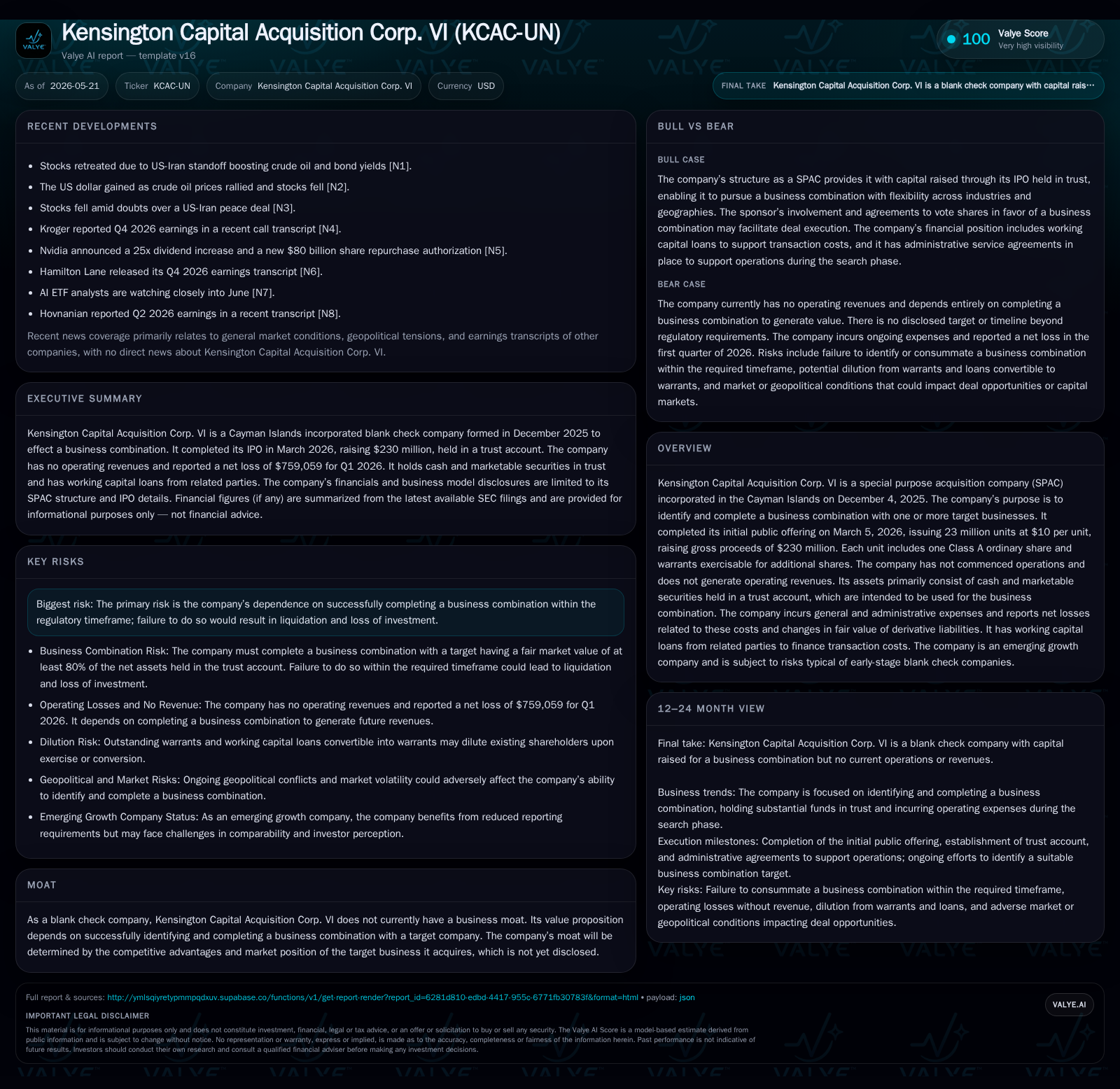
Kensington Capital Acquisition Corp. VI completed its initial public offering (IPO) in early 2026, raising approximately $230 million to fund its search for a business combination target. The company holds substantial cash and U.S. Treasury securities in a trust account dedicated to this purpose, with minimal liabilities and no operational revenues as it is still in the pre-combination phase. Its strategy relies on successfully identifying and closing a qualifying acquisition within regulatory timelines amid current geopolitical and market volatility risks. The firm’s capital structure includes Class A shares bundled with warrants, with outstanding working capital loans to cover administrative costs. Key growth drivers revolve entirely around executing a merger or acquisition, while watchpoints focus on timing, deal flow, and regulatory considerations.
Latest Quarterly Filing: Financial Position and Implications
Kensington Capital Acquisition Corp. VI's latest quarterly report filed May 14, 2026 ([S2]) delineates its foundational financial posture following its initial public offering completed on March 5, 2026 ([S3]). The IPO raised gross proceeds of approximately $230 million consisting of sale of 23 million Units priced at $10 each ([S4]), which now reside primarily in a trust account as U.S. Treasury Securities totaling $230.5 million ([S4]). This substantial capital pool forms the bedrock from which KCAC-UN intends to identify and consummate a business combination.
The filing confirms the absence of operational revenues reflecting the typical SPAC status—holding cash while incurring only administrative expenses ([S2], [F1]). The complex warrant structure includes Class 1 and Class 2 redeemable warrants attached fractionally to each Unit at specific exercise prices, introducing potential future equity dilution upon exercise ([S3]).
Notably, management underscores risks linked to geopolitical instability generating market uncertainty that could influence deal flow or valuations adversely ([S5]). The concentration of credit risk is limited due to high-quality short-term securities held.
Business Model: The Blank-Check Company Framework and Share Structure
As a newly listed SPAC incorporated December 2025 in the Cayman Islands (), Kensington Capital Acquisition Corp. VI serves as a blank-check vehicle designed solely to raise capital through an IPO for the express purpose of acquiring one or more operating businesses. It currently operates without revenue-generating lines or products; its intrinsic value lies entirely in the prospective business combination transaction.
Each publicly traded Unit includes one Class A ordinary share plus fractional Class 1 (one-quarter) and Class 2 (three-quarters) redeemable warrants exercisable at $11.50 per share after the initial merger completion ([S3]). These warrants could lead to dilution post-combination but provide upside leverage to investors if the combined entity appreciates materially.
Sponsor shares and private placement warrants add additional layers impacting eventual equity composition but align sponsor incentives with successful deal execution ([S2], [F1]). Overall, KCAC's value proposition hinges completely on management’s ability to source and close an attractive target whose competitive positioning will define KCAC’s enduring moat post-merger.
Industry Context: SPAC Market Dynamics and Regulatory Environment
KCAC enters an environment characterized by significant competition among SPACs targeting quality private companies amid heightened regulatory scrutiny on blank-check vehicles. The compressed timeline—typically two years post-IPO—to identify and close a combination exerts pressure on management teams to act decisively ([S2]).
The geopolitical backdrop outlined in recent disclosures elaborates on ongoing conflicts impacting global markets—namely volatility spikes in commodity markets, credit tightening, supply chain disruptions, and cyber threats—that can affect access to capital markets and deter potential targets ([S5]). This macro environment heightens execution risk.
Market participants also face evolving SEC rules increasing transparency obligations around SPAC disclosures. Investor sentiment remains cautious post-SPAC boom years given historical uneven performance across deals.
Growth Drivers: Strategic Capital Deployment and Target Search
Since KCAC has no operating assets nor intrinsic revenue streams pre-combination, growth depends solely on completing a transformational business combination with one or more operational targets meeting minimum value thresholds (at least 80% of net assets held in trust) ([S4]). Once identified and closed, the combined entity potentially gains immediate scale with operational cash flow transforms driving upward trajectory beyond KCAC’s current shell structure.
Key milestones signaling potential growth inflection points include announcements of target companies pursued for merger/acquisition consideration ([S3]), progress towards securing shareholder approval votes establishing deal viability (), and closing dates enabling transition from SPAC shell status to active operating company.
Choosing a well-positioned target with structural competitive advantages—be it strong market share, technological edge, regulation-driven barriers to entry or unique customer bases—could materially influence KCAC’s long-term moat post-merger despite lacking such specifics currently ().
Risks and Watchpoints: Time Constraints and External Volatility
The dominant risk derives from failure to consummate an initial business combination within mandated regulatory timeframes (typically two years), triggering mandatory liquidation that would return trust funds minus expenses—resulting effectively in early termination of investor exposure with downside implications ([S6], [F1]).
Additionally, geopolitical instability introduces uncertainty affecting capital markets liquidity curves that might shrink available targets or result in downward valuation pressures once targets surface ([S5]). This external environment may elongate negotiation cycles or elevate competitive auction dynamics disadvantageous for KCAC.
Watchpoints also include navigations of registration rights clauses associated with founder shares & private placement warrants which bind KCAC regarding timely resales impacting share supply dynamics post-merger ([S23], [S24]).
What to Watch Next: Milestones in Business Combination Process
In the coming quarters, stakeholders should follow closely any disclosed announcements regarding identified acquisition targets—a crucial validation of management's execution capability ([S3]). Following disclosure of definitive agreements typically comes proxy solicitation materials seeking shareholder vote approval delineating ownership implications post-merger.
Regulatory filings will be instructive for tracking compliance timelines critical for SPAC survival beyond the cut-off window.
Monitoring SEC commentary around SPAC practices provides sector-wide indications potentially affecting transaction structures chosen by KCAC's management team.
Financial Snapshot: Liquidity, Expenses, and Capital Structure
At March 31, 2026 end-of-period ([F1], [S2]), Kensington maintains about $2.17 million in current assets exclusive of the primary Trust Account funding hold ($230.5 million). Current liabilities stand at approximately $159,360, resulting in a strong current ratio of about 13.61x ([F1]).
The company's total debt and net debt are both zero as of the latest quarter ([F1]). Losses recorded primarily stem from general administrative costs consistent with early-stage status rather than operational losses from product/service activities (net loss was -$759K for Q1 2026) ([F1]).
Deferred underwriting fees ($9.2 million) plus offering costs recognize expenses embedded within total trust asset calculations but payable contingent upon successful combination completion impact adjusted equity value realized by shareholders upon closing ([S4]).
Disclaimer: This analysis is prepared for informational purposes only based on specified filings and does not constitute investment advice or an offer to buy or sell securities.
Disclaimer: This is research-only, informational analysis and not investment advice. It may include AI-generated interpretation and general industry context. Always verify important details using primary sources.

Comments