
KKR & Co. Inc. 2025 Financial Turnaround and Strategic Growth Outlook
Analyzing KKR's recent financial contraction within its diversified investment platform and strategic capital moves.
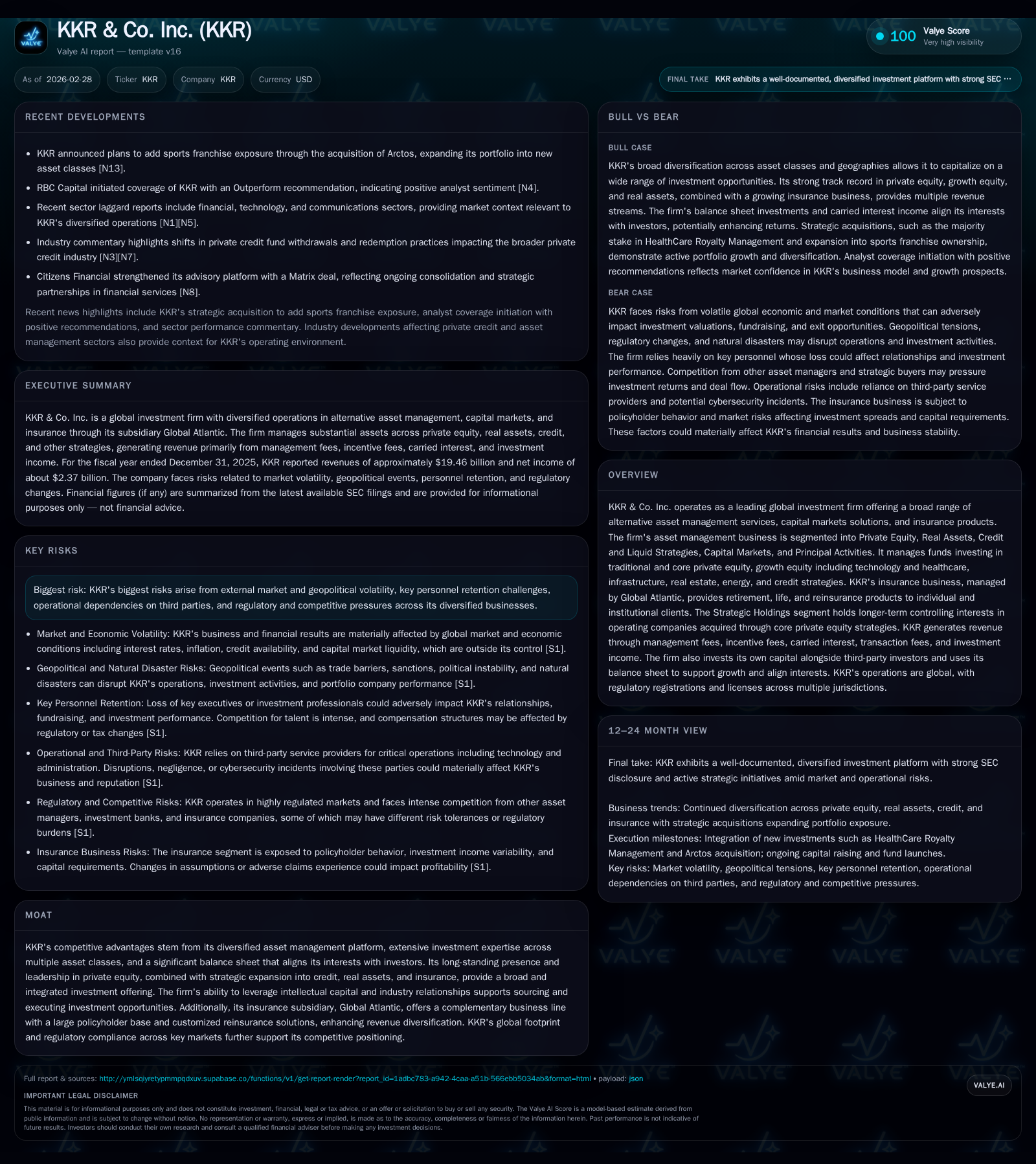
KKR & Co. Inc., a global alternative asset manager and insurer, experienced a notable pullback in 2025 after several years of rapid revenue growth driven by expansion in private equity and diversified strategies. Despite an 11% revenue decline and nearly 23% net income fall in 2025, the firm's broad multi-asset approach encompassing private equity, credit, real assets, and insurance offers resilient foundations for recovery. Capital allocation remains disciplined with modest buybacks and steady dividends amid prudent liquidity management. Going forward, new ventures like adding sports franchise exposure via Arctos acquisition signal strategic diversification though risks from market volatility and regulatory complexity persist.
Historical Financial Performance and Key Drivers
KKR's fiscal trajectory over the past four years illustrates a rapid ascension followed by a setback in 2025. Revenue surged from $5.72 billion in FY2022 to $21.88 billion in FY2024 before contracting by approximately 11% to $19.46 billion in FY2025 [F1]. Net income mirrored this pattern with a recovery from a loss of $841 million in FY2022 to a peak of $3.73 billion in FY2023 but then declined by nearly 23% to $2.37 billion in FY2025 [F1]. Operating cash flow exhibited high volatility; turning positive only recently at $6.65 billion in FY2024 before plunging by close to 93% to under $478 million in FY2025 [F1].
This oscillation reflects heavy reliance on carried interest realizations tied closely to investment exits and valuations which can be unpredictable given market cycles. Capital expenditures remain modest relative to scale but rose sharply near 90% indicating increased investment or technology costs possibly linked to platform expansion.
Historical performance (annual)
| FY | Rev ($bn) | Net ($bn) | CFO ($bn) | Rev YoY | Net YoY |
|---|---|---|---|---|---|
| 2025 | 19.5 | 2.4 | 0.5 | -11.0% | -22.9% |
| 2024 | 21.9 | 3.1 | 6.6 | +50.9% | -17.6% |
| 2023 | 14.5 | 3.7 | -1.5 | +153.4% | +543.7% |
| 2022 | 5.7 | -0.8 | -5.3 |
Source: SEC companyfacts cache [F1].
Capital returns and efficiency (annual)
| FY | Buybacks ($mm) | ROE% |
|---|---|---|
| 2025 | 3 | 7.7 |
| 2024 | 0 | 13.0 |
| 2023 | 290 | 16.3 |
| 2022 | 347 |
Source: SEC companyfacts cache [F1].
Note: Approximate ROE for FY2025 calculated as net income over shareholder equity ($30.9B) yields ~7.7%[F1].
Impact of Market Conditions on Investment Valuations
In KKR’s asset base, valuation sensitivity stems primarily from the methods applied to Level III investments that lack observable market prices [S1]. Discounted cash flow analyses dominate these valuations but fluctuate materially with interest rate changes; rises increase cost of capital assumptions thereby depressing values whereas declines have offsetting effects.
Simultaneously, the market multiples approach may deliver contrasting signals creating offsetting valuation results within the portfolio depending on prevailing economic dynamics.
Within Global Atlantic’s insurance business, management employs sophisticated hedging programs including static hedges for fixed-indexed annuities and dynamic hedges for variable annuity guarantees which mitigate interest rate and equity price risks but add operational complexity and accounting considerations [S1]. Such risk management is essential given potential for policyholder behavior variability impacting liabilities.
KKR’s Core Businesses: Private Equity, Credit, Real Assets, and Insurance
KKR commands leadership status through its diverse investment platform spanning core private equity — representing traditional buyouts complemented by growth equity targeting healthcare and technology sectors — alongside credit solutions including leveraged loans and CLOs [S24].
Real assets encompass infrastructure, energy projects, and real estate investments providing defensive qualities against inflationary pressures while offering yield enhancement.
Insurance operations via wholly owned subsidiary Global Atlantic specialize in retirement products such as fixed-rate/fixed-indexed annuities along with customized reinsurance solutions aimed at institutional clients [S24]. This segment services over three million policyholders leveraging distribution through banks, broker-dealers, and independent marketing organizations.
Fee income derives mainly from management fees on committed capital plus performance or carried interest fees stemming from successful fund realizations.
The firm articulates carried interest as a principal performance driver — aligning incentives with fund outcomes — while utilizing block reinsurance structures built into Global Atlantic’s product suite that differ from traditional run-off models common among competitors.
Strategic Holdings and Capital Markets Activities
Strategic Holdings reflects KKR’s longer-term ownership stakes taken through its private equity strategies rather than third-party managed funds; these investments provide recurring dividend income coupled with potential capital appreciation beyond customary fee streams [S4]. This creates balance sheet alignment incentivizing shared interests between KKR and its investors.
Capital markets activities complement investment returns via underwriting equity/debt issuances for portfolio companies alongside facilitation of leveraged financing solutions; although these engagements carry risk exposures mitigated through syndication arrangements limiting KKR's net commitments [S12]. Such an integrated approach positions KKR competitively compared to standalone asset managers or traditional investment banks lacking deep operating-company involvement.
Recent News: Expansion into Sports Franchise Exposure
In early February 2026, KKR announced an acquisition of Arctos Sports Partners signaling entry into sports franchise ownership—a growing trend among alternative asset managers seeking uncorrelated revenue streams and brand engagement opportunities beyond financial markets [N4].
This strategic move diversifies KKR’s portfolio beyond conventional alternatives into experiential assets that may appeal strongly to retail investors increasingly attracted to sports-related investable vehicles while leveraging KKR’s operational expertise.
The impact on financial performance hinges on integration success and monetization ability within burgeoning sports entertainment ecosystems; however, it denotes willingness to innovate asset mix amid competitive pressures.
Future Growth Opportunities and Operational Constraints
Growth pathways center on further organic expansion within multi-asset categories such as credit — where demand persists despite tightening funding conditions — along with continued scaling of insurance offerings addressing demographic tailwinds around retirement preparedness [N8].
However, operational headwinds loom large: geopolitical conflicts raise risk premiums affecting deal activity; fundraising cycles face pressure due to market volatility; regulatory compliance burdens intensify especially concerning retail product marketing; key personnel retention remains critical amid industry competition for talent [S9][N8]. Additionally, policyholder behavior uncertainty imposes constraints on predictable cash flows particularly within insurance liabilities.[S1]
Risks from Market Volatility and Regulatory Environment
KKR confronts multi-layered risks emanating from macroeconomic uncertainties including inflationary trends influencing cost structures and investment exit timings impacting carry generation negatively when ill-timed [S9][S10][S11]. Insurance pricing must adapt dynamically to interest rate regimes while maintaining regulatory solvency margins restricting product flexibility.[S13]
Legal exposure surfaces from complex litigation risks tied not only directly to KKR but also via portfolio company actions potentially implicating control person liabilities.[S16] Heightened scrutiny arises from international jurisdictional overlaps imposing costly disclosure demands.[S11]
Distribution channels embracing individual investors subject KKR products to enhanced standards of suitability assessment under regulations across jurisdictions (SEC Reg BI in U.S., MiFID II in Europe), making marketing compliance resource intensive while litigation risks intensify if standards slip.[S17]
Capital Deployment, Returns, and Shareholder Remuneration
KKR maintains conservative capital discipline post-peak growth phase evidenced by minimal share repurchases ($3.36 million in FY2025 vs larger historical amounts) coupled with stable declared dividends totaling approximately $0.74 annually per share paid quarterly as $0.185 increments reflecting board commitment to returning capital steadily without overextension amidst earnings pressure [F1][S8].
With operating cash flow severely compressed leaving approximate free cash flow near $283 million after capex investments,[F1] balancing reinvestment needs against distributions presents ongoing challenges.
The firm’s approximate return on equity stands at a modest ~7.7% signaling room for improvement relative to private equity peers dependent on incentive fee performance fluctuations.[F1] Capex shifts suggest heightened expenditure possibly for technology infrastructure amidst growing product complexity.
What to Watch: Milestones and Catalysts Ahead
Absent explicit forward guidance beyond recent analyst coverage initiation highlighting an outperform stance,[N8] key indicators warranting monitoring include capital raising progress across flagship private equity and credit funds which underpin fee revenue sustainability; portfolio exit volumes/timing dictating incentive fee realization patterns; successful integration traction for nontraditional assets like sports franchises acquired through Arctos partnership.[N10]
Additionally, regulatory developments governing retail investment disclosures could materially influence marketing channels’ effectiveness impacting product uptake rates.[N14] Geopolitical stability will remain a barometer for deal activity velocity while talent retention signals will hint at organizational resilience sustaining next-phase growth ambitions.
Disclaimer: This analysis is intended solely for informational purposes without provision of investment advice or recommendations regarding purchase or sale of securities.
Disclaimer: This is research-only, informational analysis and not investment advice. It may include AI-generated interpretation and general industry context. Always verify important details using primary sources.

Comments