
Klarna's Journey to a $128 Billion Network and Its Next Growth Chapters
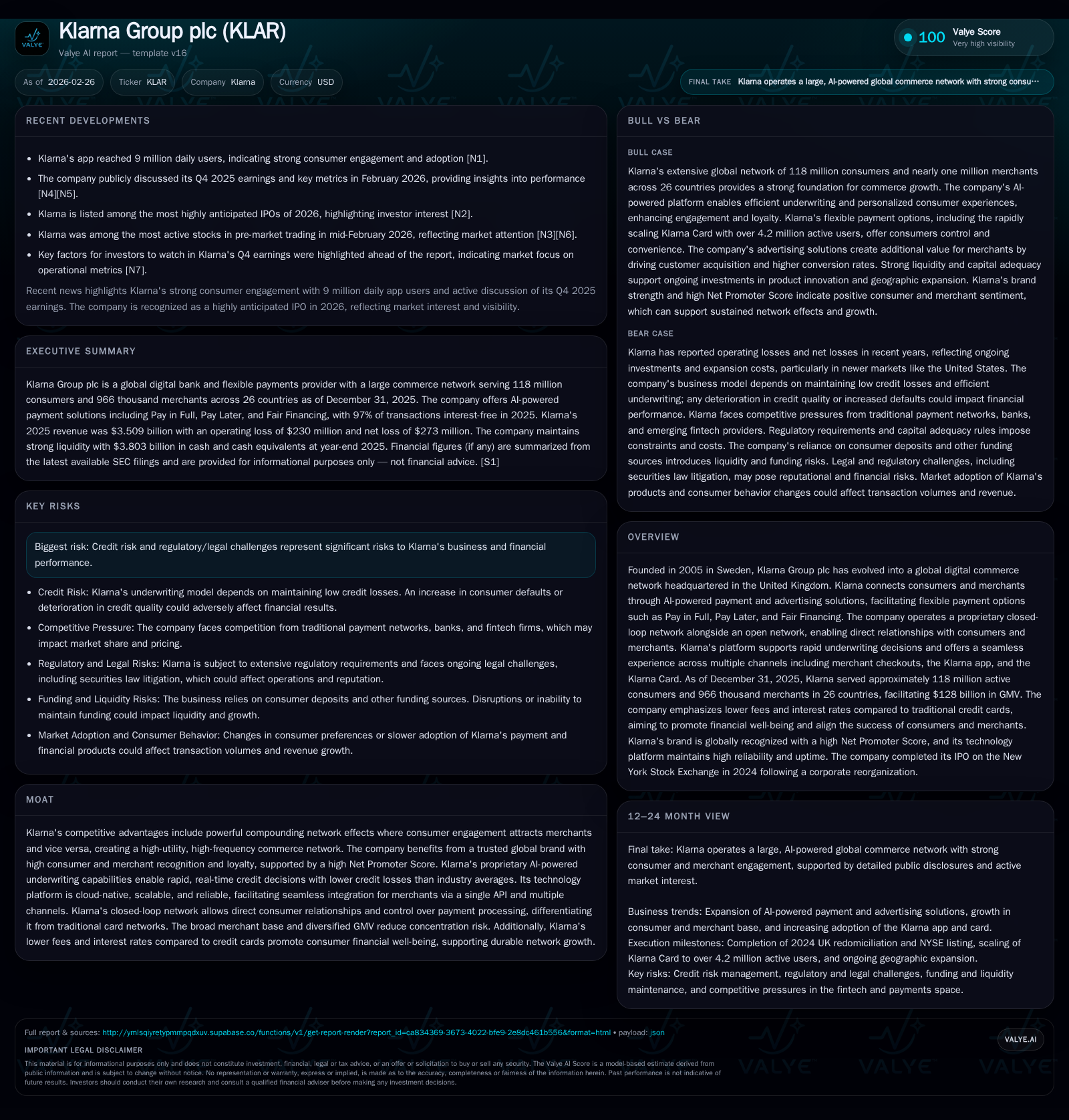
Klarna has built one of the largest global commerce networks by connecting 118 million consumers with nearly a million merchants through AI-driven flexible payment solutions.
Founded in Sweden and now headquartered in the UK, Klarna Group plc has evolved into a major digital commerce network facilitating $128 billion in GMV during 2025 across 26 countries. The company’s rapid expansion, driven by network effects and innovative AI underwriting, powered 25% revenue growth last year despite widening losses led by credit costs and regulatory headwinds. Klarna’s future growth hinges on scaling its Fair Financing product, expanding merchant partnerships, and navigating credit and legal risks while maintaining strong liquidity supported by deposit-based funding.
From Nordic Startup to Global Payment Powerhouse: Historical Growth and Drivers
Founded in Sweden in 2005, Klarna began as a solution to improve trust and reduce friction in online commerce by enabling consumers to pay after delivery. The firm rapidly expanded beyond the Nordics into broader Europe through the early 2010s, reaching nine markets by 2016 including the UK. A pivotal step occurred in 2017 when Klarna acquired a banking license within the European Economic Area, allowing it to fund lending via consumer deposits—a key competitive advantage that underpins its low-cost funding model today [S1][S21].
This transformation facilitated product innovation from simple Pay Later installments to its proprietary Fair Financing offering, which extends longer-term interest-bearing loans typically ranging from three to 48 months [S1][S21]. The company leverages AI-powered underwriting that evaluates repayment ability in real time across millions of daily transactions, enabling sub-60-second credit decisions [S19].
Network effects between merchants and consumers fuel momentum; as the active consumer base reached approximately 118 million with nearly one million merchants worldwide by end-2025, Klarna cultivated a high-frequency commerce network with rising GMV ($128 billion in 2025) [S1][S21][N5]. Merchant partnerships with major players across multiple verticals—including integration through PSPs like Stripe and Adyen—helped embed Klarna as a payment method at checkout in both online and offline channels [S21][N5].
Historical performance (annual)
| FY |
|---|
| 2025 |
Source: SEC companyfacts cache [F1].
Table: Klarna Annual Financial Summary (2023-2025). Revenue growth adjusted for divestiture impact and FX effects where applicable.
2025 Financial Performance: Dissecting Revenue Gains and Rising Losses
Klarna posted total revenue of $3.51 billion for FY2025—a healthy rise of 25% from $2.81 billion in FY2024 on a like-for-like basis after adjusting for the sale of its KCO checkout business in Q4'24 [F1][S1]. The uplift tracks closely with the underlying GMV increase of approximately 21%. Within revenue streams, transaction and service revenue rose by $364 million or +17%, while interest income surged almost +39%, largely due to broader Fair Financing adoption [S1]. The gain on sale of consumer receivables ($73 million) also contributed positively to total revenue.
Operational expenses inflated sharply to $3.74 billion (+28%) driven notably by several cost centers: credit loss provisions jumped to $794 million (+61%), funding costs climbed $667 million (+32%) reflecting higher lending volumes and market rates, while sales and marketing spent increased modestly but customer service costs remained stable [S1]. This pushed the operating loss wider to $230 million compared with $121 million loss prior year.
These cost dynamics reflect growing scale but also deeper credit risks inherent with consumer financing expansion. Earnings volatility was compounded further by rising general administrative expenses tied to regulatory compliance frameworks developed around Klarna’s banking activities [S12].
The Role of Fair Financing and Merchant Network Expansion in Revenue Mix
Fair Financing represented about 9% of gross merchandise volume in FY2025 compared with only around 5% in FY2024—indicating accelerated penetration of these longer-duration installment products [S1]. Unlike fee- and interest-free Pay Later plans that generate merchant-paid transaction fees counted mostly under transaction revenue, Fair Financing produces predominantly interest income as customers pay interest over multi-month terms.
This product mix shift reduces near-term transaction yield but lifts total revenue quality through recurring interest stream—albeit exposing Klarna to higher credit risk given longer weighted average life loans (~109 days for Fair Financing vs. ~27 days for Pay Later). This trend aligns well with sector-wide moves toward diversified BNPL offerings that balance fee income and finance charges .
Meanwhile merchant additions reached approximately 966 thousand globally across diverse sectors including apparel, electronics, home goods and travel services [S19]. Importantly, no single merchant contributed more than a low double-digit percentage of GMV per major market—helping minimize concentration risk while reinforcing high utility network effects that tighten engagement metrics such as conversion rates and average order values.
Credit Losses and Regulatory Risks: Key Constraints Tempering Profitability
The biggest headwinds for Klarna’s profitability stemmed from elevated provisions against consumer receivables which surged alongside expanding loan volumes [S1][N12]. Provisions touched $794 million equating roughly to a provision rate near~0.63% of GMV—a figure helped by rigorous AI-led underwriting models constantly refined via transaction-level monitoring and internal governance controls [S14]. These models allow granular delinquency tracking with early-warning indicators feeding monthly credit committee reviews.
Nonetheless escalating delinquencies are anticipated given macroeconomic uncertainties plus rapid U.S. market growth where loss rates have traditionally run higher compared to matured European operations . Furthermore, mounting regulatory scrutiny linked to its bank license within Europe escalates compliance costs while increasing operational complexity . Legal challenges include ongoing securities law claims recently publicized which add another layer of uncertainty over reputational risks [N12].
Future Growth Outlook: What Klarna Highlights in Recent Earnings Commentary
Klarna’s management highlighted several levers underpinning forward expansion opportunities including:
- Continued rollout of Fair Financing across existing and new geographies,
- Leveraging its popular mobile app which now boasts ~9 million daily active users fostering habitual engagement beyond payments,
- Scaling distribution integrations via prominent PSP partners enhancing checkout presence,
- Expanding use case reach beyond e-commerce toward everyday spending via their proprietary Klarna Card available offline and online [N3][N5][S2].
While explicit financial guidance remains limited owing partly to macroeconomic uncertainties around credit performance trajectories, trackers such as merchant sign-ups, app usage statistics, incremental GMV growth rates as well as evolving regulatory developments represent key monitor points going forward [N4].
Capital Structure, Liquidity, and Cash Flow Trends Supporting Operations
Klarna maintains robust liquidity buffers underpinning operational resilience under stress scenarios characteristic of Basel III frameworks. The company reported $3.8 billion cash & equivalents at year-end coupled with High Quality Liquid Assets composing about two-thirds of these holdings providing instant access [S4][F1]. Its liquidity coverage ratio stood at an impressive ~892%, vastly exceeding minimum regulatory thresholds.
Funding strategy centers around its licensed banking subsidiary using consumer deposits ($13 billion recorded at year-end versus $9.5 billion prior year—a +37% increase) as primary low-cost source financing ~90% of their loan book offering an advantaged cost-of-capital structure versus wholesale debt issuance or securitizations [S12][S15]. Deposit maturities average roughly nine months which comfortably exceed weighted loan durations lending financial stability against interest rate fluctuations.
Supplementing deposit funding is access to capital markets through Swedish and Euro medium term note programs totaling hundreds of millions outstanding across senior unsecured notes as well as subordinated capital instruments used prudently alongside synthetic securitizations reducing direct portfolio risk exposure [S9][S10][S11].
Shareholder Returns: Dividends, Buybacks, and ROE Analysis
Despite scale advances top-line profitability remains elusive evidenced by negative net income ($273 million loss for FY2025) resulting in an estimated negative ROE near -10.2% consistent with recent losses reported following international expansion investments plus elevated credit reserves [F1][S1]. Shareholder distributions such as dividends or buyback programs are presently absent reflecting prudent capital retention policies amid ongoing growth phase prioritization.
This stance aligns with Klarna’s strategy emphasizing reinvestment into product innovation infrastructure expansion rather than short-term returns at this stage.
What Investors Must Watch: Milestones and Potential Industry Shifts Ahead
Primary KPIs critical over coming quarters entail:
- Consumer credit performance trends scaled geographically especially U.S./U.K.,
- Further penetration rates for interest-bearing Fair Financing products,
- Daily active user growth on the Klarna app signaling sticky consumer engagement,
- Merchant network expansion velocity particularly among top global retailers,
- Regulatory actions impacting operating licenses or capital requirements given evolving EU banking directives,
- Competitive positioning relative to BNPL peers focusing on emerging embedded finance APIs.
Macroeconomic pressures and e-commerce valuation multiples volatility underline caution but sustained fundamental innovation combined with scaling proprietary AI underwriting capabilities provide an optimistic platform for longer-term commercial fintech relevance [N4][N3].
Disclaimer: This report is strictly informational based on publicly available data through February 26, 2026. It does not constitute investment advice or endorsement.
Disclaimer: This is research-only, informational analysis and not investment advice. It may include AI-generated interpretation and general industry context. Always verify important details using primary sources.

Comments