
KKR Real Estate Finance Trust: Strategic Platform Leverage Amidst CRE Market Headwinds
KKR Real Estate Finance Trust’s integration with KKR’s global platform and disciplined portfolio management are critical as it navigates evolving challenges in commercial real estate lending.
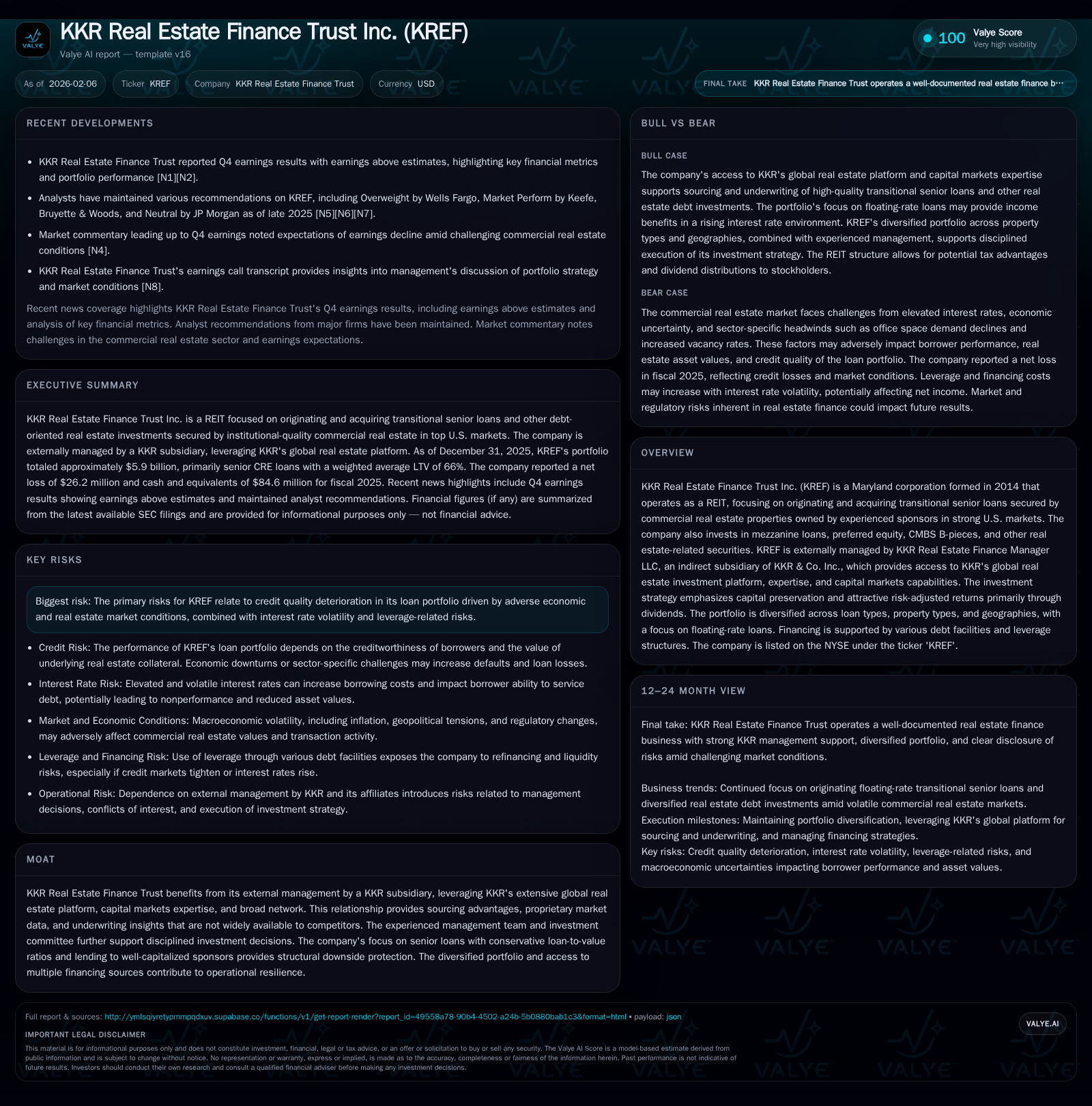
KKR Real Estate Finance Trust Inc. (KREF) has demonstrated resilience in a difficult commercial real estate (CRE) lending environment by capitalizing on its strategic external management relationship with KKR. Despite recording GAAP net losses driven by loan loss provisioning and realized markdowns linked to foreclosures, KREF delivered positive distributable earnings supporting its dividend profile. Its diversified, predominantly floating-rate senior loan portfolio and prudent financing structure, coupled with access to KKR's broad capital markets expertise, position the company to manage competitive pressures and credit risks amid uncertain economic conditions. Going forward, the emphasis remains on capital preservation via cautious underwriting and maintaining operational flexibility through strong liquidity and longer debt maturities.
KREF’s Investment DNA: Strategic Origins and Capital Blueprint
KKR Real Estate Finance Trust Inc. was formed in October 2014 as a Maryland corporation structured as a real estate investment trust (REIT), enabling efficient capital deployment and shareholder tax advantages through mandatory dividend distributions under U.S. tax law [S1];[S2]. The company centers its investment mandate on originating and acquiring transitional senior loans secured by institutional-quality commercial real estate (CRE) in leading U.S. markets owned by well-capitalized sponsors with proven track records. This focus on transitional assets positions KREF to capitalize on refinancing or repositioning opportunities across property types.
Beginning with an initial $400 million capital commitment from KKR along with additional third-party investor equity prior to its May 2017 IPO that raised approximately $226 million net proceeds, the company has steadily grown its invested asset base [S1]. As of December 31, 2025, KREF reported common book value of $844.8 million and an investment portfolio totaling just under $6 billion primarily comprising performing senior loans [S1].
This foundational blueprint—capital efficiency through REIT status combined with strategic targeting of senior loans backed by quality collateral—aligns closely with its long-term objective of capital preservation supplemented by attractive risk-adjusted returns largely via consistent dividend distributions.
Harnessing the KKR Advantage: The Power of External Management
KREF operates under an external management arrangement whereby day-to-day operations, investment decisions, deal origination, underwriting processes, portfolio management, and financing activities are conducted by KKR Real Estate Finance Manager LLC—an indirect subsidiary of global alternative asset manager KKR & Co., Inc. [S1];[S2]. This relationship furnishes KREF with a robust competitive moat grounded in proprietary deal flow sourced through KKR’s expansive global real estate network.
KKR’s formidable presence—over $700 billion in assets under management spanning private equity, credit, infrastructure, hedge funds, and real estate—provides a diversity of market intelligence and access to capital markets solutions unavailable to many peer lenders [S2]. Importantly for KREF, this enables rigorous underwriting capabilities supported by comprehensive market data as well as flexible funding structures leveraging multiple financing sources.[valye_report_excerpt.moat]
Furthermore, the firm benefits from senior investment professionals embedded within both KKR’s global real estate groups and dedicated investment committees ensuring disciplined decision-making aligned with risk parameters.[S2]. This cohesive management architecture facilitates responsive capital deployment while balancing risk tolerances appropriate for a REIT focused on steady income generation.
Portfolio Narrative: Balancing Diversification with Risk Controls
KKR Real Estate Finance Trust’s portfolio strategy emphasizes diversification across product types — predominantly floating-rate senior loans complemented by allocations in mezzanine loans, preferred equity instruments, CMBS B-pieces, and other real estate-related securities [S1];[S2]. By year-end 2025, the company reported approximately $5.9 billion invested mainly in floating-rate senior loans yielding an unlevered all-in rate of about 7.3%, demonstrating alignment between asset yields and cost of funds in a rising rate environment [S1].
The weighted average loan-to-value (LTV) for newly originated loans stood at roughly 68%, underscoring conservative underwriting standards designed to offer structural downside protections against collateral value declines [S1]. Geographic diversification assists in mitigating localized market headwinds while the presence of established sponsors reduces counterparty risk.
Reflective of heightened industry uncertainties during 2025 marked by elevated delinquencies across CRE property types like office spaces due to shifting demand dynamics post-pandemic [analysis], KREF increased its Current Expected Credit Loss (CECL) reserves significantly—to $204 million or about $3.15 per share—with additional provisions mainly allocated toward higher-risk rating categories (Risk Rating 5 loans) totaling near $119 million [S1]. This prudent reserving exemplifies conservative risk controls essential amid macroeconomic volatility.
Decoding the 2025 Financial Pulse: Navigating Losses and Distributable Earnings
The financial results for the full year 2025 portray a nuanced picture indicative of the underlying stress in CRE lending but also highlight positive cash flow fundamentals supporting dividends. While GAAP net income registered a substantial loss attributable to common stockholders amounting to roughly $69.9 million or $(1.05) per share—primarily driven by non-cash credit loss reserves and realized losses linked to foreclosed assets—the company generated distributable earnings of $26.3 million ($0.39 per diluted share) [S1];[F1].
Distributable Earnings exclude impairments and unrealized mark-to-market items that depress GAAP income but do not impact recurring cash available for dividends—a key metric given the REIT structure prioritizing consistent payout streams [S1]. In fact, despite reported losses, KREF maintained its dividend distribution at an annual rate of $1.00 per share aligning with investor expectations for yield stability.
Additionally noteworthy was share repurchase activity totaling approximately $43 million at an average price near $9.35 per share during 2025 which bolstered shareholder value metrics amid uncertainty [S1];[N2]. This buyback underscores confidence in intrinsic asset values despite headline profitability pressures.
Financing Fortitude: Debt Structure, Refinancing, and Liquidity Positioning
KKR Real Estate Finance Trust fortified its capital structure during 2025 by executing several refinancing initiatives that enhanced liquidity profiles while extending debt maturities crucial in a rising interest rate climate.[S1]
The company upsized one major secured term loan facility from approximately $340 million to $650 million while successfully reducing borrowing spreads from SOFR plus 3.50% down to SOFR plus 2.50%—reflecting favorable credit terms given broader macro challenges—and lengthening maturity out to March 2032 [S1]. Revolving credit capacity also expanded by $90 million to total $700 million with maturity extension into 2030.
These actions yield structural benefits: nearly three quarters (74%) of secured financing is now non-mark-to-market funded providing expense stability; importantly there are no final maturity events until at least 2027 reducing refinancing risks; corporate-level debt does not mature until 2030 affording ample runway for opportunistic deleveraging or reinvestment.[S1]
Overall this financial positioning supports operational resilience scaffolding against potential CRE market turbulence while maintaining access to match-term financing aligned with underlying loan durations.
Competitive Terrain: Positioning Amidst Increasing Market Pressures
The competitive landscape for CRE lending has intensified markedly with multifaceted pressure points constricting origination windows.[S1.Item1A.RiskFactors] Multiple institutional lenders including peer REITs flush with capital; bank lenders benefiting from regulatory shifts; specialty finance companies; private funds targeting opportunistic yields all vie aggressively for high-quality loan engagements.
Differing risk appetites amongst competitors may drive some players toward more aggressive pricing or non-core property types absent from KREF's strategy focused on conservative underwriting.[analysis] This dynamic could lead to compressed yields for comparable credit profiles potentially pressuring net interest margins.
However, KREF’s affiliation with KKR remains a salient advantage granting proprietary access to off-market deals sourced within the firm’s broad global ecosystem unavailable readily to rival lenders lacking such integrated platforms.[valye_report_excerpt.moat]
Such differentiation aids sustained pipeline quality enabling selective originations efforts amidst crowded markets where mispricing opportunities narrow rapidly.
Market Volatility and Credit Risks: Assessing Exposure in the Current Economic Climate
Macroeconomic challenges continue shaping credit risk trajectories within CRE finance broadly—and directly influence borrower performance central to KREF’s asset quality analysis.[valye_report_excerpt.risks] Persistent inflationary pressures coupled with uncertain Federal Reserve monetary policy complicate interest rate forecasts impacting cost of capital for borrowers alongside valuation adjustments on collateral properties.[S2]
Higher vacancy rates particularly within office sector properties reflecting shifting demand patterns impose strain on cash flow generating ability that underpins loan service capacity.[analysis] As documented in recent filings portions of the portfolio required direct intervention including deed-in-lieu foreclosures leading to realized losses nearing $35 million primarily related to multifamily properties ultimately conveyed back through restructuring mechanisms.[S1]
CECL reserves elevated materially responding proactively to expected deteriorations provide cushions against future impairments but also highlight layered credit vulnerabilities inherent at this cycle juncture.[S1] These factors collectively underscore ongoing vigilance required balancing yield aspirations tempered against potential defaults or restructurings amidst uncertain economic environment.
Forward-Looking Lens: Missives from Management’s Playbook and Market Indicators
Recent earnings results released in early February demonstrated that despite analyst expectations predicting declines due largely to reserve build-outs [N4], KREF surpassed fourth-quarter earnings estimates signaling resilience grounded in core business fundamentals [N1][N2]. However rising implied volatility observed in options markets surrounding KREF stock suggests heightened investor nervousness regarding underlying risks consistent with broad market anxieties around CRE sectors [N5].
Management commentary reiterates commitment toward disciplined underwriting standards prioritizing low-to-moderate leverage levels alongside engagement only with well-capitalized sponsors possessing meaningful equity stakes which historically correlate with lower default frequencies.[S1][S2]
Strategic focuses remain intact emphasizing selective financing paired with active portfolio monitoring integrating early warning indicators designed to mitigate downgrade potential—critical when operating within volatile sectors subject to rapid condition shifts.[analysis]
Future outlook leans toward cautious optimism facilitated by flexible balance sheet standing combined with integrated platform insights enabling nimble responses should market dislocations deepen further or recovery outlook solidify more clearly.
Conclusion: The Crossroads of Resilience and Opportunity for KREF
KKR Real Estate Finance Trust distinctly operates at the nexus between protecting capital amid pronounced commercial real estate headwinds while seeking sustainable income generation within competitive yet dynamic lending landscapes. Leveraging a symbiotic relationship with global investment powerhouse KKR affords rare sourcing advantages coupled with unmatched financing flexibility critical for managing cyclical risks inherent within CRE loan portfolios.
While headline GAAP losses emphasize margin pressure primarily stemming from credit loss provisions tied to sector stressors—including office vacancies and borrower distress—the demonstrated ability to maintain distributable earnings consistent enough to support steady dividends contributes foundationally toward investor confidence.
Moreover, proactive balance sheet maneuvers strengthening liquidity profiles alongside diversified exposure across property types underscore sound risk management guardrails navigating period uncertainties.
Unfolding economic realities will unquestionably test these frameworks further yet embedding conservative underwriting philosophies coupled with access to premium global resources likely positions KREF favorably relative to peers constrained by narrower platforms or less flexible capital structures.
Consequently investors looking through fundamental durability rather than transitory accounting noise would recognize this confluence positioning as emblematic of well-constructed resilience meeting opportunity—a hallmark characteristic essential within today's evolving commercial real estate finance milieu.
This analysis is intended solely for informational purposes based on publicly available information as of early February 2026 and does not constitute investment advice or recommendations.
Disclaimer: This is research-only, informational analysis and not investment advice. It may include AI-generated interpretation and general industry context. Always verify important details using primary sources.

Comments