
Knightscope Expands Security Platform with Event Risk Acquisition Amid Persistent Profitability Challenges
Latest quarter highlights operational progress and strategic expansion while financial sustainability remains a critical concern.
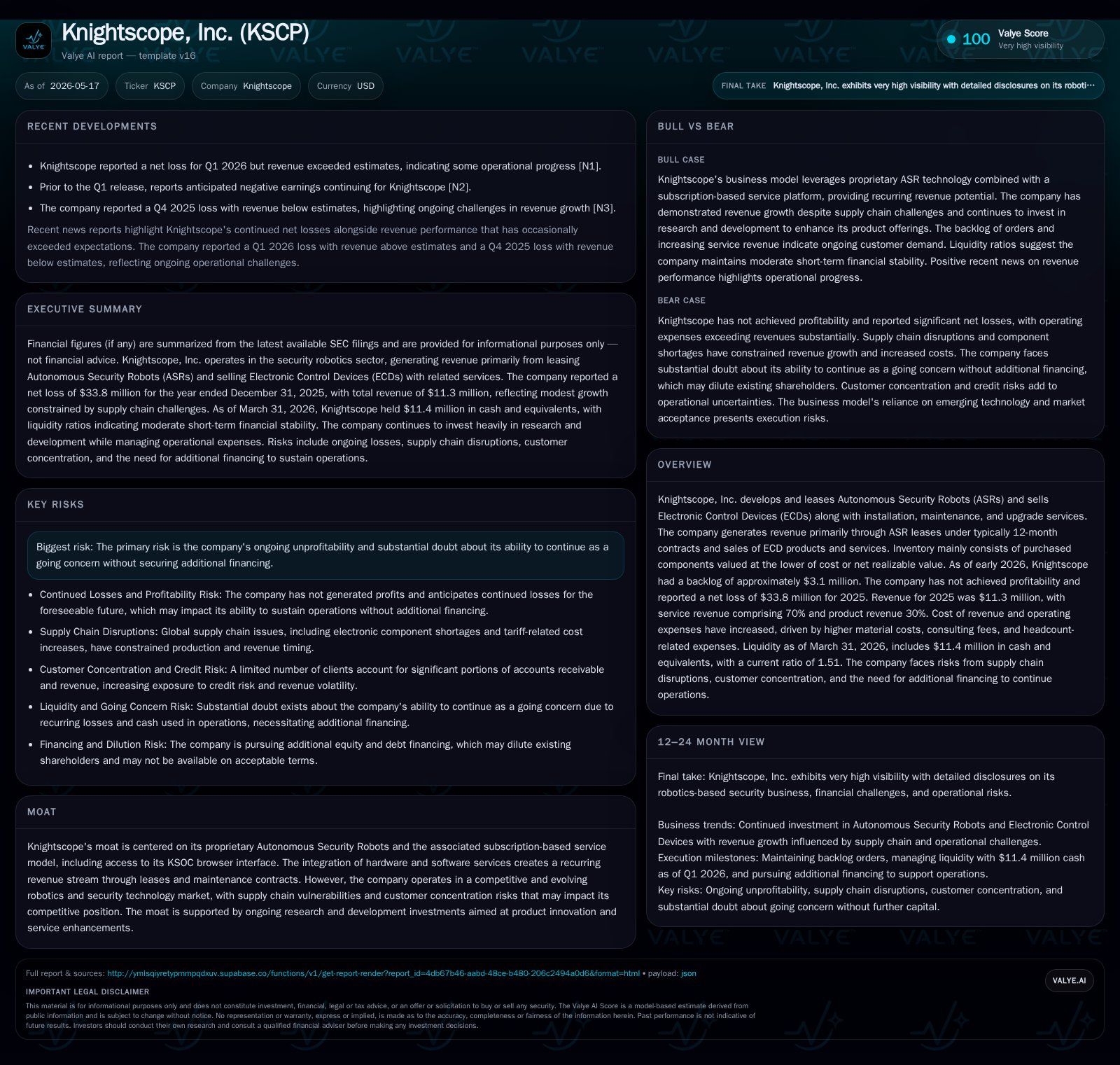
In its 2026 first quarter, Knightscope reported revenue growth surpassing estimates but continued to post significant net losses, reflecting high R&D and operating expenses. The company’s business model centers on leasing Autonomous Security Robots (ASRs) complemented by Electronic Control Device (ECD) sales and maintenance services. The recent acquisition of Event Risk enhances Knightscope’s integrated security offering by adding licensed personnel services, aiming to blend robotics with human response capabilities. Despite technological advancements and a growing backlog, Knightscope faces notable risks related to ongoing unprofitability and liquidity demands.
Recent Operating Update
Knightscope’s latest quarterly report for Q1 2026 [S2] reveals incremental revenue gains that top consensus expectations but continues to highlight considerable operating losses. Revenue growth stems primarily from leased Autonomous Security Robots (ASRs) under typical twelve-month contracts alongside Electronic Control Devices (ECD) sales and associated service contracts.
Operationally, Knightscope reported a net loss consistent with prior trends emphasizing ongoing investments in product development (notably R&D spending surged 77% to $12.5 million in 2025 [S18]) and expansion of its service infrastructure. The company’s backlog of approximately $3.1 million reflects demand traction mostly from ECD orders ($2.5 million) compared to ASR orders ($0.6 million) [S1].
Strategically pivotal is the February 2026 acquisition of Event Risk LLC, a licensed security services provider operating nationally [S24][S25]. This move expands Knightscope's footprint beyond hardware-software into integrated human-enabled security solutions, promising synergies via technology-enabled supervision enhancing productivity over traditional labor-intensive guarding models [S4][S8].
Business Model
Knightscope operates predominantly on a recurring revenue model via leasing its proprietary Autonomous Security Robots (ASRs), which are equipped with sensors, cameras, and AI-driven alerting capabilities accessible through its KSOC software platform [S1][S13]. Typical leases span twelve months, encompassing both the robotics hardware and continuous software access. The company supplements this with sales of electronic control devices (ECDs), which include emergency communication platforms such as KEMS.
Revenue recognition varies:
- ASR lease fees are recognized over contract terms,
- Non-lease revenues such as professional services around deployment or training are accounted when delivered,
- ECD sales revenues recognize upon customer receipt of certificates of completion,
- Maintenance agreements generate service revenues recognized during the service period.
This blended hardware-plus-service approach aims to create switching costs through bundled offerings where customers depend on both physical robotics presence and ongoing software monitoring/support.
Margins remain challenged due to elevated direct costs for materials (components for robots), outsourced engineering consulting, increasing headcount-related expenses, and amortization/depreciation pressures tied to ASR manufacturing cycles (3–5 year useful lives) [S1][S18].
Industry Structure and Competitive Position
The security technology market combines several distinct segments:
- Traditional guarded services relying heavily on human personnel,
- Technology-only vendors supplying devices or software platforms,
- Hybrid models like Knightscope aiming for end-to-end autonomous robotic patrols augmented by central command oversight.
Knightscope's moat rests on its proprietary robotics innovation coupled with subscription-based service models bolstered by the KSOC interface—an AI-driven operational backbone integrating sensor data fusion, alert prioritization, and human verification workflows [S4][N1]. Its autonomous roaming units provide physical presence once solely fulfilled by human guards.
However, competitive pressure persists from low-cost traditional guarding firms who offer immediate response capabilities through personnel as well as technology providers lacking active robotic assets or licensed security infrastructure [N1][S4]. The recent Event Risk acquisition attempts to bridge these gaps by embedding licensed humans within an autonomous framework — potentially enabling scalable multi-site supervision supported by AI for routine patrol automation [S8].
Supply chain constraints affecting critical robotics components have caused material cost increases impacting gross margins; this points to vulnerability unless mitigated by scale economies or alternative sourcing strategies.
Growth Drivers
Key growth vectors include:
- Expansion of ASR fleet deployments across diverse property types leveraging annual lease contracts driving predictable recurring revenue,
- Increasing hardware density per site combining multiple robots with supporting infrastructure such as autonomous charging stations enhancing service quality,
- Improvements in AI algorithms reducing false alerts thus improving operational efficiency,
- Cross-selling opportunities unlocked through integrated human-robot security platform enabled by Event Risk’s personnel network,
- Strengthening customer retention via bundled maintenance agreements ensuring steady service income,
- Backlog growth in ECD product lines supporting one-time sale revenues plus recurring maintenance contract extensions.
Growth is structurally underpinned by increasing demand for automated surveillance replacing manual patrols where feasible due to cost advantages and enhanced data analytics capabilities delivering actionable insights [S4][S8].
Risks / Watchpoints / Growth Constraints
Financially, persistent unprofitability—net loss was $33.8 million in 2025—and negative cash flow remain primary concerns raising substantial doubt about ongoing viability without additional financing [S1][S3][N2].
Capital raises could dilute existing shareholders given historically frequent equity issuances needed to fund operations [S3]. Liquidity appears sufficient for near term with $11.4 million cash against $4 million debt as of March 31, 2026 providing a current ratio of about 1.51 [F1], but runway depends heavily on execution.
Execution risk surrounds integration of Event Risk operations into the autonomous platform including regulatory compliance associated with human-staffed security services [S24][S25]. Supply chain disruptions may persist given complexity of components driving robot assembly costs higher than planned affecting margins [S1]. Relative pricing power remains uncertain amid competition from commoditized security devices or incumbent guarding firms.
Customer concentration also poses exposure risk if key contracts are lost or delayed – although partial mitigation comes from diversified product-service mix.
What to Watch Next
Monitoring indicators include:
- Quarterly bookings growth in new ASR leases and ECD sales,
- Backlog expansion beyond the reported $3.1 million mark,
- Impact metrics from Event Risk integration such as combined revenues from staffed guarded services,
- Gross margin trajectory signaling absorption or mitigation of component cost inflation,
- Cash burn rate trends relative to financing activities reflecting capital efficiency improvements,
- Any updates or amendments on contingent consideration related to Event Risk acquisition earn-outs,
- New financing announcements addressing going concern risks highlighted in filings [S12].
Significant near-term milestones will be tied to demonstrating scalability of the hybrid autonomous-human security model along with improved operating leverage through higher robot density per location.
Financial Profile Snapshot (Q1 Ending March 31, 2026)
Latest financial snapshot
| Metric | Value | Period |
|---|---|---|
| Cash & equivalents | $11mm | |
| 2026-03-31 | ||
| Total debt | $4mm | |
| 2026-03-31 | ||
| Net debt | $-7mm | |
| 2026-03-31 | ||
| Current assets | $21mm | |
| 2026-03-31 | ||
| Current liabilities | $14mm | |
| 2026-03-31 | ||
| Current ratio | 1.51x | |
| 2026-03-31 |
Source: SEC companyfacts cache [F1].
*Net Debt equals total debt less cash & equivalents indicating net cash position.
While maintaining a net cash position modestly strengthens liquidity claims, the balance sheet does not alleviate risks linked to continued operating losses necessitating capital raises.
This analysis reflects company disclosures as of May 2026 based on SEC filings [S1][S2] and related public news reports [N1][N2]. It does not constitute investment advice but aims to critically appraise operational status and strategic positioning.
Disclaimer: This is research-only, informational analysis and not investment advice. It may include AI-generated interpretation and general industry context. Always verify important details using primary sources.

Comments