
Kinetic Seas Faces Capital Strains and Customer Concentration in AI Infrastructure Build-Out
The latest quarterly filing reveals Kinetic Seas grappling with liquidity challenges and high customer concentration that constrain its ability to scale AI infrastructure assets amid fierce market competition.
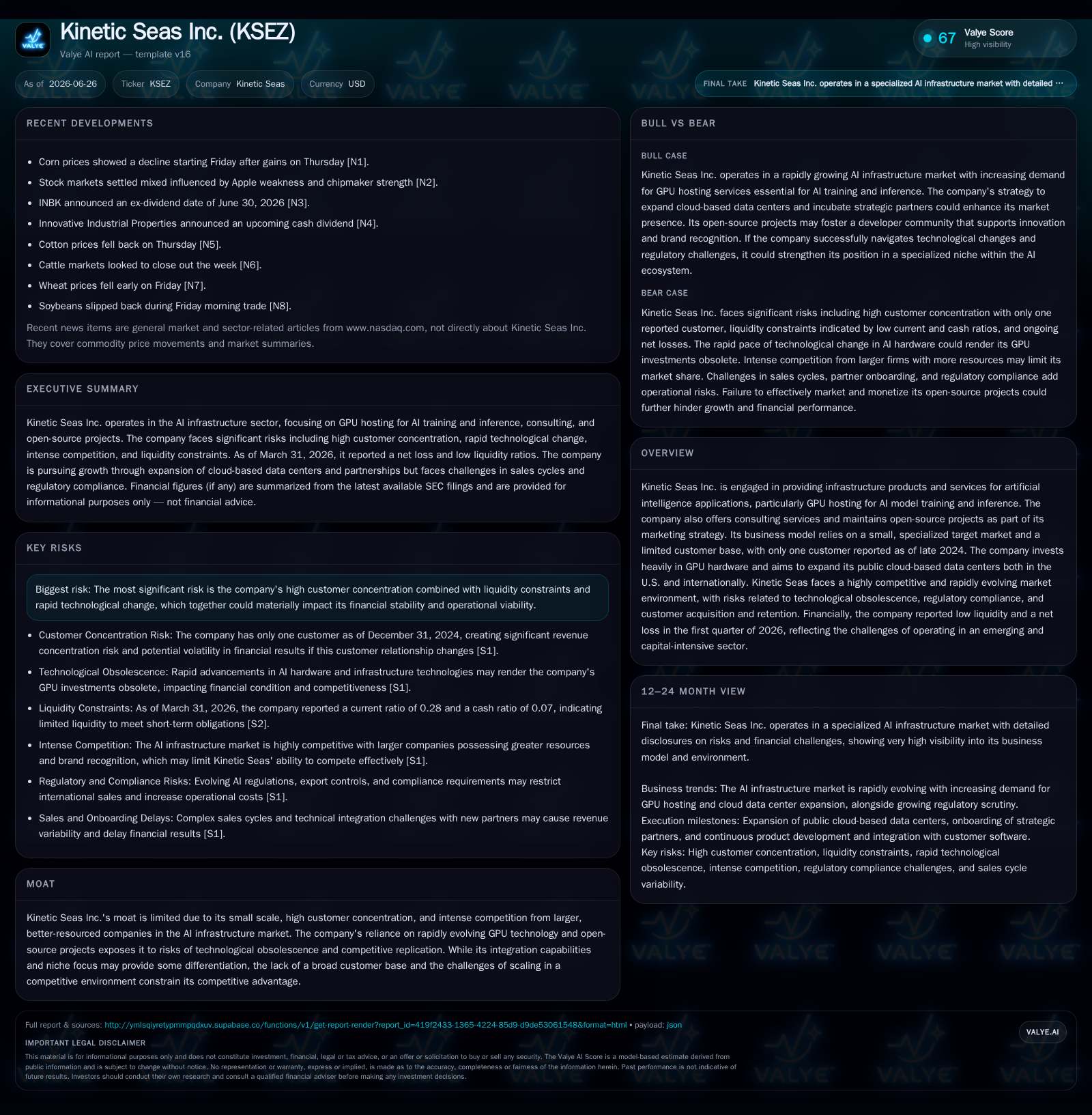
Kinetic Seas Inc. continues to pursue expansion in the capital-intensive AI infrastructure services industry, primarily offering GPU hosting for AI workloads and consulting services to a highly concentrated customer base. The company’s Q1 2026 10-Q discloses ongoing net losses combined with a strained liquidity profile, reflected by a low current ratio of 0.28 and modest cash reserves. Despite investments in cloud data center capacity aimed at scaling, Kinetic Seas faces inherent constraints from rapid technological change, limited geographic footprint, and dependence on a single reported customer. These factors challenge its competitive positioning against hyperscale cloud providers and other specialized AI infrastructure firms. Monitoring customer diversification, execution on capacity expansions, and financial flexibility will be crucial for near-term operating viability and growth.
Latest Quarterly Operating Update Highlights Financial Pressure
Customer metrics remain sparse; the company reports just one active customer confirmed as of late 2024 ([S1]). This extreme concentration risk compounds volatility potential and impairs revenue predictability. There were no material updates to risk disclosures or new mitigating developments reported in the latest filing ([S2]). The persistence of these conditions frames Kinetic Seas' environment as one of ongoing financial constraint amid aggressive growth ambitions.
Overview of Kinetic Seas’ Business Model and Product Offering Quality
According to the comprehensive description from the May 2026 annual report ([S1]), Kinetic Seas generates revenue primarily through GPU hosting services tailored for artificial intelligence workloads involving both model training and inference phases. This compute is provisioned within their own cloud-enabled data centers structured specifically for high-performance computing needs intrinsic to AI applications.
Complementing core infrastructure is a consulting arm providing integration support—a necessary service as customers often require expertise to optimize hardware utilization against evolving AI software frameworks ([S1]). Additionally, the company maintains open-source projects that bolster marketing initiatives by contributing to developer ecosystems but do not directly produce revenues or cash flow.
Underlying these offerings is a capital-intensive strategy centered on building out geographically diversified cloud data center facilities in the US and international markets ([S1]). This positioning aims to overcome scale disadvantages but comes at the cost of significant upfront CapEx commitments, compressing near-term profitability. The product quality largely depends on state-of-the-art GPU hardware deployment combined with reliable service uptime, elements critical for customer retention in AI workloads demanding continuous availability and performance.
Industry Structure and Competitive Positioning in AI Infrastructure Services
The Artificial Intelligence Infrastructure sector is dominated by hyperscale cloud providers such as AWS, Microsoft Azure, and Google Cloud who benefit from extensive global data center footprints and broad service portfolios. In contrast, Kinetic Seas operates as a niche provider with limited geographic scope and significantly smaller scale (, [S1]).
This structural contrast imposes moat limitations for Kinetic Seas given its inability to match competitors' distribution breadth or strategic resources devoted to cutting-edge R&D. The company’s reliance on a single high-concentration customer base heightens vulnerability compared to peers who typically pursue diversified enterprise clientele mitigating revenue volatility.
Furthermore, rapid advances in GPU architectures necessitate continuous investment in hardware refresh cycles—a challenge for smaller firms contending with higher relative capital costs (). Success hinges on securing strategic differentiation through integration capabilities, bespoke consulting services, or targeted market verticals rather than competing head-to-head on scale or price.
Key Growth Drivers: Scaling Challenges and Opportunities in GPU Hosting Market
Kinetic Seas benefits structurally from secular tailwinds shaping the AI compute landscape: increasing enterprise adoption of machine learning workloads drives demand for specialized GPU hosting environments capable of supporting complex model training and inference tasks. Growth in areas like generative AI further escalates compute intensity requirements per application.
However, converting this opportunity into scalable growth is constrained by the company's financial position—liquidity bottlenecks restrict rapid capacity expansion essential for meeting rising compute hours demand (, [S1]).
Key performance indicators such as GPU utilization rate and compute hours sold are critical levers for expanding top-line revenue but are not explicitly disclosed in recent filings. Ongoing investments in domestic and international data center capacity aim to improve these metrics but remain dependent on securing additional funding or improved operating cash flows.
Consulting services offer a complementary revenue stream that can enhance customer stickiness while supporting upsell into greater compute usage; however, this segment's size relative to hosting remains limited according to disclosed context ([S1]).
Risks and Growth Constraints: Customer Concentration, Obsolescence, Capital Needs
Foremost among risks articulated in filings ([S1], ) is heightened dependence on a single reported customer, which creates significant revenue concentration risk potentially exacerbating financial instability should this client reduce or terminate usage.
Technological obsolescence presents another salient threat: evolving GPU designs require frequent refresh cycles demanding meaningful R&D investment—which may be difficult given current strained finances (, [S1]). Falling behind technology curves could erode service competitiveness rapidly.
What to Watch Next: Milestones for Capacity Expansion, Customer Diversification, Liquidity Moves
Near-term markers signaling traction include announcements of new customers beyond existing concentration—broadening the base would directly mitigate principal volatility risks highlighted repeatedly by management ([S2], [S1]).
Capacity additions via new cloud data centers or expansions are pivotal milestones informing whether planned scaling materializes despite evident funding hurdles ([S2], [S1]). Monitoring regulatory approvals related to cross-border operations will also indicate progress toward geographic diversification.
Financial maneuvering such as future equity raises or refinancing initiatives aimed at bolstering liquidity will be material indicators reflecting the company’s ability to sustain operations during capital-intensive build phases ([S2], [S1]). Improvements in key operational KPIs—if disclosed—like GPU utilization rates or average contract length would further validate business momentum.
Disclaimer: This analysis is based solely on information publicly available from Kinetic Seas' SEC filings as of mid-2026, supplemented by general industry knowledge; it does not constitute investment advice or forecasts.
Disclaimer: This is research-only, informational analysis and not investment advice. It may include AI-generated interpretation and general industry context. Always verify important details using primary sources.

Comments