
Kura Oncology’s Launch of KOMZIFTI Marks Transition to Commercialization with Mounting Losses and Robust Pipeline Development
The company recently transitioned to commercialization with its first FDA-approved menin inhibitor for AML, while investing heavily in R&D and expanding its clinical programs.
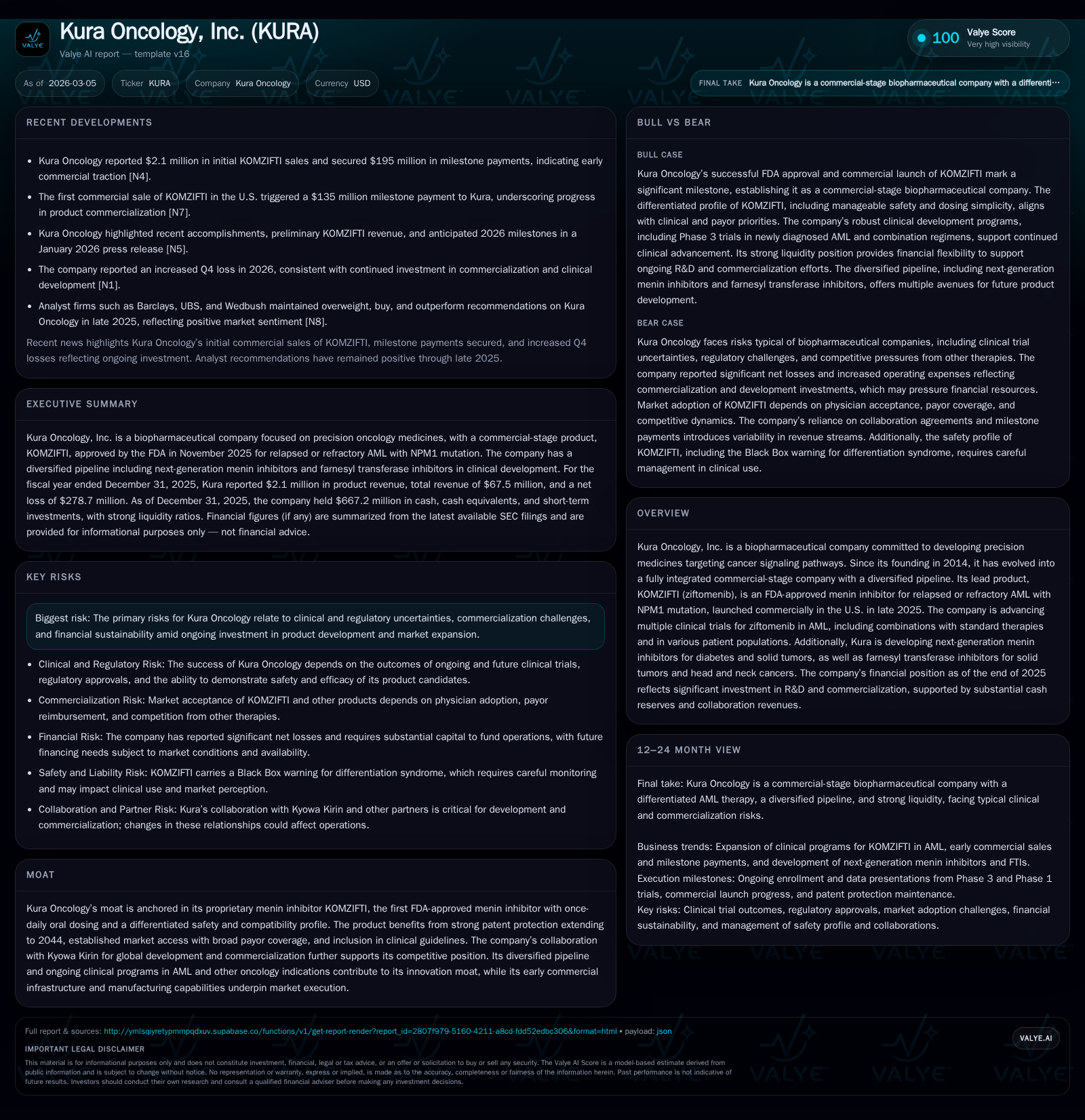
Kura Oncology, founded in 2014, progressed from R&D focus to a commercial-stage biopharma by late 2025 with FDA approval and U.S. launch of KOMZIFTI (ziftomenib), its menin inhibitor targeting relapsed/refractory AML patients with NPM1 mutations. The drug’s differentiated safety profile and market access underpin the company’s moat, supported by collaboration with Kyowa Kirin. Despite initial commercial revenues, Kura continues to report deep losses driven by significant commercialization and research investments, reflected in its worsening operating income and cash flow metrics for fiscal 2025. Its diversified pipeline beyond AML, including next-generation inhibitors targeting solid tumors and diabetes, provides future growth avenues yet uncertain due to clinical and regulatory risks.
Company Overview and Historical Performance
Since its inception in 2014, Kura Oncology has evolved from an early-stage research entity into a fully integrated commercial-stage biopharmaceutical company focused on precision medicines addressing cancer signaling pathways. The firm’s technological and scientific cornerstone is the discovery and development of menin inhibitors—specifically targeting acute myeloid leukemia (AML) driven by NPM1 mutations—a niche cancer subtype lacking effective treatments historically.
The milestone event was the FDA approval on November 13, 2025, of KOMZIFTI (ziftomenib), which represents the first orally-administered, once-daily menin inhibitor on the market [S1]. The approval stemmed from results of the KOMET-001 Phase 1/2 trial demonstrating a combined complete remission rate (CR + CRh) of approximately 21% among relapsed/refractory NPM1-mutated AML patients [S1]. KOMZIFTI distinguished itself against competing molecules not only via efficacy but also through an improved safety profile—most notably lacking QTc prolongation black box warnings associated with other menin inhibitors—and ease of co-administration without dose adjustments [S1].
Financially, Kura transitioned from pre-revenue towards initial product sales within the trailing twelve months ending December 31, 2025. This transition coincided with substantial increases in operating losses as commercial infrastructure scaled rapidly alongside sustained investment in pipeline development.
Historical performance (annual)
| FY | Net ($mm) | CFO ($mm) | OpInc ($mm) | Capex ($mm) | Net YoY |
|---|---|---|---|---|---|
| 2025 | -279 | -64 | -304 | 7 | -60.2% |
| 2024 | -174 | 134 | -193 | 0 | -14.0% |
| 2023 | -153 | -125 | 0 | -12.4% | |
| 2022 | -136 | -110 | 1 |
Source: SEC companyfacts cache [F1].
Capital returns and efficiency (annual)
| FY | FCF ($mm) | ROE% |
|---|---|---|
| 2025 | -71 | -160.0 |
| 2024 | 134 | -42.1 |
| 2023 | -125 | -38.4 |
| 2022 | -111 | -32.3 |
Source: SEC companyfacts cache [F1].
Table: Financial summary highlighting widening losses amid commercialization initiation [F1].
The sharp increase in losses (+57% YoY operating loss deepening from -$193M to -$304M) reflects incremental headcount additions, marketing efforts for KOMZIFTI's U.S. launch late in the year, manufacturing scale-up costs transitioning zero-cost inventory into cost of goods sold (COGS), plus continued sizable expenditures on clinical trials across multiple indications [S8][S9]. Operating cash flow swung back negative (-$64M) after positive inflows in prior year due to revenue recognition lagging expenses related to commercialization investments [F1]. Capital expenditures surged by over thirteen-fold to $6.6 million reflecting expanded manufacturing capabilities and infrastructure required for commercial readiness [F1][S18].
Commercialization Catalyst: KOMZIFTI Launch Dynamics
KOMZIFTI is positioned as a first-in-class therapy addressing an unmet need within AML subsets that historically have had limited second-line options following relapse or refractory disease progression [S1]. The product benefits from broad payer coverage secured early post-approval and incorporation into clinical treatment guidelines bolstering adoption potential.
Despite being a pioneer menin inhibitor on the market, Kura’s initial revenues remain nascent given the product began commercial sales only late in fiscal year 2025 [S15]. The company sells primarily through specialty distributors/pharmacies under standard payment terms but must navigate typical oncology product reimbursement complexities including chargebacks, rebates, co-pay assistance programs impacting transaction price netting [S20].
Inventory management presents transitional challenges as zero-cost inventory expensed during R&D phase now converts into COGS at higher commercial production cost basis—a phenomenon that will pressure gross margins initially until greater scale is achieved [S8][S9]. Zero-cost inventory is projected to last until mid-2030 according to internal forecasts, providing some margin stability window post-depletion [S8].
KOMZIFTI differentiates not only on efficacy metrics but safety advantages such as reduced cardiac risk signals compared to peers—critical factors influencing prescribing behaviors among oncologists treating fragile AML patients [S1]. Compatibility without need for dose modification when co-administered with CYP3A4 modifiers also simplifies regimen complexity.
Pipeline Expansion: Beyond Initial Approval
While KOMZIFTI is currently approved for adults with relapsed/refractory AML harboring susceptible NPM1 mutations who lack satisfactory alternatives, Kura Oncology aims to broaden its reach significantly:
- Advancing ongoing trials combining ziftomenib with established AML therapies across frontline/relapsed settings.
- Developing next-generation menin inhibitors intended not only for hematologic malignancies but also exploring indications such as diabetes and solid tumors showcasing cross-indication pathway targeting potential.
- Early-stage development of farnesyl transferase inhibitors targeting solid tumors and head & neck cancers diversifies their portfolio away from AML dependency.
This multi-pronged clinical strategy reflects an ambition to capture wider oncology markets leveraging proprietary modality expertise although each indication carries distinct regulatory hurdles and timelines yet to be crystallized.
Capital Structure and Liquidity Status
Kura Oncology ended fiscal 2025 fortified by substantial liquidity:
- Cash & equivalents standing at approximately $149 million.
- Additional short-term investments totaling around $503 million provide near-term operational runway.
- Current assets exceed current liabilities by a factor of six (current ratio ~6.06), indicative of strong near-term financial flexibility [F1][S14][S16].
Capital structure features $10 million drawn under a $125 million term loan facility maturing November 2027 carrying an interest rate above nine percent (9.15%) during year-end reporting period; repayments are interest-only until May 2027 followed by amortization [S4][S5][S16][S21]. Covenants under this facility restrict encumbrances on intellectual property assets but allow prepayment options offering refinancing flexibility if conditions prove favorable.
Despite revenue generation commencing late last year, persistent high operating losses resulted in widening accumulated deficits nearing $1.2 billion as of December 31, 2025 reflecting cumulative investment scale since founding [F1][S14]. No dividends or share repurchases have been declared or executed indicating capital preservation focus amid commercialization buildout.
Returns Profile and Capital Allocation Outlook
Given recent market debut status for KOMZIFTI revenues amid continued intensive R&D spending across expanded programs plus layered commercial investment costs, Kura’s ROE remains deeply negative (~-160%), aligned with biotech commercialization stage peer norms experiencing substantial upfront capital deployment prior to profitability horizons [F1].
Free cash flow based on latest CFO adjusted for capital expenditures remains negative (-$70.7 million), underscoring dependency on existing capital resources or further financing rounds until positive cash conversion emerges [F1].
Management has not provided explicit guidance or milestones quantifying timeframes to reach profitability targets or peak sales volumes publicly; key catalysts to monitor include further uptake trends for KOMZIFTI both domestically and via potential Kyowa Kirin-facilitated international expansion as well as clinical readouts that validate pipeline efficacy breadth [N2][N3]. Clinical trial progress updates—especially confirmatory Phase II/III outcomes—and reimbursement developments will critically influence commercial traction pace.
Competitive Moat and Risks Summary
The core moat emanates from:
- Proprietary first-to-market status of KOMZIFTI with favorable dosing/safety nuances.
- Patent exclusivity through mid-century coverage.
- Secured market access channels through payor negotiations embedding reimbursement pathways early.
- A global partnership leveraging Kyowa Kirin’s development/commercial infrastructure mitigating regional execution risk.
- Innovative pipeline expanding therapeutic scope enhancing long-term resilience beyond single-product dependency.
Risks remain material:
- Clinical outcomes may vary leading to delays or failures impacting expansions beyond current indication.
- Regulatory changes or competitive entrants could erode market share over time.
- Commercialization dynamics in rare oncology indications entail unpredictable uptake trajectories requiring sustained education/resource allocation.
- Financial runway management must balance aggressive R&D spend versus dilution risks if external capital raising becomes necessary given persistent losses.
Conclusion: A Pivotal Year Sets Stage Amid Financial Challenges
The calendar year closing December 31, 2025 delineated Kura Oncology's critical inflection point—from research-focused biopharma towards commercialization-led enterprise supported by transformational proprietary technology represented by FDA-approved KOMZIFTI. This strategic progression introduced notable revenue streams even as substantial losses widened because of simultaneous scaling of sales/marketing functions coupled with sustained innovation expenditures.
While near-term financial performance underscores typical startup biotech volatility—characterized by negative earnings metrics and cash burn—the strong patent estate plus collaboration-driven global development platform highlight foundational strengths supporting optimism about medium-to-long term growth prospects linked to expanding indications and geographic reach.
Close attention should be paid to forthcoming quarterly updates detailing revenue growth pace for KOMZIFTI alongside pipeline clinical milestones that represent essential drivers defining Kura Oncology's ultimate trajectory toward sustainable profitability within a competitive precision-oncology landscape.
This analysis is based on public disclosures including SEC filings through Q4 fiscal year end December 31, 2025, news reports as of March 2026, and company-provided summaries.
Disclaimer: This is research-only, informational analysis and not investment advice. It may include AI-generated interpretation and general industry context. Always verify important details using primary sources.

Comments