
Kymera's Pipeline Progress: Balancing Clinical Innovation and Financial Challenges
Kymera Therapeutics advances its oral targeted protein degradation platform in immunology, navigating heavy operating losses and strategic collaborations.
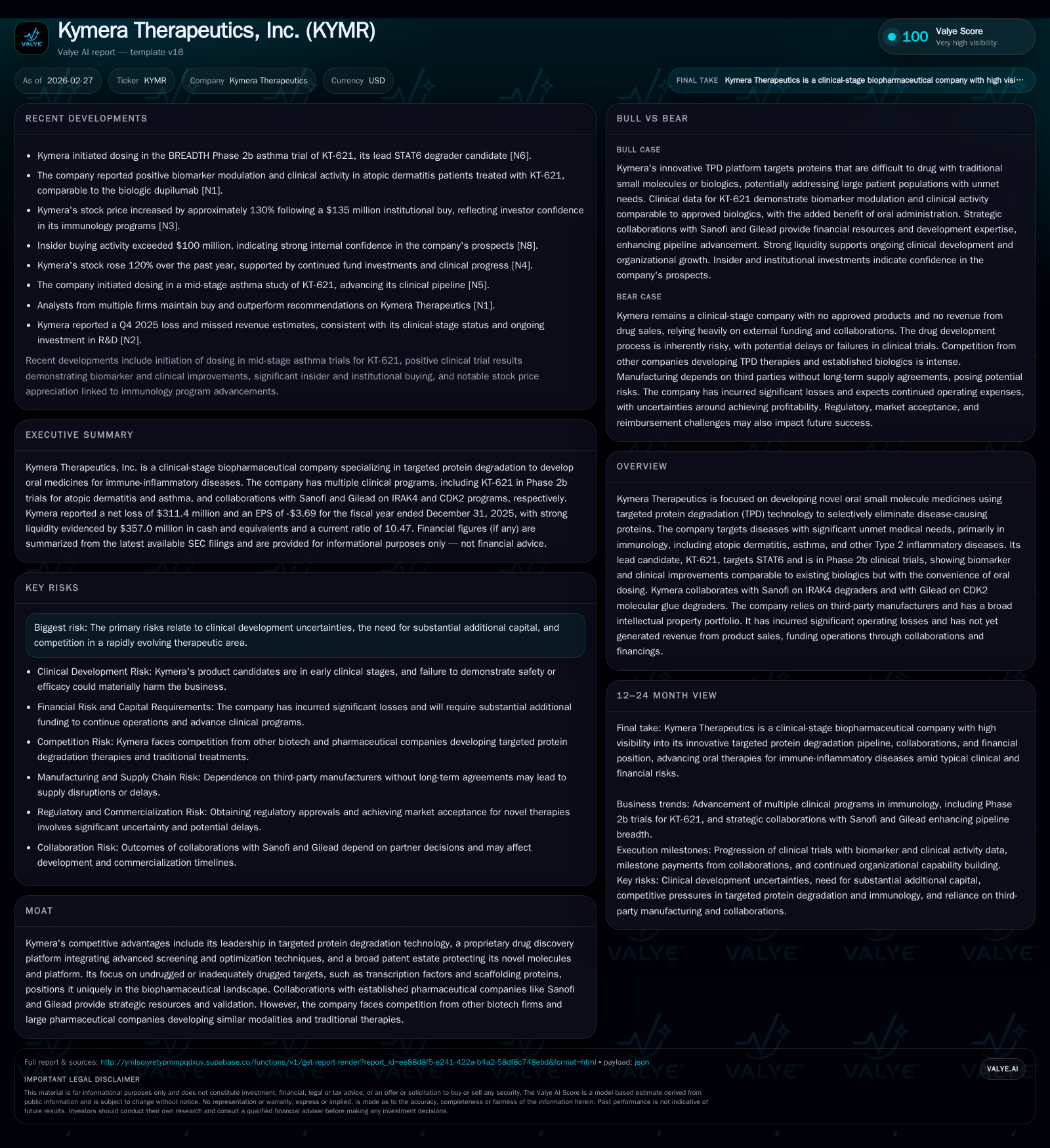
Kymera Therapeutics operates at the forefront of targeted protein degradation (TPD), developing oral small molecule therapies primarily for immune-inflammatory diseases. Its lead candidate KT-621, targeting STAT6, progresses through Phase 2b trials demonstrating promising biomarker and clinical signals. The company’s innovation is supported by prominent partnerships with Sanofi and Gilead, enhancing pipeline depth and validation. Despite accelerating R&D expenditures reflected in widening operating losses and negative cash flows, Kymera maintains a strong liquidity position bolstered by recent financings. Key risks remain from regulatory uncertainties inherent to novel modalities and the need for eventual commercial scale.
Progression from Foundation to Clinical-Stage Innovation
Founded on the pioneering principle of leveraging targeted protein degradation (TPD), Kymera Therapeutics has evolved into a clinical-stage biopharmaceutical company focused on constructing oral small molecule therapies that selectively degrade disease-causing proteins[S1]. This approach aims to overcome traditional drug discovery limitations by engaging the ubiquitin-proteasome system to eliminate proteins difficult to target by conventional modalities such as transcription factors and scaffolding proteins.
Since inception, Kymera has methodically built a diverse pipeline centered in immunology, addressing immune-inflammatory disorders like atopic dermatitis and asthma which presently have large untreated populations or rely heavily on injectable biologics with administration drawbacks[S1].
The progression to clinical stages is exemplified by its lead candidate KT-621, a STAT6 degrader entering late-stage clinical validation. The molecule has progressed through early studies into pivotal Phase 2b trials such as BROADEN2 for moderate-to-severe atopic dermatitis and BREADTH for asthma[N5][N6][S1]. This maturation underscores Kymera’s platform capability to deliver oral agents with biologic-like efficacy but enhanced patient convenience.
Financially, the company’s escalating research efforts parallel rising operating losses indicative of upfront investment intensity typical for biopharma translating novel science into therapeutics[F1].
Financial Trajectory: Operating Losses and Capital Strength
Between FY2022 and FY2025, Kymera’s operating income deteriorated steeply from -$161 million to -$349 million—a near doubling in yearly losses reflective of aggressive R&D spending required to advance multiple clinical programs[F1]. Net income followed a similar trajectory reaching -$311 million for FY2025.
Cash flow from operations (CFO) remained significantly negative at approximately -$233 million in FY2025, signaling ongoing cash burn aligned with clinical development stages but supported by minimal capital expenditure (~$1.45 million) emphasizing limited fixed asset needs as operations focus tightly on drug R&D rather than infrastructure expansion[F1].
The company ended FY2025 with robust liquidity: $357 million in cash and equivalents within total current assets of $871 million producing a strong current ratio of roughly 10.5—indicating sound short-term solvency[F1]. This financial cushioning derives largely from recent equity financings amounting to over $135 million as well as prior capital raises that bolster runway duration sufficient for continued trial execution[N3][N4][S21].
Equity grew substantially from $490 million at end-FY2022 to approximately $1.58 billion in FY2025 driven by stock issuances aimed at funding sustained clinical progression[F1]. However, lacking commercial products means zero revenue generation so far.
Historical performance (annual)
| FY | Net ($mm) | CFO ($mm) | OpInc ($mm) | Capex ($mm) | Net YoY |
|---|---|---|---|---|---|
| 2025 | -311 | -233 | -349 | 1 | -39.1% |
| 2024 | -224 | -195 | -262 | 13 | -52.3% |
| 2023 | -147 | -103 | -166 | 34 | +5.1% |
| 2022 | -155 | -153 | -161 | 3 |
Source: SEC companyfacts cache [F1].
Capital returns and efficiency (annual)
| FY | FCF ($mm) | ROE% |
|---|---|---|
| 2025 | -234 | -19.7 |
| 2024 | -207 | -26.8 |
| 2023 | -137 | -37.2 |
| 2022 | -156 | -31.6 |
Source: SEC companyfacts cache [F1].
All figures sourced from [F1] in USD millions.
Pipeline Focus: Oral STAT6 Degraders and Immunology Targets
Kymera’s therapeutic innovation centers on key targets within validated immune pathways: STAT6, IRF5, and IRAK4[S1]. KT-621 — their flagship oral degrader directed at STAT6 — is progressing through dual Phase 2b studies BROADEN2 (atopic dermatitis) and BREADTH (asthma), initiating dosing milestones reported early 2026[N5][N6].
The novelty lies not only in selective protein elimination but achieving biomarker improvements congruent with injectable biologics while delivering the simplicity of an oral pill regimen[S1]. Given biologics' high manufacturing cost complexity and administration barriers (injections causing patient inconvenience), KT-621 offers potential disruptive value especially if phase trial data confirm safety and efficacy equivalence or superiority.
Additional oral programs tackling IRF5 (KT-579) and IRAK4 are under development leveraging both internal platforms and collaboration-driven co-development pathways[S1][N3]. These molecules aim to broaden disease application scope including other type 2 inflammatory conditions,
Collaborative Partnerships as Growth Catalysts
Strategically, partnerships form an essential component of Kymera’s pipeline acceleration model[S1]. Collaborations with major pharma companies Sanofi (focused on IRAK4 degraders) and Gilead Sciences (working on CDK2 molecular glue degraders) not only provide non-dilutive funding but also bring advanced technical expertise and shared development risk across key immunology modalities[N3].
These alliances enhance research throughput capacity while validating Kymera's proprietary TPD technology within industry paradigms—a critical endorsement facilitating investor confidence reflected in recent equity infusions totaling roughly $135 million intended to boost the immunology focus area[N3][N4].
Such synergistic models balance Kymera’s innovative agility with established pharma's resource depth—an advantageous hybrid strategy amid competitive biotech landscapes.
Future Milestones: Upcoming Clinical Trial Readouts and Expansion
While precise guidance is limited, investor communications stress monitoring forthcoming Phase 2b efficacy and safety results for KT-621 as pivotal near-term catalysts expected during calendar year 2026[N1][S1]. Positive data here would materially derisk the lead program’s pathway toward registration trials.
Parallel advancement in asthma indication via BREADTH trial dosing initiation marks expansion beyond dermatological scaffold into respiratory immunology sphere—diversifying future commercial prospects[N6]. The continuing portfolio evolution anticipates introduction of at least one novel molecular entity into clinical testing annually reflecting sustained pipeline productivity ambitions.[S1]
Analysts should watch regulatory filings post-readout periods for updated enrollment statuses or any amendments that may impact valuation clarity.
Capital Allocation, Cash Flow Dynamics, and Return Prospects
Capital deployment overwhelmingly targets R&D activities consistent with an early-to-mid stage biotech exclusively engaged in drug discovery/development rather than commercialization or infrastructure build-out[F1]. Cash flows indicate persistent negative free cash flow near $234 million for the latest fiscal year defined as operating cash flow less modest capex outlays.
No product sales revenue or dividend distributions exist at this stage while share buybacks are absent reflecting preservation of resources amid capital-intensive development strides.[F1]
Approximate return on equity calculated as net income divided by shareholders’ equity yields negative ~19.7% consistent with industry expectations where significant losses prevail pending successful product launches or exits.[F1]
Hence, investor returns are contingent upon milestone clinical successes followed by regulatory approvals—a high-risk/high-reward biotech profile rather than stable profit generation.
Regulatory and Commercial-readiness Risks in Novel Modalities
Kymera explicitly acknowledges heightened regulatory complexity stemming from its pioneering therapeutic platforms employing targeted protein degradation—a modality still nascent within FDA frameworks[S4][S5][S6][S7][S8]. Regulatory submissions must address safety signals distinct from classical small molecules or biologics given unique mechanism action impacts.
Price setting, reimbursement negotiations face intensified scrutiny given emerging health policy initiatives prioritizing cost containment especially in competitive immunology markets currently dominated by expensive injectable biologics.[S7][S23]
Further compliance challenges arise from extensive healthcare laws governing anti-kickback statutes, fraud prevention, transparency reporting requirements affecting dealings with providers and payors potentially complicating market entry strategies.[S4][S5][S6][S9]
Manufacturing relies heavily on third-party contract organizations subject to FDA inspections under current Good Manufacturing Practices adding operational third-party risk layers.[S13]
Environmental health & safety norms around hazardous materials usage also impose operational cost structures.[S18]
Collectively these factors frame a multi-dimensional commercial hurdle landscape requiring deft execution alongside scientific breakthroughs.
This report synthesizes the most recent SEC filings [F1][S#] alongside contemporaneous market reporting [N#] reflecting Kymera Therapeutics’ trajectory within emerging immune-inflammatory targeted therapies through oral protein degradation modalities balanced against operational financial realities typical of clinical-stage biopharmaceutical innovators.
Disclaimer: This analysis does not constitute investment advice or recommendations but aims to provide a detailed factual review based strictly on documented disclosures without speculative projections beyond provided sources.
Disclaimer: This is research-only, informational analysis and not investment advice. It may include AI-generated interpretation and general industry context. Always verify important details using primary sources.

Comments