
CS Disco’s Growth Hindered by Persistent Losses Amid AI-Driven Legal Tech Competition
CS Disco combines AI innovation and legal domain expertise but faces recurring operating losses and market challenges.
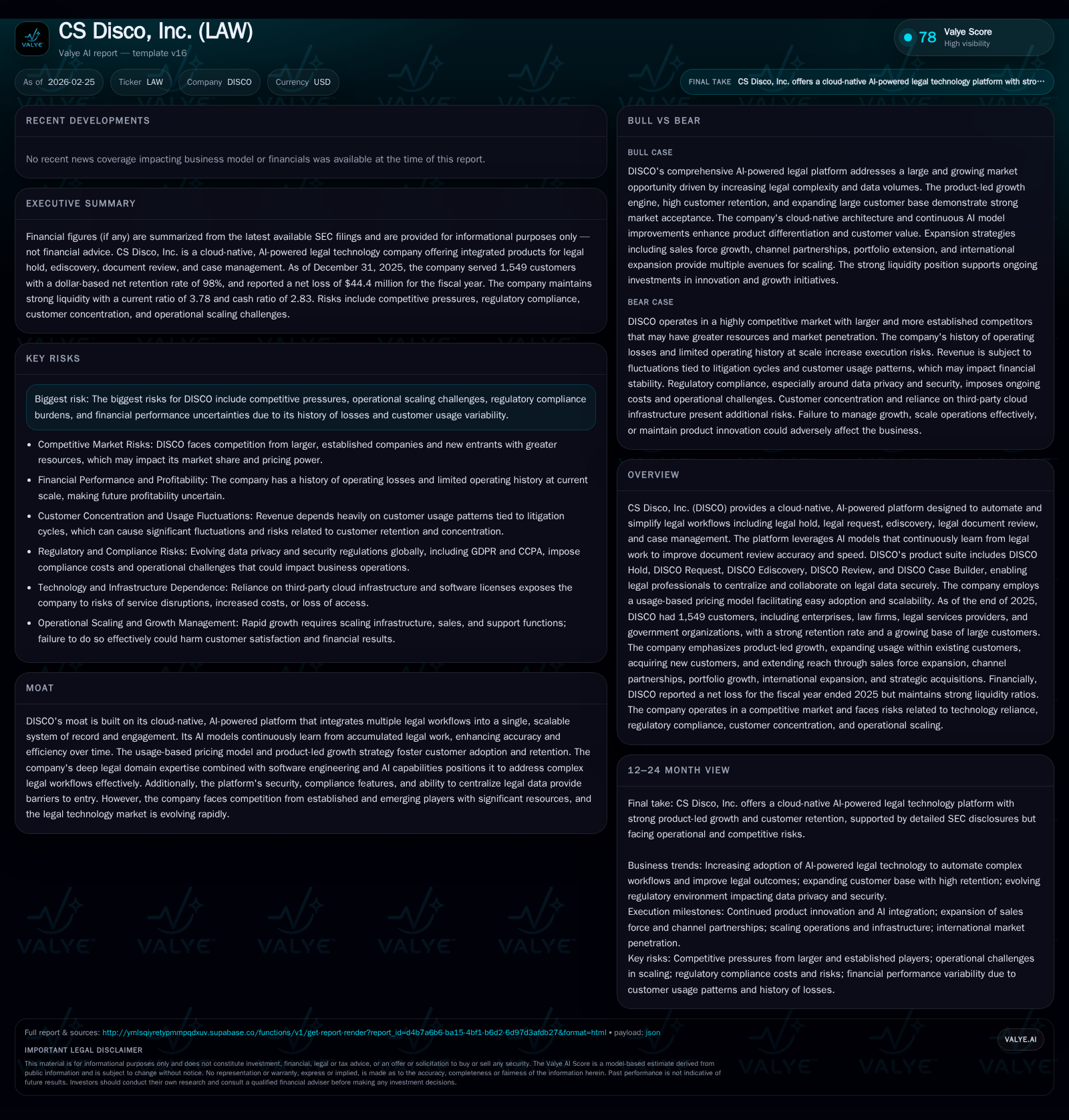
CS Disco, Inc. offers a cloud-native AI platform streamlining legal workflows such as ediscovery and document review, boasting a diverse customer base exceeding 1,500 with solid retention. Despite steady customer growth and product-led expansion, the company has sustained multi-year operating losses and negative cash flows, reflecting the capital-intensive nature of its innovation-driven model. Competitive pressures in an evolving legal technology sector and regulatory complexities pose additional hurdles. Monitoring growth metrics, usage-based revenue progression, and operating leverage will be key to assessing future prospects.
Company Overview
Founded in 2013, CS Disco (NASDAQ: LAW) operates at the intersection of legal services and cutting-edge cloud-native technology driven by artificial intelligence. The DISCO platform is designed specifically for legal departments, law firms, legal service providers, and governmental organizations to automate labor-intensive workflows including legal hold, legal request processing, ediscovery, document review, and case management.
Its core advantage lies in integrating multiple historically fragmented legal processes into a single scalable system enriched by AI models that continuously improve through ongoing use, thereby increasing accuracy and efficiency over time [S1][S10].
As of December 2025, DISCO counted 1,549 customers globally with a strong focus on the U.S., including a growing cohort of 330 customers spending over $100K annually [S5][S6]. This customer expansion aligns with its product-led growth approach underpinned by a simple usage-based pricing model intended to foster broad adoption and predictable cost structures.
Historical Financial Performance
While comprehensive revenue data is unavailable from public filings [F1], several financial trends emerge through operating income, net income, cash flow patterns, and capital allocation measures:
Historical performance (annual)
| FY | Net ($mm) | CFO ($mm) | OpInc ($mm) | Capex ($mm) | Net YoY |
|---|---|---|---|---|---|
| 2025 | -44 | -15 | -48 | 3 | +20.4% |
| 2024 | -56 | -9 | -62 | 3 | -32.3% |
| 2023 | -42 | -26 | -50 | 5 | +40.4% |
| 2022 | -71 | -46 | -72 | 4 |
Note: Omitted columns lack sufficient annual XBRL coverage in the provided tags (need ≥2 annual points): Rev, Div. Source: SEC companyfacts cache [F1].
Capital returns and efficiency (annual)
| FY | Buybacks ($) | FCF ($mm) | ROE% |
|---|---|---|---|
| 2025 | 105000 | -18 | -34.6 |
| 2024 | 127000 | -12 | -37.8 |
| 2023 | 89000 | -30 | -21.0 |
| 2022 | 264000 | -50 | -31.6 |
Source: SEC companyfacts cache [F1].
Notes: Operating Income YoY % based on absolute values; similar approach for Net Income YoY %; Revenue not disclosed [F1]
Operating losses remain substantial but show an improving trend after peaking in FY22 and FY24 interruptions likely tied to intensified investments or market shifts [F1]. Net losses follow suit yet remain significant relative to equity ($128M as of FY25) yielding a negative return on equity around -35% [F1].
Cash flows illustrate persistent negative operating cash flow reaching nearly -$15M in FY25—a deterioration versus prior year—reflecting continued burn needed to fund product development and sales expansion efforts despite roughly stable capital expenditures around $3M annually [F1]. Free cash flow remains negative near $18M.
Capital allocated back to shareholders via repurchases remains trivial at just over $100K annually with no dividend payments disclosed; the decline in shareholders' equity over three years reflects accumulated deficits eroding retained earnings [F1].
Strategic Moat and Competitive Positioning
DISCO’s value proposition centers on its:
- Cloud-native architecture enabling seamless scalability,
- Deep integration across diverse but interrelated legal workflows,
- Sophisticated continuously learning AI models trained on proprietary data accumulated from customers,
- Transparent usage-based pricing that aligns costs with demand,
- Emphasis on security/compliance crucial for sensitive legal information handling,
- Product-led expansion strategy fostering organic usage growth within accounts.
These elements forge its moat especially against legacy providers reliant on fragmented on-premise or less integrated tools [S22]. Nevertheless, the market shows rapid technological evolution fueled further by emerging general-purpose AI agents possibly capable of transformative impacts beyond current offerings [S22][S25].
Competitive dynamics also include well-capitalized incumbents such as Relativity Technologies (including Logikcull acquisition) that may leverage economies of scale or broader service portfolios challenging DISCO's positioning [S25].
Risks Impacting Prospects
DISCO faces several structural risks documented extensively:
- Regulatory Compliance: The company operates in complex jurisdictions with varying rules governing unauthorized practice of law claims given that it is not a law firm but provides alternative legal service technologies [S4][S11][S13].
- Cybersecurity Threats: Given the sensitive nature of client data processed via its cloud platform, security breaches could cause reputational damage and financial liabilities despite proactive governance involving senior officers reporting directly to CFO/Audit Committee overseeing incident response [S1].
- Customer Concentration & Usage Variability: Despite a broad client base, top clients drive disproportionate revenue volumes subjecting DISCO to uneven revenue fluctuation tied heavily to litigation timing cycles affecting usage spikes/dips notably for document review offerings like DISCO Review [S14][S23].
- Emerging Regulatory Frameworks: Data privacy laws evolving globally could impose higher compliance costs or restrict functionality affecting adoption velocity [S12][S18].
- Market Adoption & Competitive Response: Success depends on continuous product enhancement outpacing competitor innovation particularly with respect to advances in AI integrations such as their Cecilia AI platform and new functionalities bundled under Case Builder for usage billing efficiency [S21][N1].
Future Growth Opportunities & Outlook Signals
Management articulates a multipronged growth strategy:
- Deepening penetration within existing clients by expanding footprints across use cases and departments,
- Geographic expansion particularly internationally albeit currently <10% revenue outside U.S.,
- Enhancement of sales coverage aligned with differentiated customer segments,
- Continued investment in next-generation AI capabilities baking them into core product pricing offering accelerating effective deployment of Cecilia AI plus Case Builder under new gigabyte based pricing architecture announced for calendar year 2026 aiming at clarity in cost-value alignment [S5][N1].
Additional drivers include leveraging strategic partnerships with law firms/legal service providers who resell or white-label DISCO offerings thus extending reach indirectly beyond direct sales force capabilities [S10][S21].
Absent explicit public revenue guidance or milestones from recent disclosures or earnings call transcripts [N1], key indicators warrant tracking: net new customer additions especially among large spenders; dollar-based net retention sustaining near current high levels (98%); uplift in average spend per active matter as adoption of bundled AI features grows; operating margin improvement signaling operational leverage gains.
Capital Allocation & Financial Health
Given continuing losses cash flow generation remains negative reflecting ongoing investments underpinning innovation-driven positioning typical for SaaS companies emphasizing AI advancements within enterprise legal tech space [F1],[S10]. Cash position near $19.7 million supports runway but heightens importance on revenue growth acceleration or capital raises.
Capital discipline manifests through minimal buybacks removing little capital from operations while no dividends exist reflecting priority on reinvestment over shareholder returns presently [F1]. The decline in shareholders' equity mirrors unprofitable history necessitating monitoring for deleveraging signs if profitability emerges.
Industry Context — Analysis
Legal technology remains an underpenetrated yet growing segment marked by slow digitization historically relative to other professional services sectors but accelerating now due to regulatory drivers (e.g., eDiscovery mandates), demand for cost predictability by corporate legal departments and sizable efficiency gains offered by AI automation. The ediscovery market itself is projected to expand steadily supported by increasing volumes of electronically stored information entangled in litigation/investigations. In this environment maintaining pace through continuous feature delivery relevant to shifting regulations while managing security/compliance risks is critical — failures here can erode trust rapidly given sensitivity around client confidentiality. Costs structures are generally variable linked closely with usage making revenue somewhat lumpy based on matter lifecycles; therefore scalability without proportional cost increases defines sustainable margin improvements. New generative AI entrants threaten disruption demanding incumbents maintain inventive edge.
Conclusion
CS Disco stands out via its uniquely integrated cloud-native AI platform addressing multiple critical legal workflows through a user-friendly consumption model backed by strong domain expertise. Yet persistent multi-year losses signal challenges balancing rapid innovation investments against achieving operational scale efficiencies. Customer growth trends coupled with high retention provide positive momentum but competitive intensity alongside regulatory risks underscore uncertainty ahead. Financial health requires close monitoring given ongoing cash burn despite narrowing losses. Tracking adoption rates of new platforms like Cecilia AI combined with margin expansion trajectories will illuminate whether CS Disco can translate technological leadership into sustained profitability.
This analysis does not constitute investment advice or solicitation and is based solely on publicly available information as cited.
Disclaimer: This is research-only, informational analysis and not investment advice. It may include AI-generated interpretation and general industry context. Always verify important details using primary sources.

Comments