
Littelfuse Capitalizes on Strategic Acquisitions and Embedded Design to Advance Power Protection Leadership
Littelfuse's Q2 2026 results underscore the impact of recent acquisitions and deeper engineering collaboration in expanding its market footprint amid evolving high-voltage and energy-density demands.
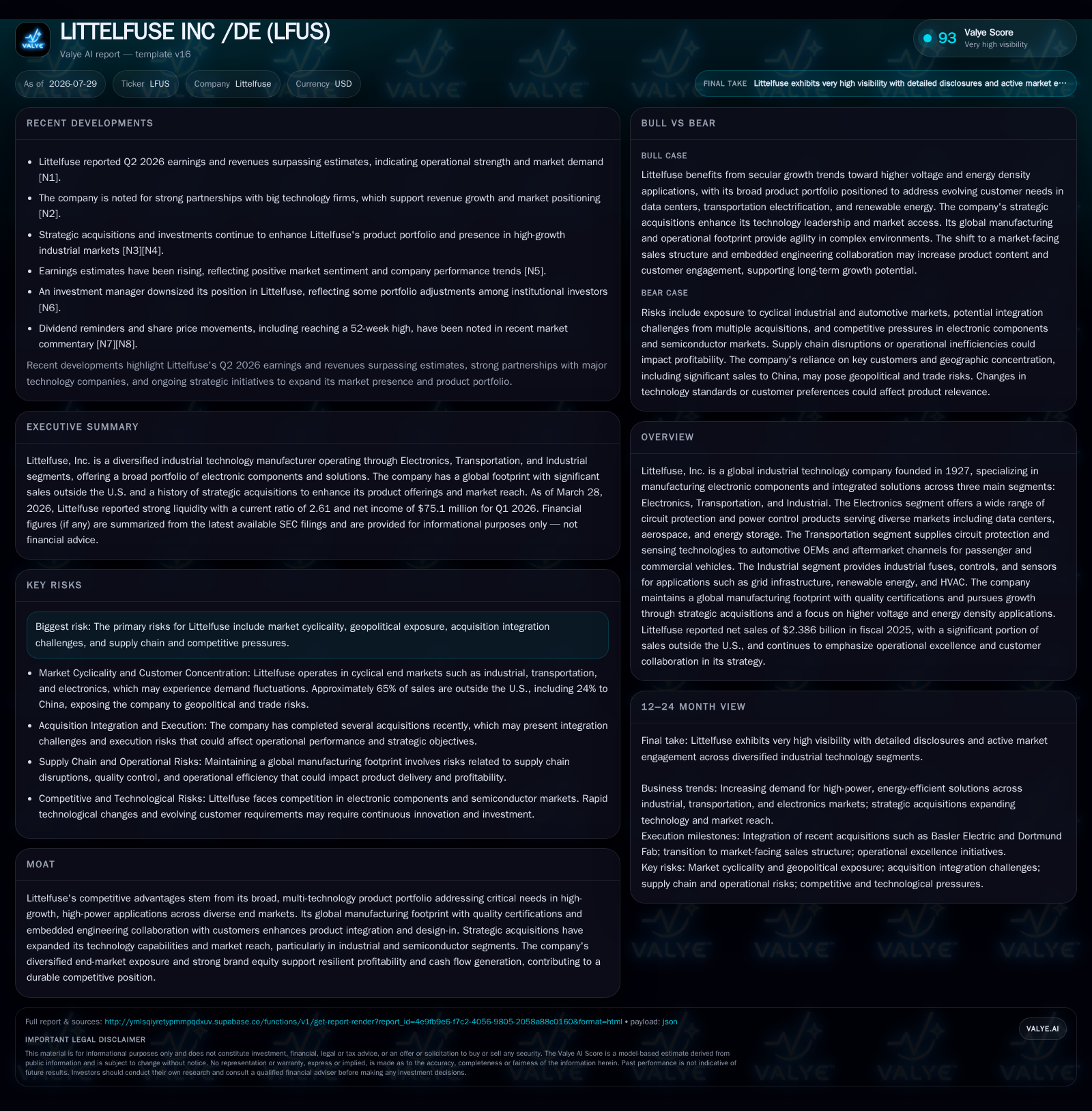
Littelfuse’s Q2 2026 performance surpassed revenue and earnings expectations, driven by the integration of Basler Electric and the Dortmund Fab acquisition, which have enhanced both the scope and technological depth of its Industrial and Electronics segments [S2][S3]. The company’s diversified portfolio across Electronics, Transportation, and Industrial segments, combined with a strategic focus on embedded engineering collaboration, continues to grow product content per platform in high-power applications such as EVs, data centers, and grid infrastructure [S1]. While cyclical demand in automotive and industrial markets poses risks alongside competitive pricing pressures, Littelfuse’s global manufacturing footprint and strong cash position support ongoing organic growth and acquisition opportunities.
Q2 Operating Results Confirm Strategic Acquisition Effects
Littelfuse reported second-quarter 2026 results that outperformed consensus revenue and earnings estimates [S2][N1]. This financial strength was notably underpinned by contributions from the Basler Electric acquisition completed late 2025. Basler adds approximately $130 million in annualized sales focused on electrical control and protection for industrial markets such as grid infrastructure and power generation. Its integration has enhanced Littelfuse’s Industrial segment breadth and deepened their exposure to mission-critical high-voltage systems [S5].
Additionally, the acquired Dortmund wafer fab expanded Littelfuse's internal capacity for power semiconductors integral to high-reliability industrial applications [S2][S3][N1]. The combination of increased manufacturing footprint with Basler’s market presence supports improved supply chain resilience amid global sourcing uncertainties. These factors collectively facilitated a stronger margin profile aided by operational synergies realized from these acquisitions. Moreover, Littelfuse’s reported order backlog confirms stable demand conditions despite certain cyclical headwinds observed in automotive markets
Multi-Segment Business Model Anchored by Technologically Diverse Portfolio
Littelfuse organizes its operations into three reportable segments: Electronics, Transportation, and Industrial [S1]. The Electronics segment encompasses a broad array of circuit protection devices including fuses (both traditional and resettable), varistors, electromechanical switches, semiconductors such as silicon carbide MOSFETs and IGBTs—targeting data centers, aerospace & defense, and energy storage markets. The Transportation segment caters primarily to automotive OEMs and aftermarket channels with sensing technologies and circuit protection designed for passenger vehicles and commercial fleets. Industrial products serve applications in grid infrastructure modernization, renewable energy systems, HVAC controls, and factory automation.
These factors provide Littelfuse pricing power supported by continuous innovation across multiple technological platforms. Pricing reflects differentiated performance benefits vital for safety-critical applications where reliability directly affects system integrity—a distinct barrier against low-cost commodity competition.
Embedded Collaboration Bolsters Design Wins and Expands Product Content per Platform
A cornerstone of Littelfuse’s competitive differentiation lies in embedded engineering collaboration with key OEM customers. This strategic approach involves early integration into product design cycles enabling tailored solutions that increase overall product content within complex platforms [S1][F1]. By working intimately with customers’ R&D teams on future technology roadmaps, Littelfuse can anticipate architectural shifts toward higher voltage or increased power density designs.
R&D investment remains substantial—over $100 million annually—indicating commitment beyond incremental improvements towards next-generation circuit protection technologies capable of addressing advanced system requirements. This facilitates improved design wins metrics indicative of sustained top-line growth potential.
Further embedding also creates switching costs through customized integration efforts enhancing customer retention while supporting premium average selling prices (ASP) justified by superior product quality and performance in critical applications [F1]
Growth Accelerators: Electrification Drivers and Advances in High-Power Applications
Key growth drivers identified include the electrification trend across transportation sectors (notably electric vehicles), ongoing expansion of data center facilities requiring efficient power management solutions, increasing adoption of renewable energy coupled with grid modernization efforts—and accelerating industrial automation across factories demanding smart sensing and energy-efficient components [S1][N5].
Each driver contributes to rising system-level complexity with higher voltage requirements pushing demand for specialized fuses, power semiconductors like silicon carbide MOSFETs, sensors capable of accurate monitoring in harsh environments—all core offerings within Littelfuse's portfolio.
The Basler acquisition strategically complements these trends by expanding presence in high-energy excitation systems prevalent in grid infrastructure—a segment benefiting from regulatory support worldwide for decarbonization efforts. This breadth across interconnected end markets diversifies risk while opening avenues to cross-sell integrated solutions leveraging operational scale including shared manufacturing efficiencies between Basler assets and core Littelfuse sites [S5]
Watchpoints: Addressing Competitive Pressures and Integration Execution Risks
Littelfuse acknowledges risks articulated extensively in its annual disclosures including intense price competition from manufacturers with lower cost structures which could erode pricing power if not offset by technology leadership or customer lock-in. Cyclicality remains a notable factor particularly within automotive OEM spending patterns susceptible to macroeconomic fluctuations causing demand volatility.
Acquisition integration represents a persistent operational challenge—the company must retain key personnel from transactions like Basler while realizing forecasted synergy timelines without disrupting existing customer relationships or supply chains. Supply chain volatility around raw materials risks persisting due to geopolitical uncertainties impacting component availability or cost inflation.
Such external factors combined with internal execution risks require vigilant monitoring as they could materially affect financial outcomes if realized unfavorably [S1][S2]. Geopolitical considerations are critical given Littelfuse’s multinational manufacturing presence spanning sensitive regions with tariff exposures or regulatory changes.
Monitoring Operative Readouts: Pipeline Milestones and Execution Metrics
Post-report indicators warrant close attention for validating ongoing momentum. Particularly relevant are design wins translating into production ramp-ups which materially expand addressable sales volumes over subsequent quarters.
Average selling price trajectories aligned with higher value-added content per platform will confirm pricing strategy execution amidst competitive environments. Manufacturing capacity utilization rates serve as effective barometers reflecting alignment between supply capabilities versus order intake trends.
Finally, changes in order backlog size reveal sales funnel health—growth or stability here signals robust customer engagement feeding future revenue streams consistent with strategic goals outlined during earnings disclosures [N1][S2]
Financial Profile Discussion: Healthy Liquidity amid Ongoing Investment
The current ratio approximating 2.61 evidences strong short-term liquidity which also supports operational continuity against cyclical headwinds or supply chain interruptions.
Gross margins remain stable driven by premium product mix despite input cost pressures documented industry-wide; operating margins benefit from disciplined cost management alongside incremental synergy savings from recent transactions.
Capital expenditures continue targeting manufacturing upgrades including semiconductor fabrication capabilities bolstering strategic priorities around supply chain resilience essential for addressing growth markets effectively.
Overall financial health enables Littelfuse to maintain balanced allocation between organic innovation programs through R&D spend commitments while expanding capabilities externally via acquisitions suggested by recent activity history [F1][S2].
Disclaimer: This analysis is based solely on publicly available company filings (), news reports (), and validated financial data ([F1]). It does not constitute investment advice nor an endorsement of securities mentioned herein.
Disclaimer: This is research-only, informational analysis and not investment advice. It may include AI-generated interpretation and general industry context. Always verify important details using primary sources.

Comments