
Lifevantage Corp (LFVN) — Navigating Operational Headwinds Amid Stable Financial Foundations
Lifevantage Corp maintains profitability and liquidity while confronting revenue and earnings pressures, underscoring the balance between growth investments and shareholder returns in the evolving health and wellness market.
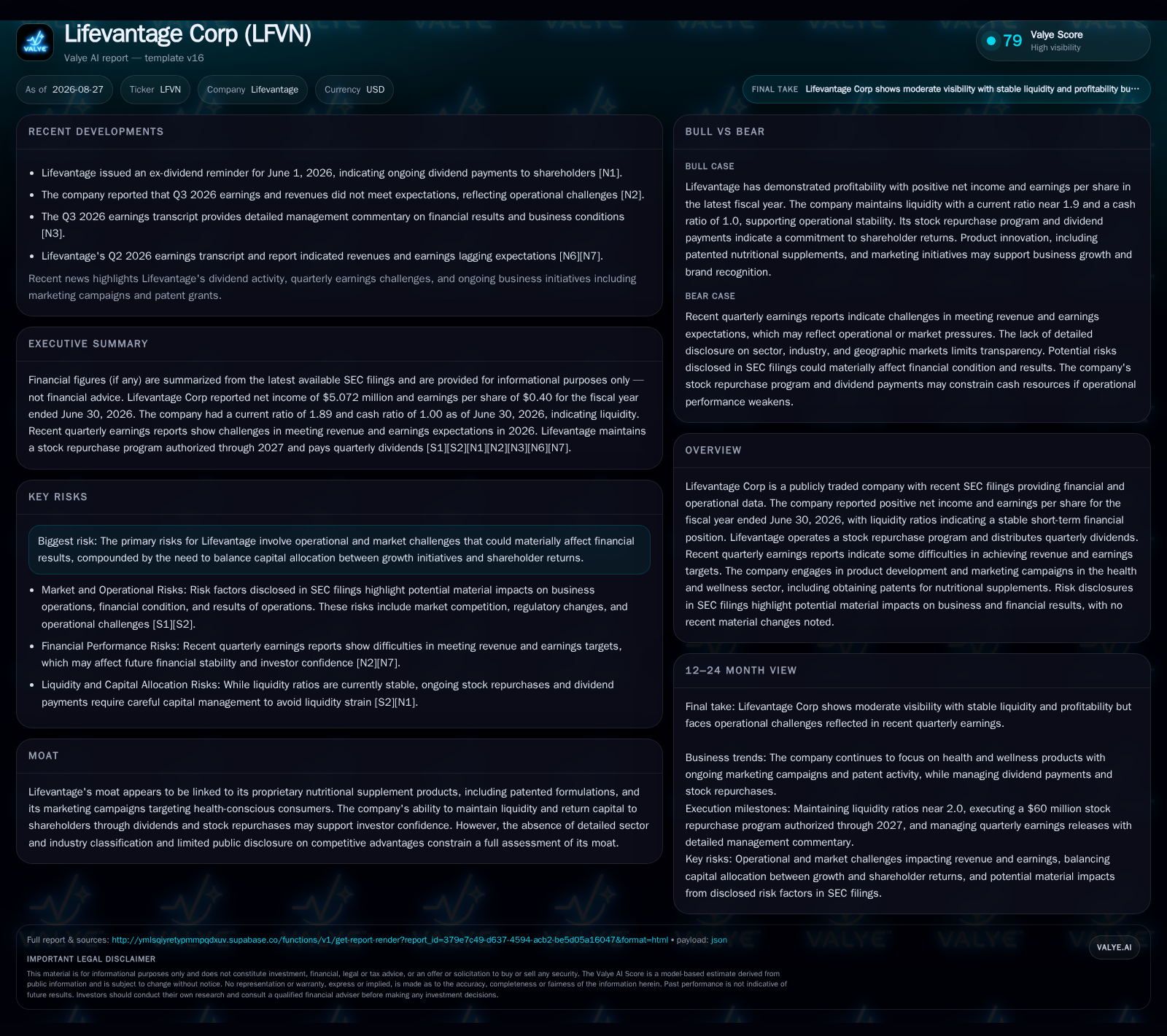
Lifevantage Corp reported net income of $5.072 million and EPS of $0.40 for FY 2026, supported by a healthy current ratio of 1.89 and cash ratio of 1.00. Despite these strengths, recent quarters have seen revenue and earnings lag expectations, reflecting operational challenges. The company's proprietary patented nutritional supplements and marketing initiatives underpin its business model, but limited disclosure and competitive pressures cloud growth visibility. The ongoing stock repurchase program and dividend payments support shareholder returns but require cautious capital management. Key risks include market competition, regulatory shifts, and the challenge of balancing cash allocation between growth and returns.
Lifevantage Corp demonstrates a financially stable profile with profitability and solid liquidity metrics in fiscal 2026, amid an increasingly competitive and dynamic health and wellness sector. While the company’s patented nutritional supplements and active marketing initiatives provide a foundation for differentiation, challenges in meeting recent revenue and earnings targets highlight operational execution risks. The firm’s commitment to shareholder returns through dividends and a sizeable stock repurchase program underscores confidence but necessitates balancing growth investments against capital deployment. Going forward, investors must weigh Lifevantage’s product innovation and financial discipline against execution hurdles and market uncertainties.
Latest Operating Snapshot
Lifevantage Corp reported net income of $5.072 million and basic and diluted earnings per share of $0.40 for the fiscal year ended June 30, 2026, signaling that the company remains profitable despite operational headwinds [S1]. As of that date, the company held current assets of $38.297 million against current liabilities of $20.227 million, yielding a current ratio of 1.89 and a cash ratio of 1.00, which indicates a healthy short-term liquidity position [S1].
However, recent quarterly earnings reports for Q2 and Q3 2026 revealed the company failed to meet revenue and earnings expectations, reflecting potential challenges in sales growth or cost management [N2][N3][N6][N7]. Despite these setbacks, Lifevantage continues to pursue growth through marketing campaigns and securing patents for its nutritional supplements, signaling ongoing product innovation and brand development efforts [N1][N2]. Additionally, the company maintains a stock repurchase program authorized up to $60 million through December 31, 2027, and continues paying quarterly dividends, underscoring a commitment to returning capital to shareholders [S2][N1].
Business Model and Unit Economics
Lifevantage's business model centers on developing and marketing patented nutritional supplements targeting health-conscious consumers. Revenue generation primarily arises from product sales, fueled by direct-to-consumer marketing campaigns and possibly channel partnerships, although specific unit economics and customer acquisition costs are not disclosed publicly. The proprietary nature of its patented formulations suggests some pricing power, contingent on continued differentiation and brand acceptance. However, the absence of detailed volume or customer retention data limits precision in understanding revenue drivers.
Operating leverage likely hinges on the scalability of marketing spend relative to revenue growth and the fixed versus variable cost structure of product manufacturing. The company’s liquidity ratios imply moderate capital intensity with working capital management that supports operational needs. Capital allocation decisions—balancing investments in R&D, marketing, and shareholder returns such as dividends and buybacks—are critical as repurchasing shares and paying dividends consume cash resources that might otherwise fund growth initiatives. If revenue growth stalls or cost pressures intensify, operating leverage could compress margins and strain capital availability.
Moat, Competition and Counterforces
Lifevantage’s moat appears rooted in its array of patented nutritional supplement products and targeted marketing campaigns aimed at a growing wellness consumer segment. Patents can provide a temporary barrier against direct product replication, helping sustain pricing power and customer loyalty. The company’s ability to maintain stable liquidity and execute shareholder-friendly capital returns may bolster investor confidence and reduce financial uncertainty, indirectly supporting its competitive positioning.
However, the competitive landscape in health and wellness supplements is highly fragmented, with numerous established brands and new entrants vying for consumer attention. Without clear evidence of scale advantages, significant switching costs, or network effects, Lifevantage’s moat may be vulnerable to competitors offering similar products at lower prices or with stronger brand equity. Broader industry risks include regulatory scrutiny on supplement claims and changing consumer preferences, which can erode market share and compress margins. The lack of detailed market share data or geographic breakdowns constrains a full assessment of competitive durability.
Bull Case
In the bull case, Lifevantage leverages its patented supplement portfolio and effective marketing to expand brand recognition and customer loyalty, driving sustained revenue growth and margin expansion. Continued product innovation backed by patent protection differentiates the company from generic competitors, enabling premium pricing and improving unit economics. Operational improvements rectify recent execution challenges, allowing the company to meet or exceed revenue and earnings expectations in upcoming quarters.
This scenario would be confirmed by consistent sequential revenue growth, expanding gross margins, and positive operating leverage effects. Increasing customer retention rates, successful new product launches, and effective marketing ROI would further validate this pathway. Conversely, failure to maintain patent exclusivity, slowing customer acquisition, or persistently missed earnings targets would falsify this bullish outlook by signaling competitive erosion or operational weakness.
Base Case
The base case envisions Lifevantage maintaining profitability and liquidity while navigating moderate revenue growth and operational challenges. The company continues incremental product innovation through its patent portfolio and sustains marketing efforts, resulting in stable but unspectacular financial performance. Shareholder returns via dividends and stock repurchases persist but are balanced cautiously against the need to fund growth initiatives.
In this scenario, revenue and earnings fluctuate around guidance with periodic misses offset by management commentary outlining corrective actions. Key validating signals include stable cash flow generation, manageable working capital needs, and steady marketing effectiveness. Falsification would occur if operational setbacks deepen materially, liquidity ratios deteriorate, or the company is forced to cut dividends or halt repurchases to conserve capital, indicating stress beyond manageable levels.
Bear Case
The bear case centers on persistent operational difficulties that prevent Lifevantage from meeting revenue and earnings targets, leading to margin compression and cash flow constraints. Competitive pressures intensify, eroding pricing power despite patent protections, while regulatory scrutiny or adverse consumer trends reduce demand for the company’s nutritional supplements. In this environment, marketing spend fails to generate sufficient customer acquisition or retention, exacerbating top-line weakness.
This scenario would be confirmed by continued quarterly earnings misses, shrinking liquidity ratios, and potential reductions or suspensions in dividends and stock repurchases. A material increase in risk factors disclosed in SEC filings, such as regulatory actions or legal challenges, would deepen downside risk. Conversely, signs of operational stabilization, improved guidance, or successful new product launches would challenge this bearish thesis by indicating turnaround potential.
What Matters Next
Key performance indicators to monitor include quarterly revenue growth rates and gross margin trends, which will reveal whether product innovation and marketing investments translate into sustainable financial gains. Additionally, tracking operating margin and net income progression will shed light on cost management and operating leverage dynamics. Cash flow from operations and free cash flow metrics are essential to assess the balance between capital expenditures, stock repurchases, and dividend payments.
Other important milestones include updates on patent grants or expirations, which influence competitive positioning, and any changes in marketing strategy effectiveness or customer acquisition costs. Transparency around customer retention rates or subscription-like repeat purchase behavior, if disclosed, would be useful metrics to gauge brand loyalty. Finally, management commentary during earnings calls concerning risk factor developments or regulatory environment shifts will provide critical context for evaluating the company’s resilience.
Disclaimer: This is research-only, informational analysis and not investment advice. It may include AI-generated interpretation and general industry context. Always verify important details using primary sources.

Comments