
Lincoln Educational Services' Revenue Surge and Strategic Expansion: Growth Catalysts and Operational Challenges
Lincoln Educational Services reports strong fiscal 2025 growth driven by enrollment gains and new campus leases while navigating regulatory complexities of Title IV funding dependence.
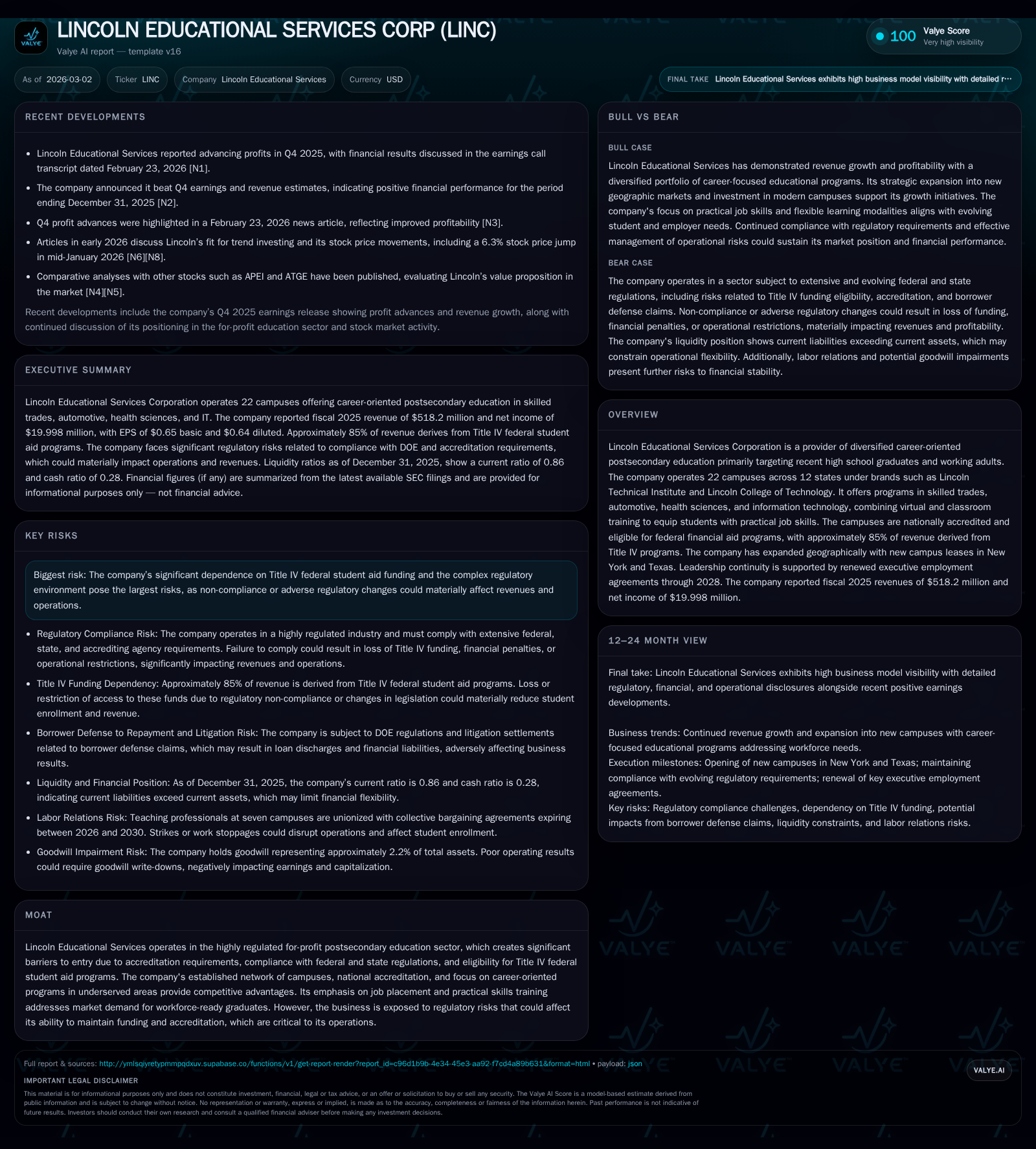
In fiscal 2025, Lincoln Educational Services achieved a notable revenue increase of nearly 18% to $518.2 million, fueled by rising student enrollments and program mix enhancements. The company expanded its geographic footprint with new campus leases in New York and Texas, aligning course offerings with workforce demands in skilled trades, health sciences, and IT. Despite the financial upswing and improving operating income, substantial reliance on Title IV federal student aid programs exposes Lincoln to significant regulatory risks, including litigation outcomes and compliance burdens that could impact future funding eligibility. Elevated capital expenditures invested in campus expansions have generated negative free cash flow, reflecting a strategy balancing growth initiatives with operational leverage constraints. With continuing executive leadership stability through 2028, market participants will monitor regulatory developments and enrollment trends as key drivers of Lincoln’s trajectory.
Strong Recovery in Fiscal 2025: Revenue and Profit Dynamics
Lincoln Educational Services Corporation marked a vigorous rebound in fiscal 2025 with revenues climbing to $518.2 million—a near 18% uplift compared to fiscal 2024—driven principally by improved enrollment yield and a strategic optimization of program mix tailored toward growing career-technical education demand sectors like skilled trades and health sciences [S1, S4]. The company reported average student enrollment reaching approximately 16,622 across its network of 22 campuses spanning 12 states as of December 31, 2025. This headcount expansion contributed notably to top-line performance alongside enhanced operational efficiencies.
Operating income almost doubled from roughly $15.2 million in FY24 to about $30.3 million in FY25 [F1], embodying improved operating leverage despite incremental expenses associated with campus expansions and new program launches. The company’s return from operational softness seen in prior years demonstrates effectiveness in aligning course offerings with workforce skill gaps while also stabilizing tuition revenue streams.
Regulatory Environment and Title IV Dependence: Critical Operational Constraints
Lincoln remains highly dependent on Title IV federal student aid funding which accounted for approximately 85% of its revenue during FY25 [S7]. This reliance constitutes both a protective moat and a substantial risk vector given the rigorous compliance requirements mandated by the U.S. Department of Education (DOE). The company faces extensive regulatory scrutiny encompassing financial responsibility standards, administrative capability thresholds, prohibitions against recruiting inducements based on enrollment success (incentive compensation bans), and meticulous adherence to gainful employment metrics assessing debt-to-earnings ratios for federally funded programs [S7, S9].
Additionally, ongoing litigation linked to borrower defense claims—resulting from an approved DOE settlement encompassing Lincoln’s institutions—introduces material uncertainty concerning loan discharges affecting hundreds of thousands of student borrowers nationally [S9]. Though the Ninth Circuit upheld the settlement's final approval in late 2024, further appeals persist outside Lincoln's involvement; regulatory actions tied thereto may impose liabilities or operational limitations adversely impacting future revenue recognition.
Growth Engines: Campus Expansion and Diversified Program Offerings
The strategic expansion footprint includes recent leases secured for two new campuses: Hicksville, New York (programs slated for late 2026 launch) and Rowlett, Texas—servicing northern Dallas suburbs—with programs anticipated by early Q1 2027 [S1]. These "destination campuses" enhance Lincoln’s competitive positioning by drawing students both locally and from broader geographical catchment areas.
The educational delivery model integrates blended learning combining virtual platforms with hands-on classroom instruction led by experienced practitioners—catering directly to labor market demand for practical skills in automotive technology, health sciences disciplines including allied health sectors, information technology fields addressing digital transformation requirements, and various skilled trades suffering from talent shortages nationwide [N1,S4]. This alignment reflects an emphasis on career readiness driving elevated job placement rates.
Financial Performance Snapshot: Cash Flows, Capital Expenditures, and Operating Leverage
From a liquidity perspective, Lincoln generated operating cash flow of approximately $59.3 million during FY25—a robust increase relative to prior year levels that stood at about $29.3 million [F1]. However, hefty capital expenditures totaling roughly $86.6 million were deployed primarily toward development activities underpinning new campus infrastructure and leasehold improvements necessary for impending program expansions [F1,S5]. Consequently, free cash flow yielded a negative figure near negative $27 million signifying capital intensity increased significantly during this growth phase.
The company’s current ratio at fiscal year-end was approximately 0.86 reflecting narrowly greater current liabilities ($100.7 million) than current assets ($87 million), underscoring tight near-term liquidity management challenges amid investment outlays [F1,S11]. It also highlights operational leverage considerations inherent in fixed cost bases aligned with enrollment fluctuations common within the postsecondary for-profit sector.
Capital Allocation Review: Equity Build-up Versus Lack of Share Buybacks or Dividends
Equity capital accumulated steadily with shareholders’ equity expanding from approximately $178 million at FY24 end to around $200 million as of December 31, 2025 [F1], supporting balance sheet strength despite elevated capex spending. Estimated return on equity hovered near a modest ~10%, indicative of profitable reinvestment yet limited excess cash generation suitable for distribution outside growth needs.
Notably absent are dividend payments or significant share repurchase activity during recent periods; historical buybacks tapered off sharply after FY22 with minor repurchases recorded only sporadically afterward [F1,S6]. This conservative approach likely reflects prioritization of retained earnings reinvestment aimed at preserving capital buffers amidst an uncertain regulatory climate impeding straightforward shareholder return policies.
Forward-Looking Commentary: What Investors Should Monitor
Looking ahead into late 2026 through early 2027 timings prescribed for new campus commencements in Hicksville and Rowlett represent pivotal milestones that will test Lincoln’s ability to scale enrollments profitably while managing operating costs effectively [N1,S1]. Executive leadership continuity is guaranteed through employment agreements extending into 2028 supporting stable governance during this period of operational expansion.
Regulatory developments surrounding borrower defense litigation outcomes remain a major watch point given their potential ramifications on both financial reserve needs and public perception impacting recruitment efforts. Changes proposed under gainful employment rules mandating new accountability metrics could further pressure program eligibility status affecting access to Title IV funds—a crucial risk factor impacting future trajectory [S7,S21].
Market Positioning Amid Industry Compliance Demands
Lincoln maintains competitive differentiation rooted foremost in its national accreditation status enabling full participation in critical federal aid programs alongside a focused curriculum catering directly to workforce skill shortages across underserved markets [S26,N6]. Its blend of legacy destination campuses combined with community-focused locations provides geographic diversity mitigating localized enrollment volatility risks.
Institutional dedication to career-technical education reinforced through partnership pipelines with industry employers fosters sustainable job placement outcomes—an increasingly valued attribute as regulatory agencies scrutinize educational value more intensely under evolving consumer protection laws applicable rigorously to the for-profit postsecondary segment [S9,S26].
Historical performance (annual)
| FY | Net ($mm) | CFO ($mm) | OpInc ($mm) | Capex ($mm) | Net YoY |
|---|---|---|---|---|---|
| 2025 | 20 | 59 | 30 | 87 | +102.2% |
| 2024 | 10 | 29 | 15 | 57 | -62.0% |
| 2023 | 26 | 26 | 33 | 41 | +105.8% |
| 2022 | 13 | 1 | 16 | 9 |
Source: SEC companyfacts cache [F1].
Capital returns and efficiency (annual)
| FY | Buybacks ($mm) | FCF ($mm) | ROE% |
|---|---|---|---|
| 2025 | -27 | 10.0 | |
| 2024 | 0 | -28 | 5.5 |
| 2023 | 1 | -15 | 15.6 |
| 2022 | 9 | -8 | 8.7 |
Source: SEC companyfacts cache [F1]. Note: Data columns reflect full fiscal years ended December; YoY comparisons calculated between available consecutive years.
This analysis is based solely on information obtained from publicly available SEC filings including audited annual reports (Form 10-K), quarterly updates (Form10-Q), earnings call transcripts as well as recent news coverage explicitly cited herein without any speculative extrapolation beyond disclosed facts.
Overall, Lincoln Educational Services shows promising momentum restoring financial performance amid measured expansion strategies suited for evolving workforce education demands but remains encumbered by regulatory complexities inherent within Title IV-dependent for-profit educational institutions requiring ongoing vigilant oversight.
Disclaimer: This is research-only, informational analysis and not investment advice. It may include AI-generated interpretation and general industry context. Always verify important details using primary sources.

Comments