
Invivyd’s Expansion into Viral mAbs Highlights Revenue Growth but Raises Financial Sustainability Concerns
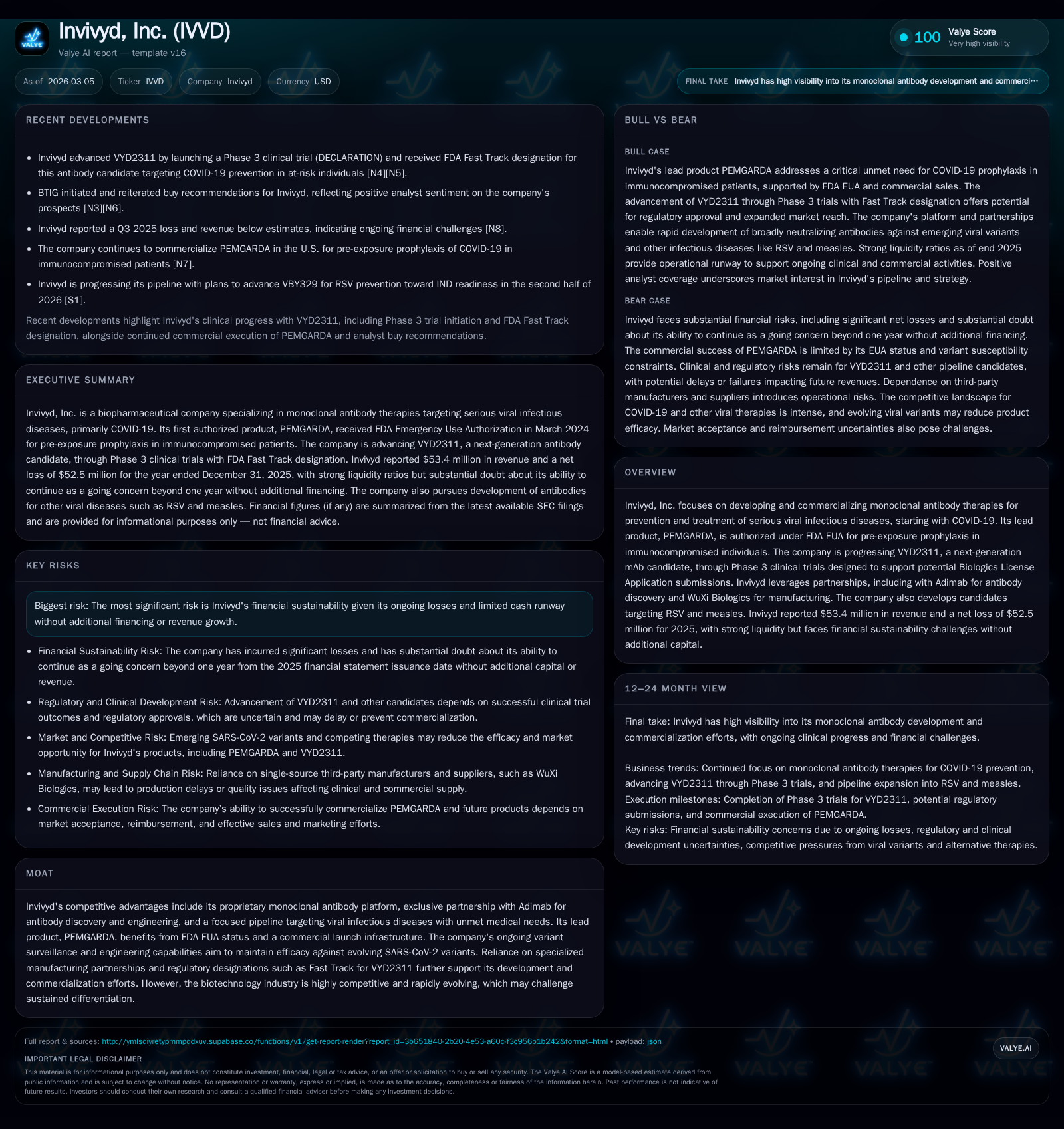
Invivyd targets serious viral diseases with monoclonal antibodies, advancing key candidates amid ongoing operating losses and liquidity constraints.
Invivyd, Inc. reported a more than doubling of revenue in 2025 to $53.4 million driven by commercial sales of its authorized COVID-19 prophylactic monoclonal antibody, PEMGARDA. Despite this progress, the company incurred a net loss of $52.5 million and negative operating cash flow of $58.1 million due to continued investments in R&D and commercialization. Its next-generation candidate VYD2311 is advancing through Phase 3 trials, representing a future growth opportunity. However, substantial doubt remains regarding Invivyd's ability to continue as a going concern beyond one year without additional capital or achievement of revenue milestones tied to loan agreements. Investors should monitor regulatory updates, clinical progress, and capital raising efforts closely.
Company Overview and Business Focus
Invivyd, Inc. develops monoclonal antibody (mAb) therapies targeting serious viral infectious diseases starting with COVID-19. Its lead product, PEMGARDA®, received FDA Emergency Use Authorization (EUA) in March 2024 for pre-exposure prophylaxis of COVID-19 in immunocompromised patients unlikely to mount adequate vaccine responses [S1]. The product's authorization depends on the prevalence of susceptible SARS-CoV-2 variants remaining above certain thresholds.
The company is advancing VYD2311, a next-generation mAb candidate with broad neutralization potency against current SARS-CoV-2 variants. Initial Phase 1/2 trials began dosing in September 2024 to evaluate safety and pharmacokinetics in healthy volunteers; Phase 3 REVOLUTION trials are ongoing aiming to support potential Biologics License Applications [S1]. Additionally, discovery programs target other respiratory viruses such as RSV and measles through partnerships with antibody engineering firm Adimab and contract manufacturer WuXi Biologics.
Historical Financial Performance
Historical performance (annual)
| FY | Rev ($mm) | Net ($mm) | CFO ($mm) | OpInc ($mm) | Rev YoY | Net YoY |
|---|---|---|---|---|---|---|
| 2025 | 53 | -52 | -58 | -56 | +110.5% | +69.1% |
| 2024 | 25 | -170 | -170 | -177 | +14.5% | |
| 2023 | -199 | -173 | -213 | +17.7% | ||
| 2022 | -241 | -220 | -248 |
Source: SEC companyfacts cache [F1].
Capital returns and efficiency (annual)
| FY | Buybacks ($) | FCF ($mm) | ROE% |
|---|---|---|---|
| 2025 | -58 | -21.7 | |
| 2024 | 0 | -171 | -251.6 |
| 2023 | 1000 | -174 | -111.9 |
| 2022 | 4000 | -222 | -67.8 |
Source: SEC companyfacts cache [F1].
Revenue more than doubled year-over-year from $25.4 million in 2024 to $53.4 million in 2025 driven by PEMGARDA sales post-EUA [F1]. Operating losses narrowed substantially by nearly 69% but remained negative at $55.6 million due to ongoing commercialization and R&D spending [F1]. Net losses improved similarly to $52.5 million in 2025 [F1].
Operating cash flow stayed negative at minus $58 million reflecting continued investment in clinical development and commercial infrastructure [F1]. Capital expenditures were modest relative to prior years as spending focused on clinical programs rather than fixed assets [F1].
Equity increased significantly from $67.5 million at the end of 2024 to $241.5 million at the end of 2025 mainly due to equity financings supporting liquidity [F1]. The company's current ratio stood at approximately 7:1 indicating strong short-term liquidity [F1].
Drivers of Historical Growth
Growth resulted primarily from receiving FDA EUA designation for PEMGARDA enabling initial U.S market access for an unmet need among immunocompromised patients [S1]. Commercial operations scaled rapidly including deployment of sales force and supply chain arrangements.
Concurrent clinical progress with VYD2311 provided proof-of-concept supporting late-stage pivotal studies [S1]. Partnerships with Adimab accelerated antibody discovery while manufacturing scale-up through WuXi Biologics ensured readiness for commercialization demands.
Future Growth Prospects
Pipeline Advancement
VYD2311's ongoing Phase 3 REVOLUTION trial represents a key potential catalyst for growth pending positive data supporting full regulatory approval [S1]. Its broad neutralization profile versus emerging variants positions it competitively relative to prior generation mAbs.
Additional pipeline diversification includes early-stage RSV and measles antibody candidates addressing respiratory diseases with significant unmet needs globally; these remain preclinical requiring sustained investment [S1].
Commercial Expansion Potential
PEMGARDA uptake depends on maintaining variant susceptibility below defined thresholds required under EUA conditions [S1]. Expansion opportunities could arise from label extensions or geographic approvals if granted.
Financial Constraints and Risks
Significant doubt exists regarding Invivyd’s ability to continue as a going concern beyond one year absent additional capital or achievement of net product revenue milestones tied to loan facility drawdowns totaling up to $30 million [S1],[S9],[S15],[S17]. Loan covenants restrict additional indebtedness, asset sales, dividends, acquisitions and other actions until financial thresholds are met [S15].
Competitive pressures from evolving viral variants may undermine durability of efficacy necessitating continual pipeline adaptation . Regulatory compliance requirements impose operational complexities especially given EUA status constraints.
Broader biotech sector risks include potential litigation exposure related to patents or securities claims along with healthcare reform uncertainties affecting pricing/reimbursement frameworks [S11,S13,S14,S16].
Returns and Capital Allocation
Invivyd remains unprofitable with a net loss of $52.5 million in fiscal year 2025 leading to an approximate negative return on equity of -21.7% based on net income divided by equity at year-end [F1]. The company has not paid dividends nor conducted meaningful share repurchases in recent years prioritizing cash preservation for growth investments [F1]. Free cash flow continues negative reflecting substantial investments in clinical development and commercialization infrastructure necessary for late-stage programs and market launch execution [F1].
Capital allocation focuses on advancing the pipeline while maintaining supply capabilities for PEMGARDA ahead of broader adoption or regulatory approvals.
Operational Challenges and Risk Environment
Key risks include managing costly clinical development alongside scaling commercial operations; reliance on external contract manufacturers introduces supply chain dependencies; adherence to federal healthcare laws such as Anti-Kickback statutes requires rigorous internal controls ; variant evolution demands continuous surveillance and antibody adaptation; inability to raise capital timely threatens survival given current limited cash runway flagged by auditors [S1,S9,S15,S22].
Competition from established biopharma players developing alternative COVID-19 prophylactics/therapeutics also presents challenges especially if emergency use authorizations expire or new products gain approval post-pandemic phase.
Conclusion
Invivyd demonstrates early commercial traction with PEMGARDA driving over double-digit revenue growth amid transitioning from development-stage losses toward initial market entry during an ongoing pandemic threat landscape. While scientific progress including advanced pipeline candidates like VYD2311 shows promise, the company faces material financial sustainability risks absent near-term capital raises or accelerated revenue ramp. Stakeholders should monitor regulatory milestones around VYD2311 approval prospects, achievement of commercial revenue triggers unlocking committed financing flexibility, and management’s strategic initiatives addressing liquidity constraints within complex healthcare regulatory frameworks. In this dynamic therapeutic niche marked by viral variant shifts and reimbursement uncertainties, Invivyd’s focused platform offers potential but warrants vigilance regarding execution risks inherent in early-stage biopharma commercialization.
Disclaimer: This analysis is based solely on publicly available financial disclosures ([F1]), SEC filings ([S#]), and news sources ([N#]) without any forward-looking projections or investment recommendations.
Disclaimer: This is research-only, informational analysis and not investment advice. It may include AI-generated interpretation and general industry context. Always verify important details using primary sources.

Comments