
Silence Therapeutics Faces Sharply Worsening Losses During Strategic Transition to U.S. Issuer Status
The biotech company's steep decline in financial performance contrasts with a robust liquidity profile and ongoing pipeline development.
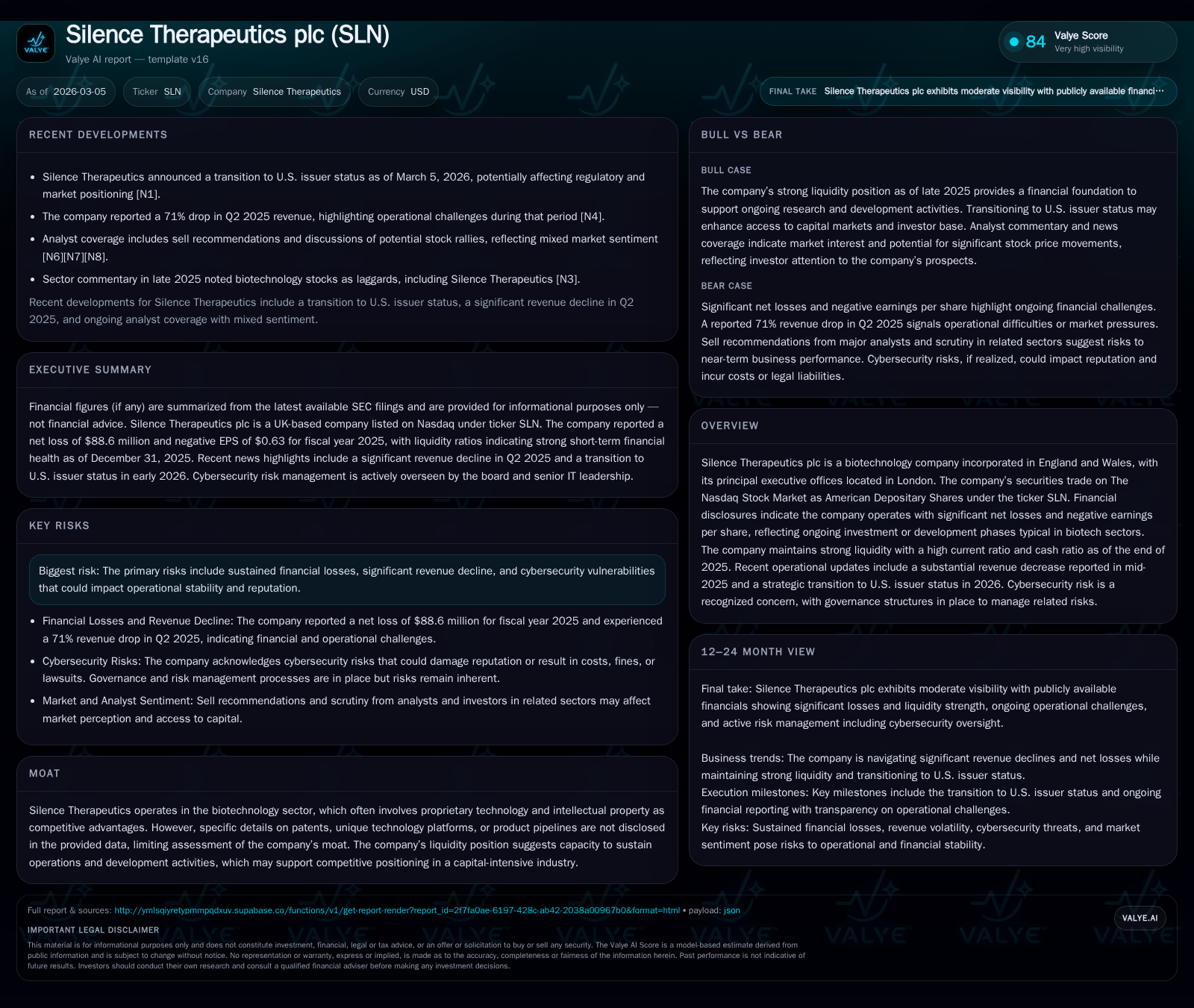
Silence Therapeutics plc, a London-based biotech firm specializing in RNAi therapeutics, reported significant deterioration in operating and net income for 2025, with operating losses widening by nearly 44% year-over-year and net losses almost doubling. Despite a sharp revenue drop previously reported in mid-2025, the company maintains strong liquidity with a current ratio above 8, supporting its continued R&D investments. The recent transition to U.S. issuer status on Nasdaq marks a strategic move expected to enhance capital access amid ongoing cash burn. Cybersecurity risk management remains a key governance focus during this pivotal phase. Going forward, pipeline progress and capital preservation will be critical milestones to monitor.
Company Overview and Historical Financial Performance
Silence Therapeutics plc is a UK-incorporated biotechnology company listed on Nasdaq as American Depositary Shares (ADS: SLN). The company specializes in developing RNA interference (RNAi) therapeutics aimed at rare diseases and severe conditions. Headquartered in London, Silence has been investing heavily in R&D activities during its growth phase resulting in sustained operating losses typical for its sector.
Recent financial disclosures highlight stark earnings declines. Operating income deteriorated from -$63.3 million in FY2024 to -$91.1 million in FY2025, representing a near 44% increase in losses year-over-year [F1]. Net income followed suit with a deepening loss approaching -$88.6 million from -$45.3 million the prior year, almost doubling the negative bottom line.
While the last publicly reported revenue figure dates back to 2020 (£5.3 million), company communications suggest revenues have seen dramatic decreases since then, reflecting perhaps a shift away from partnered revenues or milestone timings within pipeline maturation [F1][N1].
Cash flow metrics mirror operational cash burn trends; operating cash flow improved marginally but remained highly negative at -$62.3 million free cash flow given minimal capital expenditures (capex continued low with $55k spent) [F1]. Yet, substantial liquidity buffers provide operational runway.
Historical performance (annual)
| FY | Net ($mm) | CFO ($mm) | OpInc ($mm) | Capex ($) | Net YoY |
|---|---|---|---|---|---|
| 2025 | -89 | -62 | -91 | 55000 | -95.6% |
| 2024 | -45 | -68 | -63 | 211000 | |
| 2022 |
Source: SEC companyfacts cache [F1].
Capital returns and efficiency (annual)
| FY | FCF ($mm) | ROE% |
|---|---|---|
| 2025 | -62 | -142.2 |
| 2024 | -68 | -33.8 |
| 2022 |
Source: SEC companyfacts cache [F1].
*Year-end revenue last disclosed; later specifics not published clearly.
Future Growth Prospects and Business Developments
The trajectory for Silence Therapeutics centers on advancing its product pipeline through clinical milestones and commercial readiness phases which will drive future revenue generation potential. As of late 2025, enrollment completion for SANRECO Phase 2 trial targeting polycythemia vera with divesiran demonstrates active clinical progress [S18]. Ongoing trials and platform innovation remain critical growth levers.
Company announcements emphasize the strategic shift by adopting U.S. issuer status completed early March 2026 to increase appeal to American investors and facilitate capital market access—a typical move for biotech firms seeking enhanced fundraising channels amid capital-intensive development cycles [N1][S3][S19]. This regulatory and investor relations transition signals an intent to broaden funding sources amid challenging financial results.
Risks such as sustained operational losses without imminent commercial products heighten financing risks; moreover cybersecurity vulnerabilities are systematically managed but remain material given data sensitivities inherent in biotechnology R&D efforts [S7]. Leadership transitions witnessed by CEO departure and temporary appointments reflect an adaptive governance posture possibly recalibrating strategy or operational execution during this pivotal evolution period [S24].
Capital Allocation and Financial Returns
Capital allocation priorities currently skew heavily toward funding research and clinical operations rather than shareholder returns including dividends or buybacks—a norm for developmental-stage biotechs without approved products generating consistent revenue streams . The absence of dividends matches the negative earnings profile while buyback programs appear inactive.
With approximately $11.3 million cash & equivalents offset by modest current liabilities ($13.6 million), the firm's liquidity position is solidified by large other current assets totaling about $119 million—culminating in an exceptionally high current ratio near 8.7 that provides cushion amid ongoing losses [F1]. This liquidity supports runway extension for R&D activities outside immediate external financing needs.
Return metrics such as return on equity are deeply negative around -142% due to widened net losses exceeding declining equity base [F1], underscoring lack of profitability but consistent with developmental-stage biotech sector profiles where value depends heavily on pipeline validation rather than immediate returns.
Governance and Risk Management
Cybersecurity is explicitly recognized as material risk with well-defined governance structures: the board’s audit and risk committee oversees risk management processes implemented by an experienced Head of IT possessing international cybersecurity certifications and over two decades expertise [S7]. Incident response plans engage executive leadership ensuring timely mitigation of cyber threats which could otherwise materially affect reputation or operations.
The company also experienced board reshuffles linked to director resignations focusing on strategic priorities without signs of disagreement—suggesting orderly transitions amid corporate evolution phases [S15,S17,S20].
Outlook: What To Watch Next
Absent formal published guidance for financials or pipeline timelines beyond those reported publicly through disclosures up to Q4-2025 and early-2026 investor presentations [N1][S19][S23], key developments worth monitoring include:
- Clinical progress updates particularly pivotal trial data readouts that could de-risk commercial pathways.
- Further capital raising or partnership announcements leveraging U.S.-based investor appetite following issuer status change.
- Executive leadership stabilization reflecting future strategic priorities.
- Cash burn trajectory versus liquidity reserves signaling sustainability window ahead.
- Any material cybersecurity incidents or regulatory actions impacting business continuity.
In sum, Silence Therapeutics embodies classic high-risk/high-reward biotech characteristics with worsening near-term financial outcomes offset by strong capital buffers deployed into advancing RNAi-based therapeutic candidates under an upgraded U.S.-focused corporate structure poised to facilitate next-phase growth opportunities.
Disclaimer: This analysis is provided solely for informational purposes without any investment advice or recommendation.
Disclaimer: This is research-only, informational analysis and not investment advice. It may include AI-generated interpretation and general industry context. Always verify important details using primary sources.

Comments