
Lindblad Expeditions’ Surge in Adventure Travel Earnings Spurs Strategic Reinvestment
Lindblad’s strong rebound in expedition and land-based segment profitability supports significant investment in fleet and operations despite ongoing leverage challenges.
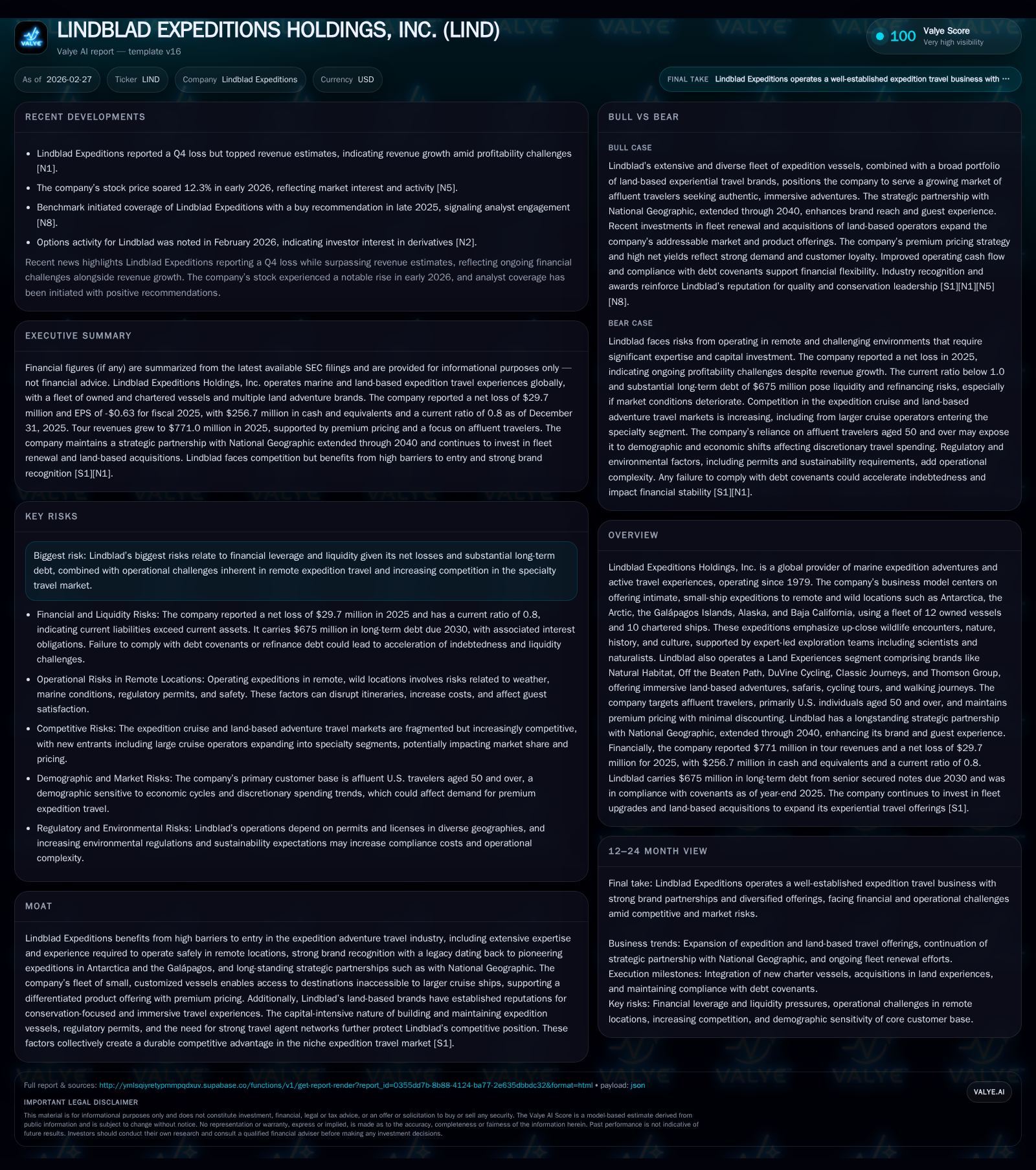
Lindblad Expeditions Holdings, Inc. has demonstrated robust financial improvement from 2023 through 2025, driven by growth across its small-ship expedition cruises and immersive Land Experiences brands. Operating income more than doubled year-over-year in 2025, led by a return to profitability in the Lindblad fleet segment alongside strong margin gains in land adventures. Despite persistent net losses and negative equity reflecting significant debt load, the company generated healthy operating cash flows, enabling increased capex focused on vessel refurbishment and modernization rather than shareholder distributions. Strategic partnerships, especially with National Geographic, underpin premium pricing and distinguished market positioning. Elevated financial leverage and operational complexity in remote expeditions remain critical risks to monitor.
Strong Historical Growth Patterns Reflecting Expedition and Land Experience Synergies
Between fiscal years 2023 and 2025, Lindblad Expeditions demonstrated notable revenue expansion complemented by improving profitability metrics across its two core segments. Total tour revenues climbed from approximately $570 million in 2023 to over $771 million by the close of 2025, translating into a compound uplift bolstered by the marine-based Lindblad expeditions business growing at a mid-single-digit pace annually while the Land Experiences segment outpaced with roughly a quarter-on-quarter increase each year [S1].
Operating income exhibited a pronounced improvement trajectory—emerging from losses within the ship-based segment during early years to reach a positive $7 million contribution in 2025, while the land offerings more than doubled operating profit over this span with enhanced scale and margin improvements. These shifts combined with disciplined cost controls fueled a consolidated operating income rise of approximately 111% year-over-year through 2025 reaching $45.5 million [F1], [S1].
Adjusted EBITDA followed a similar upward path reflecting effective operating leverage driven primarily by increased net yields (revenue per available guest night adjusted for commissions) and higher occupancy rates aboard their intimate fleet of vessels alongside enhanced utilization of land tour capacity.
Historical performance (annual)
| FY | Net ($mm) | CFO ($mm) | OpInc ($mm) | Capex ($mm) | Net YoY |
|---|---|---|---|---|---|
| 2025 | -30 | 112 | 45 | 48 | +4.7% |
| 2024 | -31 | 92 | 22 | 34 | +31.6% |
| 2023 | -46 | 25 | 11 | 30 | +59.1% |
| 2022 | -111 | -2 | -63 | 38 |
Source: SEC companyfacts cache [F1].
Capital returns and efficiency (annual)
| FY | FCF ($mm) | ROE% |
|---|---|---|
| 2025 | 64 | 10.4 |
| 2024 | 59 | 12.3 |
| 2023 | -5 | 20.3 |
| 2022 | -40 | 61.0 |
Source: SEC companyfacts cache [F1].
Table: Annual Financial Summary for Lindblad Expeditions Holdings (FY2023-FY2025) drawn primarily from SEC filings and company data [F1], [S1]
Operational Performance Breakdown: Ship-Based vs Land-Based Segments
Disaggregating financial results reveals how Lindblad’s ship-based segment reversed recent losses into a positive operating contribution of $7 million for FY25 after a negative swing in prior years (-$2.9 million in FY24), helped substantially by increased capacity deployment during peak Arctic/Antarctic seasons and improved yield management strategies around itineraries impacted by weather and wildlife migration patterns [S1]. The smaller-sized vessels specialized for these remote destinations offer access denied to larger cruise lines but necessitate meticulous scheduling to maximize occupancy without discounting—an attribute that maintains yield integrity.
Meanwhile, the Land Experiences segment delivered stronger margin progression with operating income of $38.4 million (+57% YoY), capitalizing on brands such as Natural Habitat, Off the Beaten Path, DuVine Cycling, Classic Journeys, and Thomson Safaris which focus on immersive cycling tours, safaris, walking journeys—all curated for the discerning affluent clientele primarily aged over fifty years from U.S markets [S1]. The direct-to-consumer sales channel dominates bookings (~90%) supported further by top-tier travel consortiums offering incentive-aligned agent partnerships like Virtuoso granting access to affluent clientele aligned with experiential luxury trends [S18].
This bifurcated yet synergistic model—leveraging specialized expedition cruising alongside scalable land tours—underpins Lindblad’s premium pricing power explicable through high net yields sustained even during seasonal fluctuations.
Revenue Drivers and Margin Expansion: Premium Pricing and Occupancy Trends
Fundamental drivers of revenue increases between FY23-25 include enhanced geographic diversification of itineraries responding dynamically to nature-based signals such as Arctic ice melt timing or Serengeti migration windows enabling suitable scheduling that optimizes guest experiences while maintaining exclusivity.
Co-branding arrangements with National Geographic since inception have been instrumental—not merely augmenting marketing reach but lending authoritative scientific credibility that justifies premium price points while opening distribution through Nat Geo’s internal travel divisions; this partnership was recently expanded further enhancing cross-market sales channels [S1], [N1]. It also advances access to exclusive exploration tools onboard including submersible vehicles or customized polar rovers thereby differentiating the product offering vis-à-vis peer expedition providers.
The relatively limited guest capacity per vessel imposes natural scarcity supporting Lindblad’s yield management ethos which eschews discounting prevalent among mass-market cruise lines focused on volume growth instead favoring steady occupancy paired with higher spend per cabin.
Liquidity and Leverage: Navigating Debt Structure Amid Net Losses
Despite sustained net losses around $30 million annually, Lindblad maintains strong operational cash flow generation—$111 million CFO noted for FY25 representing over a fifth increase compared with prior year despite negative equity of approximately −$285 million reflecting substantial debt levels on balance sheet ([F1]). Available cash balances of nearly $257 million provide a liquidity buffer though constrained current ratio (~0.8) underscores working capital pressures derived largely from unearned passenger revenues recorded as liabilities until voyage completion.
In August 2025, Lindblad completed strategic refinancing issuing $675 million senior secured notes at an interest rate of 7%, replacing previous credit facilities with less favorable terms while extending maturity profiles out to September 2030; additionally, revolver commitments were increased from $45 million to $60 million though remained undrawn at year-end reflecting currently sufficient liquidity position ([S4],[S5],[S6]). This new debt structure brings covenant restrictions limiting incremental indebtedness or dividend payouts which are prudent given existing leverage risks.
The company faces non-trivial interest expense obligations (~$45 million annually), which despite improved EBITDA coverage demands continued rigorous cash flow discipline including vigilant monitoring of covenant compliance metrics amid evolving market dynamics ([S10],[S11]).
Capital Allocation Strategy: Capex on Fleet Upgrades versus Limited Shareholder Returns
A clear priority identified is investment back into the fleet—capex rose sharply by over forty percent year-over-year reaching almost $48 million in FY25 relative to $33 million previously ([F1]), focused particularly on refurbishments of recently acquired National Geographic Defina and National Geographic Gemini vessels operating predominantly in high-profile ecotourism locations such as the Galápagos Islands ([S21]).
No dividends were declared nor shares repurchased during FY25 although a Board-authorized repurchase plan remains with about $12 million capacity unused implying capital allocation favors enhancing long-term asset value poised for sustained demand inflows over near-term shareholder returns ([S8]).
This strategy leverages operating leverage benefits inherent in fixed asset upgrades counterbalancing aging vessel maintenance requirements against newbuild or retrofit demand necessary to maintain competitive advantage within regulatory frameworks governing expedition vessel safety and environmental standards internationally.
Forward Outlook: Growth Prospects Fueled by Strategic Partnerships and Market Demand
Management signals expansion plans hinge upon itinerary innovation including introduction of new routes attuned to shifting climatic or wildlife migration phenomena ensuring continuous refreshing of customer offerings aligned with core values of meaningful exploration ([N5],[S28]). This is expected to deepen loyalty among their primary demographic—affluent U.S.-based travelers aged fifty-plus seeking authentic active travel experiences uniquely accessible via Lindblad’s intimate vessel footprint.
The strategic alliance expansion with National Geographic remains a cornerstone facilitating co-marketing synergies plus scientific legitimacy reinforcing pricing resilience especially amid rising competition within experiential luxury travel subsectors ([N5]). Backlog demand indicators show cautiously optimistic booking trends highlighting sustained consumer appetite post-pandemic recovery phases though subject invariably to macroeconomic headwinds affecting discretionary travel budgets ([S28]).
Critical Risks: Leverage, Competition, and Operational Complexity in Remote Regions
Financial leverage constitutes a pivotal concentration risk—significant long-term debt coupled with ongoing net losses impose refinancing risks should capital markets tighten unexpectedly or cash flow deteriorate ([S7],[S10],[S16]). Covenant breaches could precipitate acceleration events amplifying liquidity distress possibilities.
Competitive pressures are intensifying as boutique operators emerge offering tailored adventures potentially challenging Lindblad’s pricing power; nonetheless, high barriers including regulatory permits for protected areas like Antarctica or Galápagos preserve some moat attributes ([S14],[N1]).
Operational complexity escalates given hazardous remote environment navigation requiring robust risk management involving comprehensive insurance protections (P&I Clubs mutual schemes), compliance expenditure impacts deriving from multilayered international laws/regulations underpinning safety/environmental standards enforcement ([S15],[S16],[N1]). Cybersecurity risks also present modern vulnerabilities due to global operations reliance on third-party vendors.
Key Milestones on the Horizon to Monitor
Stakeholders should monitor upcoming quarterly earnings releases for validation of continuing trajectory disclosed at FY25 year-end given Q4 loss presence albeit beating revenue estimates ([N1]). New fleet acquisitions or renovation completions signaling enhancement cadence plus potential further brand integrations could signal growth inflection points ([N4],[S28]). Refinancing windows tied to debt maturities post-2030 notes issuance warrant attention regarding market conditions offering extensions or cost-of-capital reduction opportunities.
Evolving consumer travel sentiment shifts influenced by economic cycles will factor materially into booking patterns focusing on premium experiential travel demand elasticity especially within core demographic cohorts ([N5]). Continuous assessment of covenant compliance status will serve as an early indicator of financial flexibility preservation or emerging stress scenarios impacting operational freedom.
This analysis synthesizes publicly available SEC filings and news reports as of February 27, 2026 pertaining solely to Lindblad Expeditions Holdings Inc., highlighting historical trends, operational dynamics, liquidity posture, growth outlooks, risks, and capital deployment strategies specific to this entity without expressing investment opinions or recommendations.
Disclaimer: This is research-only, informational analysis and not investment advice. It may include AI-generated interpretation and general industry context. Always verify important details using primary sources.

Comments