
Lockheed Martin’s Sustained Defense Prime Leadership Driven by Backlog Growth and Government Spending
Lockheed Martin’s latest quarterly disclosure highlights robust sales growth and backlog expansion amid stable U.S. defense budgets and geopolitical tensions.
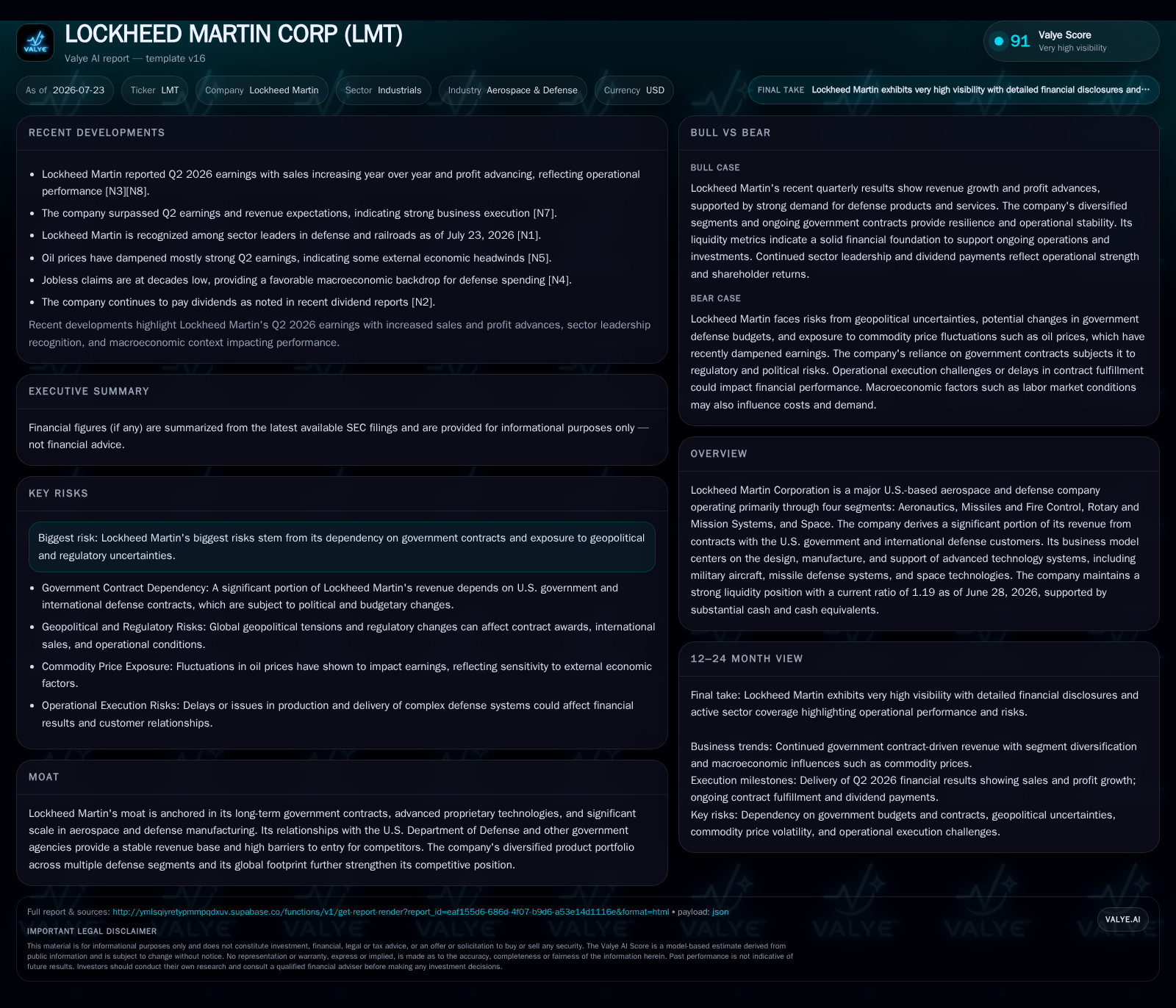
Lockheed Martin posted year-over-year sales growth in Q2 2026, driven by continued strength across its signature aerospace and missile defense programs. The company’s diverse portfolio spanning Aeronautics, Missiles and Fire Control, Rotary and Mission Systems, and Space segments benefits from long-term government contracts with high customer concentration but strong barriers to entry. Despite operational complexity and environmental liabilities, Lockheed’s scale, technological leadership, and contract backlog support resilience against cyclical defense budget uncertainties. Key growth drivers include modernization programs, missile defense expansion, space systems development, and increasing international sales. Balance sheet liquidity remains solid with a current ratio of 1.19, although leverage levels are elevated from capital intensity. Investors should monitor new contract awards, order intake trends, production delivery rates, and government procurement budgets to assess momentum into the second half of 2026.
Recent Operating Update: Q2 2026 Financials and Disclosures
Operating costs for products also rose but at a controlled pace; services saw a slight decline in costs corresponding with the steadier sales base [S2]. Lockheed's earnings beat analyst expectations this quarter amid a macro backdrop of sustained defense spending hikes driven by geopolitical friction [N1][N4].
The company also disclosed involvement in several environmental remediation proceedings related to legacy contamination at current or former manufacturing sites [S2]. While management indicates these exposures are financially manageable at present without material impact on earnings or cash flow projections, they bear monitoring for potential cost escalations.
Business Model Architecture: Prime Contractor Focused on Long-Term Government Defense Contracts
Lockheed Martin operates predominantly as a prime aerospace and defense contractor selling advanced military hardware and systems integration services primarily to U.S. federal agencies—the Department of Defense (DoD) being the largest customer—and international allied governments under Foreign Military Sales (FMS) arrangements [S1]. Revenue is generated through a mix of long-term fixed-price and cost-plus government contracts characterized by substantial upfront R&D investment followed by multi-year production and aftermarket support phases.
Lockheed’s four main business segments—Aeronautics (aircraft), Missiles and Fire Control (missile defense suites), Rotary and Mission Systems (rotorcraft, sensors), and Space (satellite/space launch)—combine to offer customers an integrated portfolio of air, land, sea, and space military capabilities [S1]. Customers value Lockheed’s system integration expertise paired with proprietary technology platforms offering mission-critical performance underpinned by high reliability standards.
Revenue mechanics depend largely on winning new contract awards effectively replacing expiring orders within a sizeable production backlog that serves as multi-year revenue visibility—a critical KPI for the company [S1]. Margins derive from successful execution against contracted unit volume plans while managing cost overruns inherent in complex fixed price projects. Services tend to provide steadier recurring revenue streams through aftermarket sustainment contracts.
Industry Structure and Competitive Positioning Among Aerospace & Defense Primes
The aerospace & defense industry is defined by high entry barriers including capital intensity, technological complexity, stringent regulatory compliance especially for export controls, and deep government relationships requiring extensive security clearances. Lockheed Martin is among a duopoly/quadripoly of prime contractors sharing dominance with Boeing Defense, Raytheon Technologies, Northrop Grumman, and General Dynamics.
Lockheed's moat derives from:
- Long-term entrenched contracts with DoD often covering entire weapon platforms.
- Proprietary technology in stealth aircraft (e.g., F-35), advanced missile systems (PAC-3), digital fire control.
- Scale advantages enabling broad portfolio management across domains reducing customer switching incentives.
- Global footprint providing diversified foreign military sales exposure albeit still concentrated in Western-aligned governments.
Comparatively, peers vary in commercial aerospace exposure which Lockheed minimizes focusing on defense sectors helping stabilize revenues versus cyclicality seen elsewhere. However, Lockheed shares industry risks including program delays affecting milestone billing timing and cost overruns impacting profitability.
Growth Drivers: Backlog Expansion Amid Geopolitical Tensions & Modernization Programs
Several structural demand drivers underpin Lockheed’s business outlook:
- Defense Budgets: Elevated geopolitical instability globally drives sustained U.S. defense budget appropriations maintaining or increasing procurement volumes especially for next-gen fighter jets (F-35 upgrades), missile defenses amidst regional threats like China or Russia.
- Modernization Programs: Ongoing need for replacement of aging aircraft fleets combined with new capability demands for digital warfare effectiveness fuels steady contract awards across all segments.
- Space Segment Opportunity: Expansion of military space exploration satellites along with commercial satellite launch demand enhances growth prospects especially given Lockheed’s heritage in NASA partnerships.
- Aftermarket Sustainment & Services: Recurring revenues from platform maintenance yield higher margin streams complementing capital equipment sale cycles.
- International Sales: Foreign Military Sales agreements introduce incremental demand though subject to geopolitical/regulatory uncertainty.
Contract backlog size—a vital KPI—remains robust providing mid-to-long term revenue visibility essential given typically multiyear project timelines [S1][S2]. Success in securing competitive wins during government procurement cycles further fortifies medium-term growth visibility.
Risks & Watchpoints: Contract Dependency & Environmental Exposure
Despite strengths various risks persist:
- Dependency on Government Appropriations: Lockheed's reliance on U.S. federal government spending constitutes a concentration risk exposed to political shifts or sequestration-led cutbacks impacting new contract awards or funding timing.
- Operational Execution Risk: Complex fixed-price contracts particularly for new platform introductions carry potential for costly schedule delays or material cost overruns eroding margins if not carefully managed.
- Geopolitical Regulatory Hurdles: Export controls (ITAR) limit flexibility on foreign sales impacting international growth offset potential; shifts in global alliances could alter procurement patterns abruptly.
- Environmental Remediation: Ongoing legal proceedings related to historical contamination create contingent liabilities that could escalate unexpectedly raising compliance expenses [S2].
- Supply Chain & Production Constraints: Sector-wide supply chain pressures continue posing challenges to meeting delivery schedules on time—critical for contract milestone payments.
Monitoring operational KPIs such as on-time delivery rates alongside governmental budget trajectory indicators will be key gauges for near-term performance stability.
What To Watch Next: Indicators & Milestones Into H2 2026
Upcoming critical factors to track include:
- New Contract Awards Announcements reflecting confidence in pipeline robustness across primary segments.
- Order Intake Levels as an early indicator of sustained demand momentum beyond backlog consumption.
- Production Delivery Rates, especially for flagship platforms like the F-35 program serving as bellwethers for execution health.
- Government Defense Budget Developments, including any congressional appropriation impacts or program funding revisions that could accelerate or delay revenue recognition timings.
- Environmental Liability Updates, assessing progress or escalations in remediation efforts affecting cost outlooks.
- R&D Spend Trends, signaling continued investment discipline balancing innovation leadership versus margin preservation.
Continued earnings releases will likely provide updated segmental guidance that will clarify whether macro tailwinds like geopolitical tensions are translating into tangible contract wins appreciably above historical averages.
Financial Profile Discussion
Lockheed maintains solid liquidity with a current ratio of 1.19 as of June 28, 2026 supported by $3.79 billion in cash and cash equivalents against current liabilities approximating $23.81 billion [S2][F1]. Current assets also encompass sizable contract assets totaling over $16 billion reflective of milestone billings in progress compensating for receivables trimming slightly quarter-over-quarter due to operational billing timing nuances [S2].
Total debt stands near $21.7 billion leading to net debt approximately $17.9 billion after excluding cash balances—typical leverage levels given the capital-intensive nature of defense manufacturing involving sizable facilities equipment investments [F1]. Operating cash flow generation remains healthy benefiting from profitable ongoing operations; depreciation/amortization charges around $798 million mark steady capital asset utilization consistent with long asset life cycles serving sustained production runs [S2].
Monitoring free cash flow conversion against net income will be critical going forward as any deviation could signal pressured cash conversion stemming from working capital volatility or unexpected remediation costs tied to environmental contingencies discussed earlier.
Conclusion
Lockheed Martin continues to capitalize on its entrenched position as the dominant U.S.-based prime contractor across multiple aerospace and defense platforms supported by robust backlog growth amid favorable government spending trends driven by increased geopolitical tension worldwide. The company leverages its scale advantage and technology depth across Aeronautics, Missiles & Fire Control, Rotary & Mission Systems, and Space to maintain diversified revenue sources balanced between products and services solutions underpinned by multi-year contracted production schedules providing revenue visibility uncommon outside its sector peers.
Although countervailing risks from dependency on government budgets remain inherent alongside executional challenges typical within fixed-price development contracts plus legacy environmental remediation obligations necessitating caution—all factors appear factored prudently into current operating models supported by traditionally strong cash flow fundamentals enabling continued investment into R&D pipelines preserving Lockheed’s innovation leadership ensures competitive advantage sustainability through the coming decade where next-generation aerospace technologies remain strategic priorities globally.
Investors should watch upcoming contract award cycles closely alongside governmental budget developments as primary indicators signaling continued strength or emerging vulnerabilities within this cornerstone aerospace prime contractor franchise.
Disclaimer: This is research-only, informational analysis and not investment advice. It may include AI-generated interpretation and general industry context. Always verify important details using primary sources.

Comments