
Franklin BSP Boosts Book Value Through Dual Commercial and Agency Real Estate Lending Platforms
FBRT’s Q2 2026 results show steady equity growth supported by disciplined capital use and expanded multifamily agency lending after NewPoint acquisition.
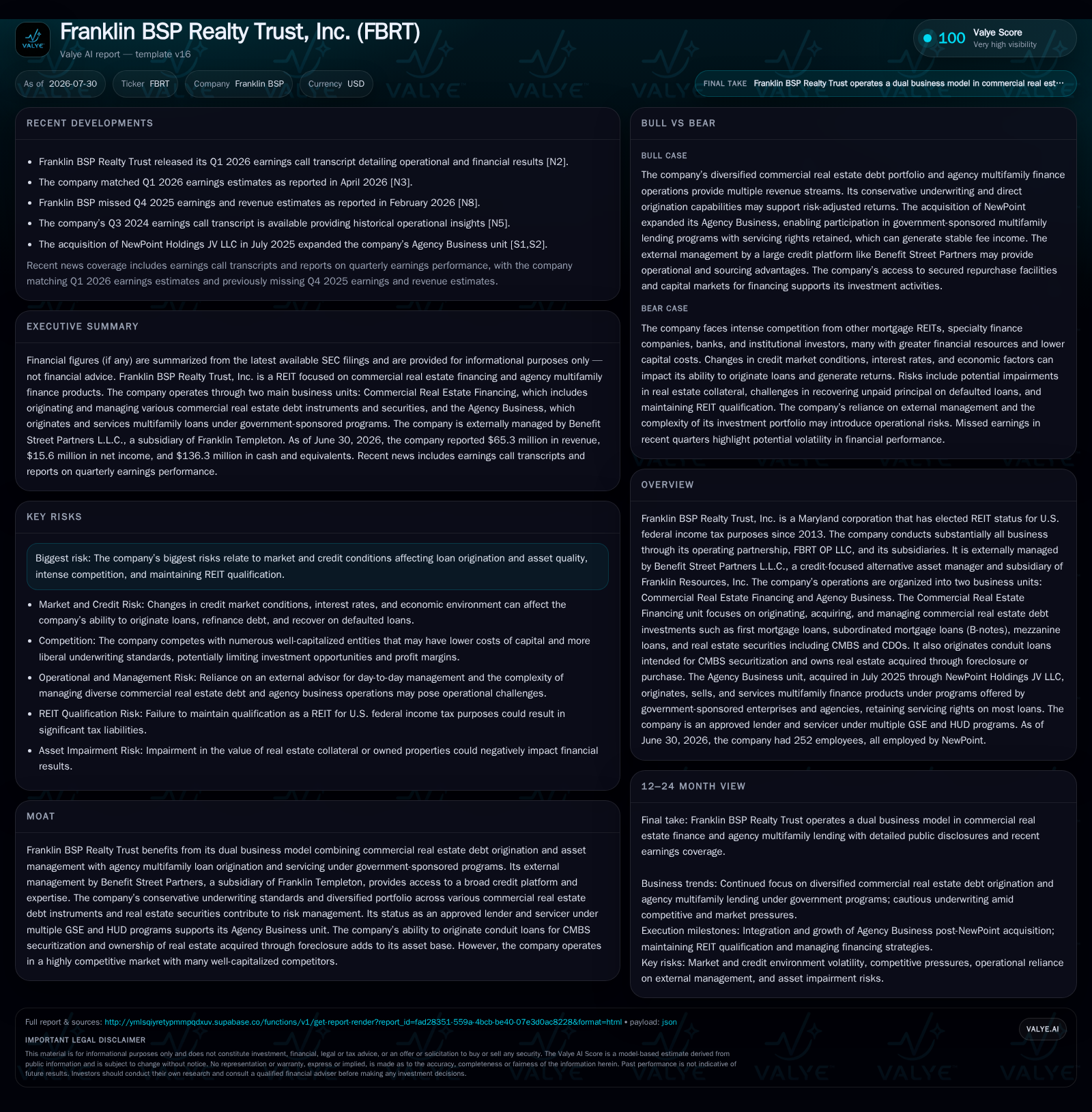
Franklin BSP Realty Trust operates through two distinct units: Commercial Real Estate Financing and an Agency Business formed after its acquisition of NewPoint in mid-2025. The commercial financing arm focuses on originating and managing diverse real estate debt instruments, while the Agency Business delivers multifamily finance products under GSE and HUD programs, retaining servicing rights. As of Q2 2026, FBRT reported modest book value per share growth to $14.51 supported by disciplined capital deployment and risk management under Benefit Street Partners’ external management. The company faces typical mortgage REIT pressures from interest rate volatility, funding environment shifts, and intense competition but is well-positioned through its diversified asset base, access to securitization markets, and agency-approved servicing capabilities.
Recent Operating Update
Notably, FBRT’s Agency Business—formed following its July 2025 acquisition of NewPoint Holdings JV LLC—now constitutes a significant operating segment focusing on originating and servicing multifamily loans under government-sponsored enterprise (GSE) programs offered by Fannie Mae, Freddie Mac, Ginnie Mae, and HUD [S1]. This unit benefits from the firm’s approved lender status under multiple agency designations including Fannie Mae Delegated Underwriting and Servicing (DUS) authority and Freddie Mac Program Plus Seller/Servicer accreditation while retaining servicing rights largely driving fee income stability
Meanwhile, the Commercial Real Estate Financing unit continues to pursue a broad investment mandate encompassing first mortgage loans, subordinate mortgages (B-notes), mezzanine loans secured by ownership interests in property-owning entities, participations in commercial real estate loans, CMBS bonds (including single asset single borrower exposures), conduit loans intended for CMBS securitization via the taxable REIT subsidiary (TRS), as well as foreclosed real estate investments. This diverse mix aims to optimize risk-adjusted returns leveraging the company's expertise in credit origination and structured product management [S1].
Business Model Analysis
FBRT operates as a mortgage REIT focused on generating income primarily through interest earned on originated or acquired real estate debt instruments plus associated fees from loan servicing roles. The firm distributes most of its taxable earnings as dividends to comply with REIT tax qualification rules. Its monetization mechanics involve:
- Interest income: Derived from performing commercial loans across various seniorities (first mortgages to mezzanine debt) and securities such as CMBS bonds.
- Loan origination revenue: Occasionally realized when conduit loans are originated through the TRS entity for subsequent sale into CMBS securitizations.
- Loan servicing fees: From retention of servicing rights predominantly related to agency multifamily originations under GSE/HUD programs which generate relatively stable fee streams.
- Other investment gains/losses: Including recoveries from foreclosed assets or fluctuations in the fair value of held securities.
Capital deployment is often funded through repurchase agreements secured by loan collateral providing short-term leverage typically ranging between 60% to 75% advance rates against underlying principal amounts. To reduce refinancing risk inherent in short-term borrowings being drawn against longer-dated assets, FBRT utilizes CLO issuances as long-term securitized financing vehicles—in 2025 alone it raised approximately $1.1 billion via its BSPRT 2025-FL12 CLO entity—allowing match-funding that supports net interest margin stability over time [S4], [S7].
Risk management is essential given the company’s exposure to interest rate fluctuations affecting borrowing costs versus loan yields; credit risk manifested through borrower defaults or asset impairments; prepayment risk reducing expected interest income; as well as collateral valuation declines that may trigger margin calls on repos requiring additional liquidity or asset sales [S11], [S17]. The firm manages portfolio quality through conservative underwriting via Benefit Street Partners’ credit-focused platform which leverages extensive analytics across complementary credit strategies including high yield corporate lending, structured credit products like CLOs/CDOs, and opportunistic debt funds [S1].
The external management arrangement with Benefit Street Partners L.L.C., a wholly owned subsidiary of Franklin Resources Inc., provides FBRT unique access to specialist knowledge across multiple credit sectors but also introduces dependency risks related to fee alignment and managerial incentives given ongoing advisory fees linked to assets under management plus subordinated performance fees subject to board approval protocols [S21]
Industry Structure and Competitive Positioning
FBRT participates within the broader real estate finance ecosystem classified under mortgage REITs specializing in commercial real estate debt combined with agency multifamily loan origination businesses. Its peers fall into categories such as Annaly Capital Management (focused on agency/non-agency residential mortgage assets), Starwood Property Trust (diversified commercial real estate finance platform), Blackstone Mortgage Trust (commercial real estate debt), Armour Residential REIT (agency residential mortgages), and New Residential Investment Corp (mortgage servicing focus).
Unlike standalone mortgage REITs purely reliant on spread income from purchased pools of mortgage assets or agencies focusing only on residential mortgages backed by GSEs, FBRT blends commercial real estate finance expertise with agency multifamily lending servicing obligations. This hybrid model affords revenue diversification but requires operational complexity given differing underwriting criteria between private commercial loans versus standardized government program products.
Maintaining key regulatory approvals as an authorized lender/servicer for Fannie Mae DUS loans or Freddie Mac Program Plus demands compliance to stringent operational standards that can serve as barriers to entry yet impose ongoing costs and risks if certifications lapse. Similarly, access to capital markets for issuing CLOs or conduits is competitive; disruptions could pressure funding costs or limit asset growth unless alternative financing avenues materialize swiftly [S1], [S22].
Growth Drivers
Growth catalysts for FBRT include expanding commercial real estate lending opportunities as property owners seek non-traditional sources beyond banks constrained by regulatory capital requirements post-financial crises; increased demand for agency-backed multifamily financing supported by demographic trends favoring rental housing; enhanced loan origination volumes driven by robust underwriting capabilities; securitization market liquidity enabling repeat conduit loan sales; strategic acquisitions bolstering scale or geographical reach; innovation within structured credit offering new risk/return profiles; efficient capital recycling enhancing portfolio yield dynamics.
The integration of NewPoint broadens FBRT’s footprint in multifamily finance providing cross-selling potential alongside scale advantages in both government-related loan origination pipelines plus retained servicing fees enhancing recurring cash flow predictability—key in supporting dividend stability amid volatile market conditions [N1], [S1].
Risks and Constraints
Key risks center around interest rate volatility potentially compressing net interest margins if borrowing costs escalate faster than loan pricing adjustments permit; credit deterioration due to market downturns leading to increased delinquencies or defaults hurting distributable earnings; liquidity shortages triggered by margin calls stemming from collateral devaluation necessitating fire sales at depressed prices adversely impacting capital preservation; regulatory changes affecting REIT qualification status or GSE participation status disrupting business continuity; intense competition pressuring originations yields especially within standardized agency product lines possibly eroding return profiles; dependency on external advisor effectiveness impacting asset selection quality and operational execution capability.
Also relevant are refinancing risks inherent in periodic maturities of repurchase agreements or CLO resets which may occur under unfavorable conditions restricting balance sheet flexibility. Additionally prepayment risk can reduce expected hold periods shortening income streams challenging forward dividend coverage assumptions.
What To Watch Next
Investors should monitor upcoming quarterly reports for trends in key KPIs such as loan origination volume growth especially post-NewPoint acquisition synergy realization; loan portfolio yield evolution relative to cost of funds adjusting for prevailing rate trajectories; delinquency metrics indicating early signs of stress particularly across subordinate/mezzanine tranches; performance metrics around retained servicing fee income sustaining its contribution amid housing market cycles; capital raising activity indicating ability to balance growth ambitions with leverage targets notably CLO issuance cadence or equity aftermarket transactions [S2], [S3], [N1]. Updates regarding any material changes in GSE or HUD lender approvals will also serve as important markers given their bearing on future originations.
Financial Profile Discussion
As of June 30, 2026, FBRT maintained approximately $136 million in cash and equivalents—a liquidity buffer supporting collateral requirements—while outstanding total debt figures are not separately reported in the latest filings, reflecting classification nuances and reliance on secured repurchase agreements backed by loan collateral rather than unsecured borrowings [F1], [S2]. Book value per share rose slightly despite a reduction in shares outstanding primarily owing to share repurchases partially offsetting lower equity from other comprehensive losses.
The company targets leverage ratios between one-to-three times book value yet actual leverage fluctuates based on market access conditions particularly revolving facilities’ availability plus CLO issuance timing. Debt maturity schedules underline dependence on maintaining access to capital markets for securitization products ensuring refinancing risk is mitigated without undue distress sales pressures.
Cash generation hinges upon net interest spread preservation reflecting ability to lend profitably above funding costs coupled with stable fee income from servicing activities triggered predominantly by the Agency Business unit generated following NewPoint’s consolidation into FBRT’s operations since mid-2025.[F1],[S4],[S26]
In summary, Franklin BSP Realty Trust sits at an intersection between traditional mortgage REIT models emphasizing yield capture through managed leverage while innovating with government-sponsored multifamily lending expansion leveraging agency relationships. The company’s external management paradigm builds upon Benefit Street Partners’ credit platform strengths counterbalanced by heightened competition risks alongside sector-specific sensitivities such as interest rate volatility coupled with funding market dynamics requiring vigilant balance sheet stewardship moving forward.
Disclaimer: This analysis is based solely on publicly available information including SEC filings dated up through July 29, 2026 (), company disclosures ([F1]), industry context frameworks referenced herein but not cited explicitly as source evidence. It does not constitute investment advice nor research views regarding the purchase or sale of securities.
Disclaimer: This is research-only, informational analysis and not investment advice. It may include AI-generated interpretation and general industry context. Always verify important details using primary sources.

Comments