
Applied Digital Advances AI and HPC Data Center Capacity with Proprietary Cooling Amid Customer Concentration Risks
The company’s pivot to high-performance computing centers reveals growth opportunities powered by proprietary technology but faces concentrated customer and regulatory challenges.
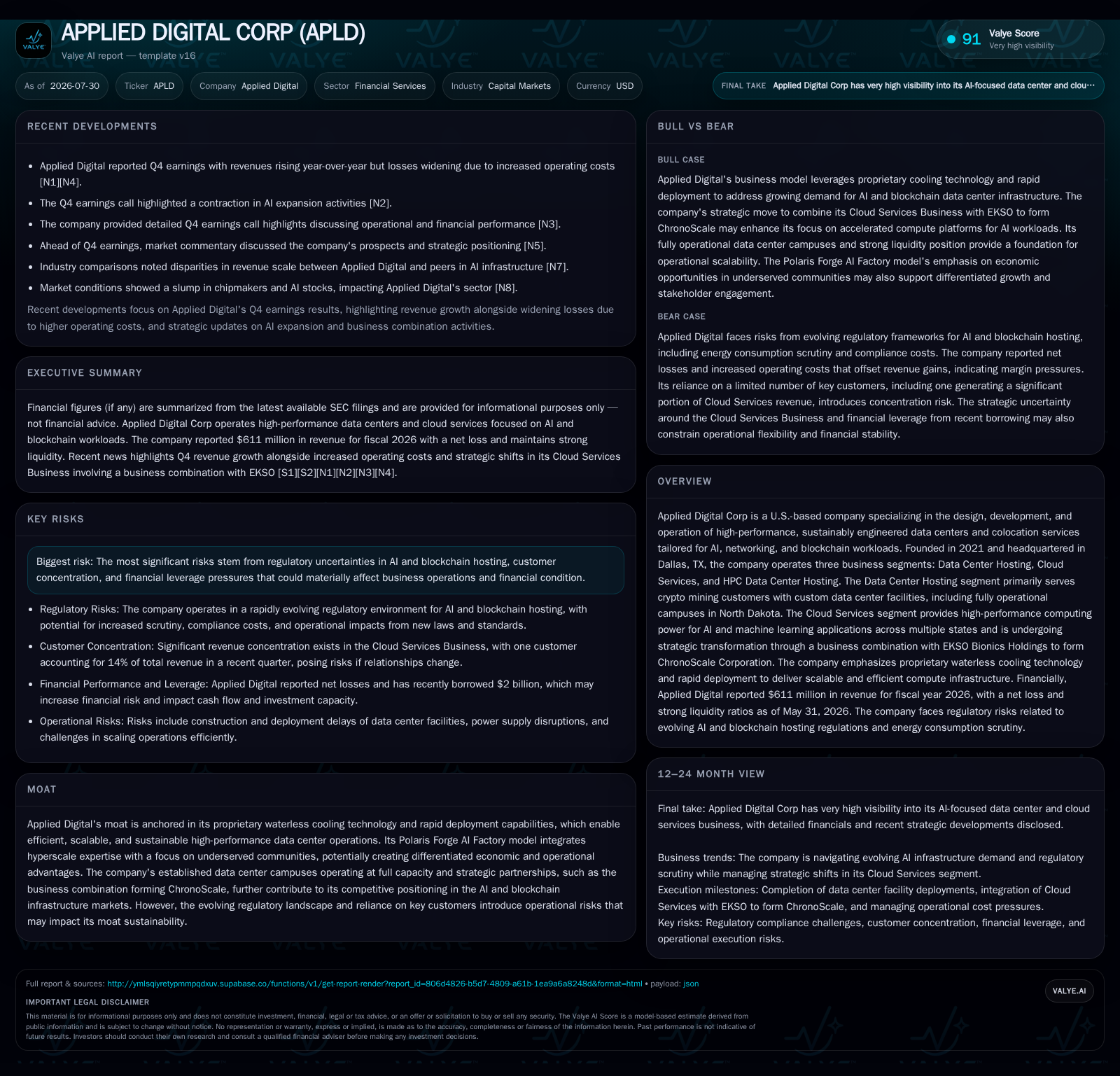
Applied Digital Corp delivered mixed quarterly results reflecting progress in its core HPC data center segment and divestiture of its Cloud Services Business. Leveraging proprietary waterless cooling technology and rapid deployment capabilities, Applied Digital is positioning itself as a specialized provider of AI and HPC infrastructure. However, the firm remains exposed to concentrated blockchain hosting demand, regulatory uncertainties, and capital-intensive development cycles. Its robust liquidity and recent financing activity support ongoing campus expansions amid evolving market dynamics.
Recent Operating Update
Notably, Applied Digital entered into the DevCo Facility in December 2025 to finance new data center construction phases with flexible drawdown options contingent on development milestones [S2]. These financing arrangements underscore the capital-intensive nature of Applied Digital's development cycle aimed at rapidly scaling AI-focused capacity.
In May 2026, the firm completed the divestiture of its Cloud Services Business via a business combination forming ChronoScale Corporation, enabling a sharpened operational focus on HPC data center hosting and traditional blockchain colocation [S1]. This transaction aligns with management's strategy to concentrate resources on proprietary high-density AI factory platforms tailored for hyperscale clients.
Business Model
Applied Digital designs, builds, owns, and operates purpose-built data centers optimized for high-performance computing (HPC), artificial intelligence (AI), machine learning workloads, and blockchain hosting. Revenues predominantly arise from long-term leasing contracts with investment-grade hyperscale cloud providers in the HPC Hosting segment and contractual arrangements with cryptocurrency mining operators in the Data Center Hosting segment [S1].
Its proprietary waterless cooling technology enables efficient thermal management that supports high compute densities while minimizing water usage—an environmental differentiator as data centers face mounting sustainability scrutiny. The standardized "AI factory" platform uses franchise-style design principles facilitating faster deployment (targeting approximately 14 to 18 months per ~150 MW campus) with scalable modularity that helps contain capital expenditure per megawatt of IT load [S1]. These capabilities underpin competitiveness against larger peers that may lack agile buildout flexibility or sustainability advantages.
The business monetizes data center space along with related power provisioning, cooling services, network interconnection access, and ancillary operational services under long-dated lease agreements that confer recurring revenue stability. High leased capacity utilization rates combined with extended contract terms improve revenue visibility and contribute disproportionately to adjusted EBITDA margins despite significant upfront capital intensity.
Industry Structure and Competitive Position
Applied Digital competes within the fragmented but capital-intensive data center infrastructure sector focused on HPC, AI workloads, cloud colocation services, and blockchain hosting facilities. Unlike hyperscale cloud providers such as AWS, Microsoft Azure, or Google Cloud who own large proprietary infrastructure stacks primarily intended for internal consumption or direct customer offerings, Applied Digital targets these hyperscalers as third-party tenants under lease arrangements—positioning as an enabler rather than competitor.
Peers encompass large-scale data center REITs/operators like Equinix and Digital Realty which offer expansive global footprints but whose portfolio mix leans more toward multi-tenant colocation rather than custom liquid-cooled HPC campuses tailored explicitly for AI acceleration. Emerging players such as CoreWeave emphasize specialized AI infrastructure; however Applied Digital's integration of waterless cooling offers operational cost advantages particularly in regions where water availability limits traditional chilled water or liquid cooling modalities.
Legacy blockchain hosting providers comprise a diminishing sub-industry niche facing pronounced cyclicality from volatile cryptocurrency markets. Applied Digital is transitioning this legacy segment toward lower relative importance while expanding HPC offerings backed by contracts with hyperscalers like Oracle at Polaris Forge campuses [S1]. This strategic dual focus maintains near-term revenue diversity while preparing for secular shifts favoring AI workloads.
Growth Drivers
Fundamental growth drivers include explosive increases in AI model training demands stretching compute needs well beyond traditional enterprise workloads. Hyperscalers outsourcing capacity provision foster long-term leasing growth backed by high-quality counterparties delivering predictable revenue streams.
Waterless cooling innovation enhances compute density capability per square foot while reducing operating costs pressured by increasing energy prices and environmental regulations—a competitive edge supporting margin expansion potential. The Company’s ability to proactively secure power-advantaged sites ahead of demand addresses known industry constraints where access to affordable green power substantially influences campus economics.
Additionally, the recent capital raises including senior notes offerings totaling billions enable financing of multiple Polaris Forge campus expansions advancing toward full commercial operation stages—each representing hundreds of megawatts of critical IT load dedicated primarily to AI infrastructure demand [S16], [S18].
Finally, divesting cloud services has freed management bandwidth to better deploy capital against core HPC infrastructure assets aligning operations tightly around construct-to-lease delivery models favored by hyperscale clients seeking scale without build-own-operate risks.
Risks and Growth Constraints
Risks are notable given customer concentration—with material reliance remaining on legacy blockchain operators constituting a shrinking revenue base susceptible to crypto market swings—raising churn profile uncertainty absent diversification acceleration measures [S1]. The ability to secure multiple long-term lease contracts with investment-grade hyperscalers is paramount; any delays or failures materially impair cash flow predictability.
Capital intensity imposes cyclical risk; large upfront CapEx precedes consistent cash flows resulting in systemically lumpy earnings patterns sensitive to construction timing variances or cost overruns. Regulatory evolution surrounding AI-related data center approval processes and environmental compliance could delay site permits impacting deployment cycle times [S1], which currently target about 14–18 months per locus but can be volatile.
Power supply volatility poses an operational threat; dependency on third-party electricity utilities exposes the firm to service disruptions or unexpected price inflation which would compress margins absent pass-through contractual provisions. Technological obsolescence risks require continuous innovation in cooling modalities to maintain competitive parity versus hyperscaler-owned cutting-edge facilities.
Operating risks include cybersecurity threats or physical site disruptions that could degrade uptime impacting contract fulfillment credibility amidst demanding SLAs intrinsic in mission-critical HPC deployments.
What To Watch Next
Key milestones include completion dates for Polaris Forge expansions (Polaris Forge 1 & 2), securing additional long-term leases especially from hyperscale tenants confirming contracted megawatt uptake beyond announced anchor deals such as Oracle’s occupancy commitment [N1], monitoring churn rates among blockchain hosting clients indicating secular decline pace, and tracking deployment cycle adherence which would validate scalable construction agility claims.
Further financing developments around senior secured notes issuances or equity sales will provide transparency into capital adequacy for continuing buildouts along with potential dilution impacts applying to shareholder value metrics. Regulatory approvals impacting new site development timelines remain crucial demand fulfillment bottlenecks.
Management commentary during upcoming earnings should be scrutinized for insights into operational efficiencies improving power usage effectiveness (PUE) metrics reflecting how waterless cooling impacts lifecycle cost structures compared to broader industry benchmarks like Equinix’s reported efficiency ranges.
Financial Profile Discussion
Applied Digital exhibits a strong liquidity position highlighted by cash and equivalents exceeding $1.59 billion as of May 31, 2026 contrasted against minimal total debt around $7.2 million reported at earlier balance sheet snapshots—resulting in net cash positive leverage metrics favorable for funding sizeable ongoing capital expenditures associated with data center campus buildouts [F1]
The firm accesses debt markets via sizable senior secured note issuances totaling several billion dollars bearing fixed interest rates in the mid-single digits (e.g., 6.75% notes due 2031), providing stable term financing aligned with long asset life profiles extending past initial payback windows typical of data center real estate investments [S15], [S18].
A current ratio above 4 emphasizes short-term asset coverage relative to liabilities reducing near-term solvency concerns critical in capital-intensive project phases requiring hefty working capital reserve positions for procurement and construction cycles [F1]
Overall financial arrangements appear calibrated toward balancing aggressive expansion objectives with conservative leverage tolerances essential given sector cyclicality risks linked especially to crypto-hosting legacy exposures.
This analysis is based entirely on disclosed SEC filings up through July 2026 alongside validated numeric evidence without forward-looking forecasts or investment research views. All observations reflect current fundamentals subject to change from macroeconomic factors affecting the digital infrastructure sector.
Disclaimer: This is research-only, informational analysis and not investment advice. It may include AI-generated interpretation and general industry context. Always verify important details using primary sources.

Comments