
DIRTT’s Modular Construction Edge Strengthened by Capital Strategy and Tariff Risks
DIRTT's Q2 2026 report shows a balancing act between tariff-induced liquidity pressures and strategic capital management enhancing its modular construction competitiveness.
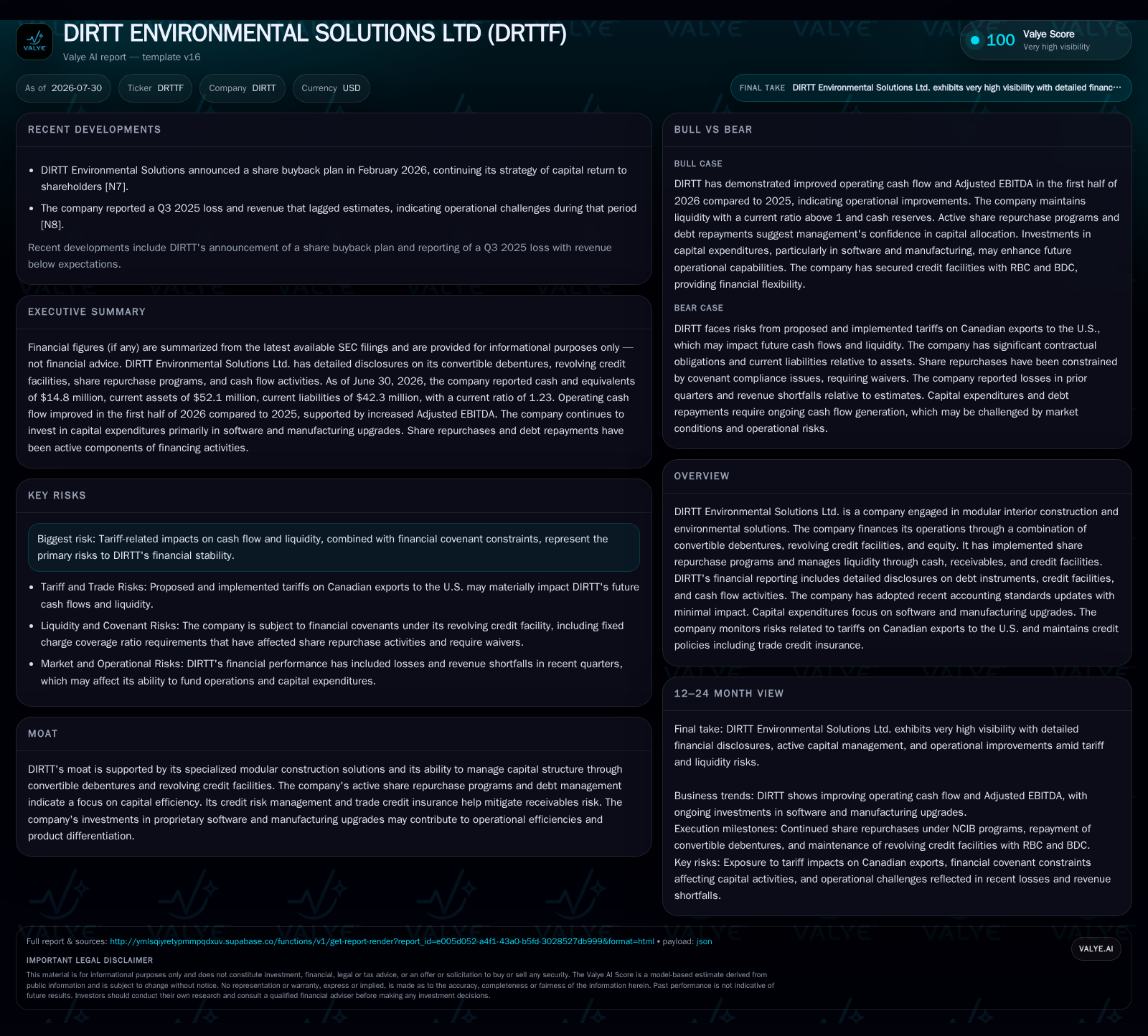
In Q2 2026, DIRTT Environmental Solutions Ltd. navigated ongoing tariff challenges on Canadian exports to the U.S. while optimizing its capital structure through convertible debenture repayments and share repurchases. The company’s modular interior construction business integrates proprietary design software and manufacturing investments, supporting operational efficiency gains amid a competitive landscape favoring sustainability. Going forward, monitoring order backlog, software adoption, and covenant compliance will be critical to assessing execution amid liquidity constraints.
Tariff Pressure Meets Capital Optimization: Latest Quarterly Trends
DIRTT’s latest quarterly filing for Q2 ended June 30, 2026 shows a company navigating tariff-induced challenges while focusing on capital structure optimization. Specifically, DIRTT fully repaid the outstanding principal and interest on its January Debentures—originally issued in January 2021—on January 31, 2026 [S2]. This deleveraging reduces near-term refinancing risks but is set against the backdrop of tariff pressures on Canadian exports into the U.S., which could materially impact future cash flows and liquidity [S1,S2]. The company continues to monitor these cross-border trade uncertainties closely.
Integrating Modular Construction and Environmental Solutions for Competitive Advantage
DIRTT operates principally in the midstream segment of the modular interior construction value chain—designing, manufacturing, and installing customizable prefabricated building interiors with an environmental focus [S1]. Its revenue mix combines physical product sales with associated project-based installation services across key sectors including commercial offices, healthcare facilities, government buildings, and educational institutions concentrated in North America [S10].
The company’s integrated offering is anchored by its proprietary ICE® software platform that translates architectural designs into 3D models directly feeding manufacturing instructions—facilitating efficiencies spanning customization to final onsite installation [S1]. Such integration provides customers faster build timelines with reduced waste compared to traditional methods—a growing priority given increasing emphasis on sustainability in commercial real estate development.
By aligning product innovation with environmental solutions (e.g., using sustainable materials and modular designs), DIRTT differentiates itself within an industry where traditional contractors face pressure to adopt prefabrication for cost and speed advantages. This positioning potentially boosts customer retention rates and average project sizes over time as modular fit-outs gain acceptance.
Proprietary Software and Manufacturing Upgrades Fuel Operational Efficiency
Capital expenditures emphasize continued investments in both proprietary software enhancement and manufacturing technology upgrades—two interlinked drivers underpinning DIRTT’s operational value proposition [S1,S2]. In H1 2026 alone, DIRTT spent roughly $0.5 million on capitalized software development and $0.3 million upgrading manufacturing assets—down from prior periods but consistent with ongoing modernization efforts facilitating installation efficiency gains [S15]
Such investments are critical to shortening project completion cycle times—a leading KPI—and increasing manufacturing capacity utilization by enabling more flexible production runs tailored to client specifications. Rising software adoption rates also support better project oversight reducing rework risk post-installation.
Improved operational leverage from these enhancements underpins a $6.8 million increase in adjusted EBITDA for Q2 2026 compared with Q2 2025 [S14], signaling early realization of productivity gains despite macroeconomic headwinds.
Capital Structure Maneuvers: Convertible Debentures and Share Repurchase Strategy
DIRTT strategically manages its capital structure through convertible unsecured subordinated debentures (collectively referred to as Debentures) coupled with active share buybacks via normal course issuer bids (NCIBs) [S1,S2]. Having issued approximately C$35 million of December Debentures late in 2021 maturing end-2026 carrying a coupon of around 6.25%, DIRTT has both repurchased portions via NCIBs and redeemed the January Debentures fully earlier this year—all aimed at reducing interest burden while preserving equity optionality.
This blend enables cost-effective financing aligned with the cyclical nature of construction project funding demands while offering flexibility on interest payments payable either in cash or shares at company discretion.
Additionally, aggressive share repurchase campaigns totaling over C$6 million since late 2024 reflect confidence in long-term value creation potential despite constraints imposed by lender covenants linked to fixed charge coverage ratios disallowing certain restricted payments at times [S18,S22]. Such buybacks help optimize capital base reducing dilution effects from convertible instruments.
Growth Catalysts: Sustainability Demand and Market Expansion Outlook
Longer term growth drivers for DIRTT relate to intensifying market preferences for rapid interior build-out solutions that are cost-effective yet environmentally conscious—a niche where modular prefabrication excels relative to traditional site-built construction models.
Expanding regulatory incentives globally supporting green building certifications add tailwinds benefiting early technology adopters like DIRTT that embed sustainable principles across their design/manufacturing workflows. Industry expansion into underserved geographic regions requiring rapid scalable interior solutions could further raise order backlogs—a leading indicator not explicitly quantified yet but essential to track moving forward.
Liquidity may thus tighten unexpectedly if tariff burdens increase or persist longer than anticipated.
Credit risk is managed prudently through trade credit insurance covering approximately 59% of trade receivables judged creditworthy by insurers as of end-2025—a positive mitigant amid broader economic uncertainties impacting customer payment behaviors [S16]. Nevertheless, accounts receivable days remain a vital metric directly influencing operating cash flow stability.
DIRTT faces ongoing legal proceedings centering on intellectual property rights enforcement against former employees and competitors alleging misuse of trade secrets primarily in Canadian jurisdiction.
Operationally, gaining visibility into order backlog trends alongside measurable improvements in installation cycle times attribute directly linked to ICE software ecosystem penetration will confirm execution strength amid evolving demand patterns.
Tracking changes in manufacturing capacity utilization fueled by targeted capex investments could provide leading signals on scaling readiness supporting higher margin projects within competitive timelines.
Financial Profile Discussion: Liquidity Buffer and Debt Load in Context
As of June 30, 2026, DIRTT reported approximately $14.8 million in cash & equivalents against total debt levels near $17.1 million leading to net debt around $2.3 million—indicative of modest leverage given current liabilities approximating $42.3 million versus current assets near $52 million yielding a current ratio of about 1.23 [F1]. These metrics suggest a cautiously sound liquidity position though susceptible to tariff-driven cash flow variability.
The company benefits from access to a revolving credit facility up to C$25 million providing undrawn borrowing capacity augmenting immediate liquidity buffers if needed alongside incremental indebtedness authorized under a Business Development Bank of Canada loan arrangement initiated early 2026 matured over several years beginning May repayment schedules [S21,S26]
These financing arrangements collectively provide DIRTT with structural flexibility essential during periods of sector cyclicality characterized by fluctuating order inflows correlated strongly with commercial real estate cycles and regulatory influences prompting green building initiatives.
This analysis synthesizes facts disclosed by DIRTT Environmental Solutions Ltd.’s latest quarterly (10-Q) and annual (10-K) filings alongside event reports consolidating evidence on operational performance, financing strategy, risk factors including tariffs impact, legal proceedings status, capital expenditure focus areas, and evolving growth drivers supported by industry context relevant to modular interior construction providers emphasizing sustainability-enhanced prefabricated solutions. No investment advice is offered herein.
Disclaimer: This is research-only, informational analysis and not investment advice. It may include AI-generated interpretation and general industry context. Always verify important details using primary sources.

Comments