
Manhattan Bridge Capital Enhances Lending Capacity with Credit Facility Amendments While Maintaining Disciplined Portfolio Management
The company’s Q2 2026 filing details a credit line extension and updated portfolio composition limits that support measured loan growth with risk controls in its niche hard money lending business.
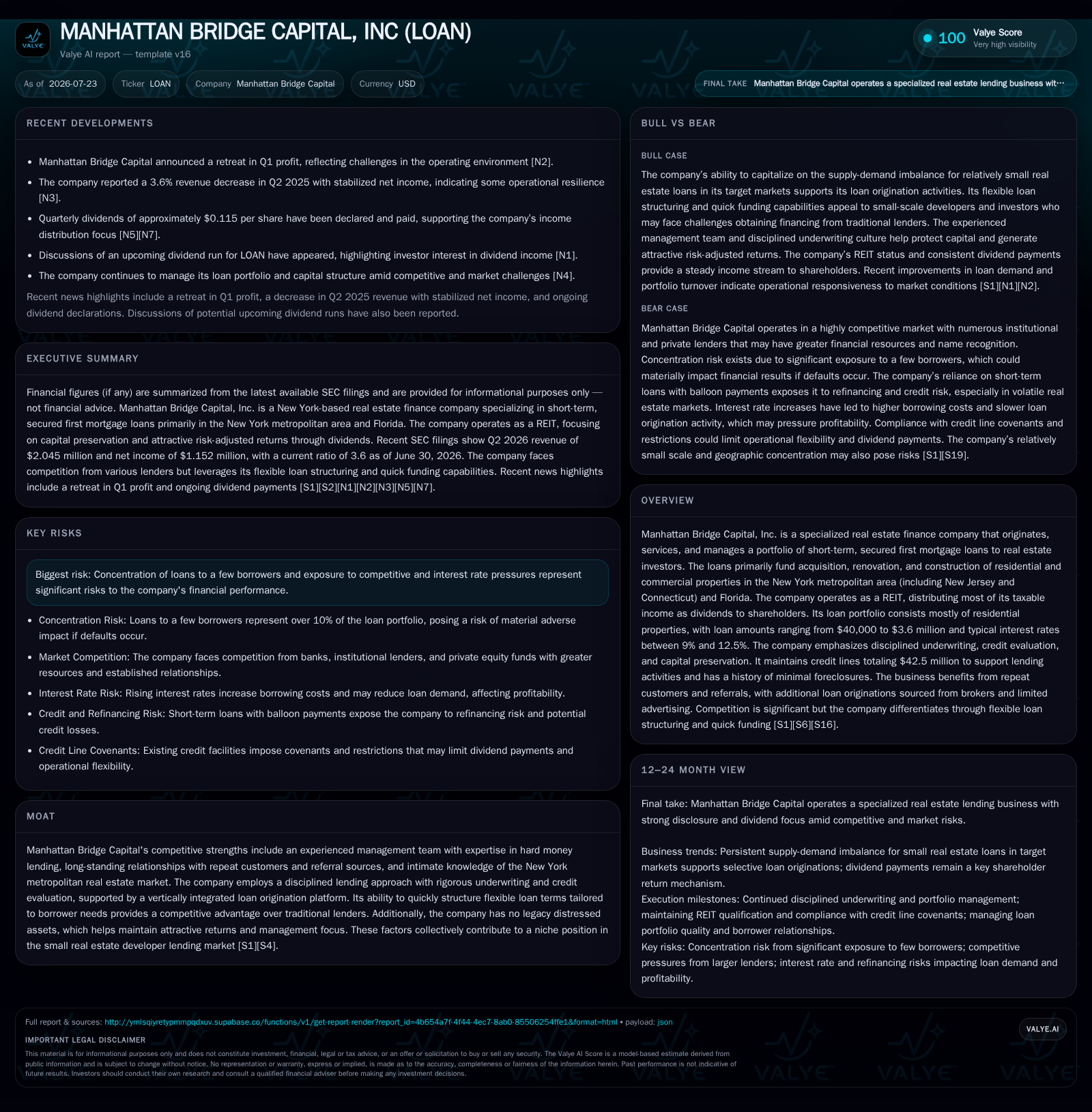
In Q2 2026, Manhattan Bridge Capital extended the maturity of its Webster Credit Line to February 2029, alongside revised interest margins and tighter caps on loans outstanding over 30 months, reinforcing its strategy to grow a portfolio of short-term, secured first mortgage loans in select regional markets. The firm’s underwriting discipline, focused on first-lien collateral and personal guarantees, underpins its ability to generate attractive risk-adjusted returns while operating as a REIT distributing taxable income as dividends. Although geographic concentration and borrower risk remain watchpoints, the company’s non-bank lender agility and local market expertise position it well against traditional banks and specialty finance peers. Key near-term indicators include origination volumes under the amended credit terms and dividend sustainability consistent with REIT requirements.
Q2 2026 Credit Facility Amendment Strengthens Funding Stability with Enhanced Risk Controls
Manhattan Bridge Capital, Inc. extended the maturity of its Webster Credit Line to February 28, 2029, through an amendment executed in Q2 2026, providing medium-term funding stability essential for supporting measured loan portfolio growth [S2]. This amendment also revised interest margins to better align with current capital costs, reflecting the company’s effort to maintain attractive net interest spreads while preserving underwriting discipline. A key risk management feature introduced is a cap limiting mortgage loans outstanding beyond 30 months to 17.5% of the total portfolio, addressing portfolio aging and illiquidity risks associated with longer-duration loans [S2]. These credit facility updates underscore Manhattan Bridge Capital’s balanced approach to scaling originations while controlling credit and liquidity risk.
Post-quarter, the company reported loan payoffs totaling approximately $3.7 million, including $506,000 originally due within the quarter, demonstrating active portfolio management and capital recycling critical to sustaining lending capacity amid evolving market conditions [S2]. This turnover supports liquidity and mitigates concentration risk by preventing excessive accumulation of long-term loans.
Focused Loan Portfolio Anchored by First Mortgage Liens Supports Consistent Risk-Adjusted Returns
Manhattan Bridge Capital specializes in originating short-term hard money loans secured predominantly by first mortgage liens on residential and commercial real estate located primarily in the New York metropolitan area—including New Jersey and Connecticut—and select Florida markets [S1][S2]. Loan amounts typically range from $40,000 to $3.6 million, financing acquisition, renovation, rehabilitation, or improvement projects where timely capital access is critical [S1].
The company’s underwriting rigor integrates stringent collateral quality assessments with personal guarantees from borrowers, often secured by pledges of ownership interests. This dual-layer security framework materially mitigates credit loss severity and default risk, enabling disciplined portfolio growth within established loan-to-value (LTV) limits [S1]. Foreclosure incidence remains minimal, reflecting sound credit evaluation and effective loan servicing practices. Operating as a real estate investment trust (REIT), Manhattan Bridge Capital distributes at least 90% of its taxable income as dividends annually, aligning revenue generation closely with net interest income from performing loans [S1]. Loan servicing is conducted internally or through affiliated platforms, maintaining close borrower relationships that facilitate renewals or extensions when appropriate.
Competitive Positioning Highlights Non-Bank Lender Agility Versus Traditional Banks and Specialty Finance Firms
Manhattan Bridge Capital operates in a competitive real estate lending environment that includes banks, mortgage REITs such as Ladder Capital and Apollo Commercial Real Estate Finance, private equity real estate lenders, family offices, and specialty finance companies [S1]. Unlike traditional banks constrained by regulatory processes and standardized underwriting that often delay or exclude smaller transactions, Manhattan Bridge Capital leverages its non-bank lender status to provide flexible, rapid credit solutions tailored to borrower needs.
Its deep local market expertise, accrued through repeated regional transactions, enhances underwriting precision amid volatile urban real estate environments. This nimbleness supports maintaining wider interest rate spreads reflective of elevated risk profiles relative to bank competitors, who typically offer lower-cost but less flexible funding options. However, the company’s geographic concentration introduces exposure to localized economic and regulatory risks, which contrasts with more diversified peers [S1].
Geographic Concentration Balances Local Expertise With Exposure Risks
The portfolio’s geographic concentration in the New York metropolitan area—including New Jersey and Connecticut—and selected Florida markets allows Manhattan Bridge Capital to apply granular market insights vital for precise property valuation and borrower assessment in complex urban settings [S1][S2]. This focus supports underwriting accuracy and risk mitigation but exposes the company to regional economic downturns, regulatory changes, and real estate market cycles.
The recent credit line amendment’s cap on loans outstanding beyond 30 months acts as a guardrail against excessive exposure to aging assets within these concentrated markets, supporting liquidity management during refinancing slowdowns or market disruptions [S2]. While future growth may consider modest geographic diversification, maintaining underwriting discipline and local market knowledge will remain critical in any expansion.
Growth Drivers: Demand for Short-Term Financing Amid Renovation Activity Supports Origination Volumes
Robust real estate development activity—particularly renovation and rehabilitation—and constrained availability of traditional bank financing underpin demand for Manhattan Bridge Capital’s short-term hard money loans [N1][N2][S1][S2]. Borrowers prioritize flexible financing aligned with project timelines rather than multi-year amortization schedules typical of banks.
Elevated construction costs and fluctuating interest rates have increased reliance on hard money lending despite premium pricing relative to conventional mortgages. These market dynamics support origination volume growth and sustain favorable net interest margins, even amid competitive pressures from other specialty lenders and mortgage REITs.
Key Risks: Borrower Concentration and Interest Rate Sensitivity Require Close Monitoring
Borrower concentration remains a salient risk given the company’s relatively modest portfolio scale compared to larger mortgage REIT peers [S1][S2]. While historical default and foreclosure rates have been low due to rigorous underwriting and strong personal guarantees, stress events affecting key borrowers could disproportionately impact earnings stability.
Interest rate volatility affects borrowing costs under credit facilities like the Webster Credit Line and influences achievable loan yields. The amended credit agreement’s updated interest margins aim to preserve net spreads amid rising rates; however, unexpected increases in funding costs or delays in passing through higher loan pricing could compress profitability.
Operational complexities, including foreclosure management in urban jurisdictions, continue to present timing and recovery risks that require careful monitoring [S1]. Additionally, geographic concentration exposes the company to localized economic downturns and regulatory changes that could affect collateral values and borrower repayment capacity.
Forward-Looking Indicators: Origination Volume Trends and Dividend Sustainability Under REIT Framework
Near-term operating performance will depend on origination volumes under the amended credit facility terms, which serve as a critical gauge of efficient capital deployment supporting earnings growth and dividend coverage mandated by REIT tax rules [N1][N2][S3]. Sustained origination momentum is essential to offset loan payoffs and maintain portfolio scale.
Dividend sustainability remains a key indicator of underlying cash flow generation, as Manhattan Bridge Capital must distribute over 90% of taxable income annually to maintain REIT status [S1]. Shareholder confidence is further supported by governance stability, exemplified by the advisory approval of independent auditors at the June 2026 Annual Meeting, coinciding with execution of capital strategies [S3].
Financial Profile Discussion: Amended Credit Facilities Provide Liquidity Cushion Supporting Growth Plans
As of June 30, 2026, Manhattan Bridge Capital held approximately $230,000 in cash (excluding restricted funds) and had access to approximately $42.5 million in combined borrowings under the Webster and Valley Credit Lines, with maturities extended through early 2029 [S2]. This liquidity position provides a cushion to support ongoing loan originations and anticipated working capital needs tied to growth initiatives over the next 12 months.
Leverage is prudently managed through covenant adjustments that limit prolonged exposure to aging loans, preserving flexible borrowing capacity essential for sustaining dividend distributions aligned with mandatory REIT payout thresholds exceeding 90% of taxable income [S2]. This financial positioning reflects a strategic focus on balancing expansion ambitions funded through cost-efficient debt with stable cash flows generated from disciplined loan servicing aimed at delivering sustainable risk-adjusted returns without compromising capital preservation.
Disclaimer: This is research-only, informational analysis and not investment advice. It may include AI-generated interpretation and general industry context. Always verify important details using primary sources.

Comments