
Boston Beer’s Innovation and Brand Diversification Support Resilient Market Position Despite Volume Growth Slowdown
Boston Beer’s latest quarter highlights challenges in volume growth offset by strategic portfolio innovation and premium pricing amid competitive pressures.
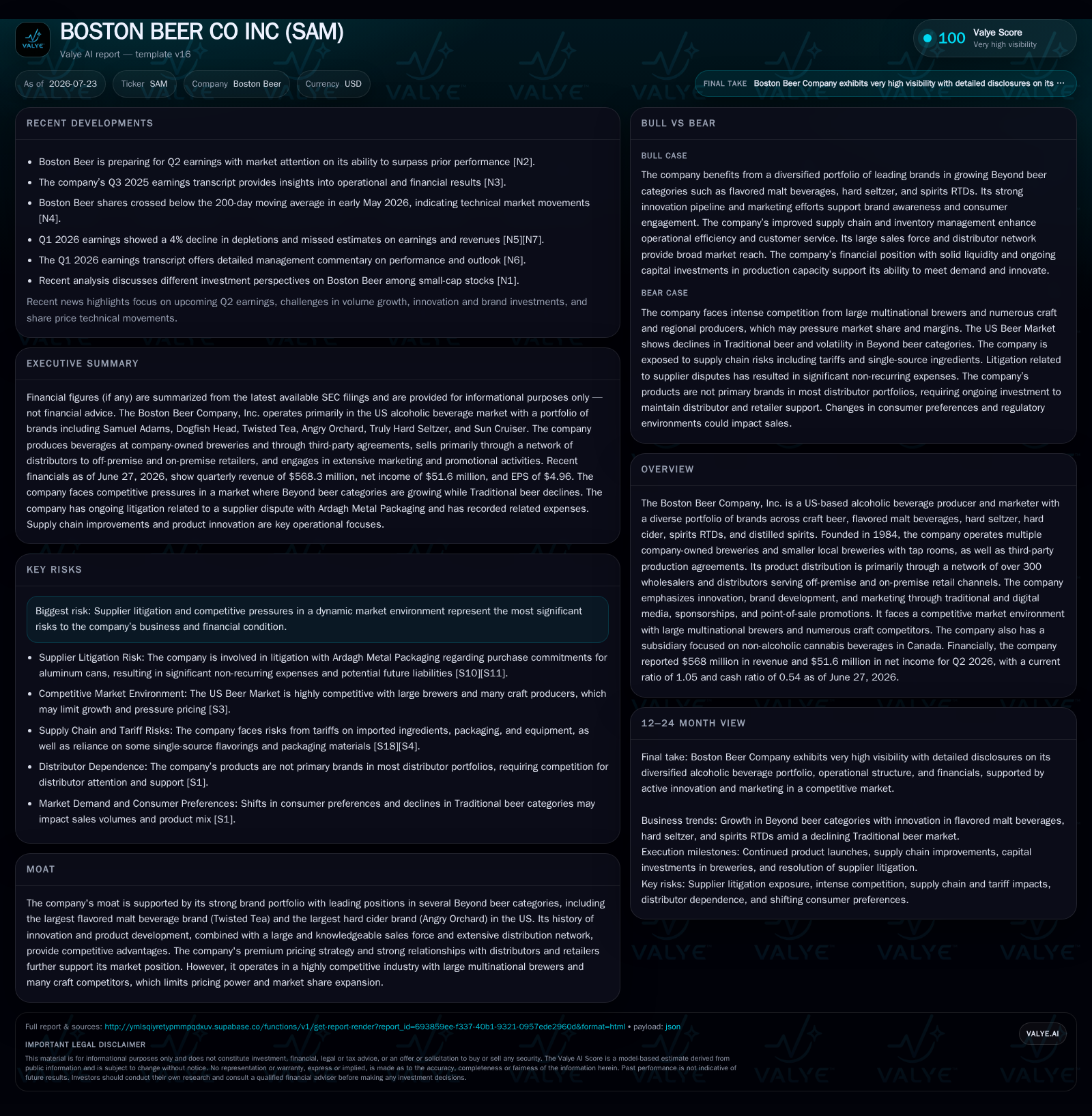
The Boston Beer Company’s Q2 2026 update reveals slower volume growth but sustained revenue resilience driven by new product innovation and diversified offerings across craft beer, flavored malt beverages, hard cider, and spirits RTDs. Operating primarily through company-owned breweries and a broad distributor network, Boston Beer leverages its strong brand portfolio to mitigate intense competition from multinational brewers and craft peers. The company faces ongoing supplier litigation risks alongside supply chain cost pressures, while growth opportunities emerge from expanded distribution, premiumization, and emerging beverage categories like cannabis-infused drinks. Financially, Boston Beer maintains a stable liquidity position with minimal debt as of mid-2026.
Recent Operating Update Highlights
In its latest quarterly filing for Q2 2026, Boston Beer reported a moderation in volume growth despite ongoing efforts to expand category presence across craft beer, Beyond Beer segments such as flavored malt beverages (FMBs), hard cider, and spirits RTDs [S2]. The filing confirms no material changes in risk factors from the prior year but underscores persistent competitive challenges that temper top-line expansion prospects. The company continues executing a multi-brand strategy supported by innovation-driven launches aimed at capturing shifting consumer demand profiles that favor variety and premiumization [N3],[S2].
Additionally, the company announced the planned closure of its Angel City Brewery in Los Angeles effective April 30, 2026, reflecting a strategic streamlining of local brewery operations to refocus resources on more productive assets within its national footprint [S1]. This move reduces exposure to underperforming capacity while allowing concentration on flagship breweries with tap rooms playing an increasingly essential role in direct consumer engagement.
Business Model Overview
Boston Beer operates predominantly as a midstream producer and marketer within the alcoholic beverage value chain. Revenue generation hinges on manufacturing proprietary branded products primarily at four major company-owned breweries located across Boston (MA), Cincinnati (OH), Milton (DE), and Breinigsville (PA). These facilities serve dual functions of large-scale production alongside research and development to fuel new product innovations [S1]. Smaller local breweries with retail tap rooms—such as Samuel Adams Boston Downtown Tap Room—complement this model by fostering community-centric brand loyalty while experimenting with niche craft styles.
Distribution depends heavily on a network of over 300 wholesalers serving off-premise retail outlets including grocery stores, liquor stores, convenience stores, clubs, and e-commerce platforms, as well as on-premise venues like bars and restaurants [S1]. The company monetizes through wholesale sales of packaged goods—canned or bottled—for off-premise consumption plus keg sales for draft service.
Significant emphasis is placed on product innovation across categories to sustain competitive differentiation. Boston Beer deploys marketing spend across traditional media, digital channels, point-of-sale promotions, sponsorships, and direct-drinker engagement efforts. Premium pricing is supported through perceived quality differentiators embedded in their brand portfolio with Twisted Tea retaining status as the top flavored malt beverage brand in the U.S., while Angry Orchard leads within hard cider—a segment showcasing consistent consumer interest beyond core beer consumption cycles [S1],[N3].
Industry Structure and Competitive Positioning
Boston Beer occupies a distinct niche balancing between large multinational brewers—such as Anheuser-Busch InBev and Molson Coors—and independent craft brewers regionally concentrated. Its diversified portfolio spans multiple Beyond Beer categories where innovation pace is critical given rapid product introductions from competitors including players like Mike's Hard Lemonade and emerging hard tea brands (e.g., Arizona Hard Tea) challenging traditional FMB dominance [S1].
Despite scale limitations compared with global giants, Boston Beer's extensive distribution network provides meaningful geographic coverage that supports retail shelf presence nation-wide. Its direct-to-consumer tap rooms also serve as important experiential venues fostering community engagement that larger peers often lack.
Pricing power faces constraints amid heightened competition; however, Boston Beer's premium positioning paired with strong brand equity allows it to maintain gross margins better than many craft-only peers whose scale limits bargaining leverage with distributors. That said, input cost inflation particularly related to aluminum can supply and commodity ingredients creates operational pressure compounded by pending supplier litigation risks that could affect supply continuity or contract terms [S1],[N3].
Growth Drivers
Innovation emerges prominently as a key growth engine for Boston Beer. The company's ability to launch new products attuned to evolving flavor trends and consumption occasions has enabled sustained relevance despite some maturity within flagship categories like traditional beer [N3]. Extensions into hard seltzers alongside non-alcoholic cannabis-infused beverages highlight attempts to capture emergent sub-segments promising long-term demand upside.
Expansion of distribution reach remains fundamental; strengthening wholesaler relationships assists in driving deeper penetration chiefly within on-premise venues resuming post-pandemic activity ramp-up. Tap room sales not only generate incremental revenues but reinforce brand loyalty critical for premium-priced lines.
Marketing investments focused on digital media amplify brand awareness efficiently compared with historical reliance on conventional channels. Continued success in converting trial consumers into repeat buyers underpins volume resilience even during periods when overall category growth slows.
Finally, premiumization trends globally support Boston Beer as consumers exhibit willingness to pay higher price points for differentiated craft styles or novel formulations aligning with wellness or lifestyle preferences.
Risks and Watchpoints
The supplier dispute with Ardagh Metal Packaging USA over alleged shortfalls on minimum aluminum can purchase commitments represents significant legal uncertainty that could result in monetary liabilities or unfavorable renegotiated terms disrupting packaging cost structures central to volume production economics [S1]. The upcoming March 2026 trial accentuates near-term risk visibility in this regard.
Additionally, rising input costs linked to commodities such as barley, hops, and aluminum materials pose margin pressure especially if price increases are not fully transferable through retail/wholesale pricing due to intense competition.
Changing consumer drinking preferences towards lower-alcohol or non-alcoholic alternatives may limit core beer segment expansion while intensifying necessity for continuous portfolio innovation. Failure or dilution of brand strength through unsuccessful new launches risks eroding market share amid an expanding field of craft entrants.
Dependency on third-party wholesalers means that shifts in distributor strategies or consolidation could adversely impact Boston Beer's market access or promotional latitude.
Finally economic downturns could disproportionately constrain discretionary spending affecting premium-priced beverage categories more than value segments.
What to Watch Next
Investors should monitor sequential quarterly volumes especially new product launch success rates within hard seltzer and cannabis-infused beverage categories as indicators of product innovation traction.
Tracking marketing spend efficiency metrics tied directly to incremental sales lift will provide clues on return effectiveness in increasingly digital-focused campaigns.
Supply chain developments including resolution progress in the Ardagh litigation remain critical milestones impacting cost structure predictability.
The performance of company-owned tap rooms such as customer traffic trends will serve as forward look indicators for direct consumer engagement strength.
Upcoming earnings releases should clarify margin trends amidst raw material inflation alongside any commentary around further capacity expansions or brewery closures beyond Angel City.
Financial Profile Discussion
As of June 27, 2026, Boston Beer held cash and cash equivalents totaling approximately $266 million against nominal debt levels near $0.4 million yielding a net cash position supportive of operational flexibility [F1]. Current assets stood at roughly $516 million versus current liabilities at $494 million resulting in a current ratio slightly above 1x at 1.05 which implies adequate short-term liquidity coverage [F1].
Capital expenditures are expected to remain moderate focusing on brewery efficiency improvements rather than major capacity builds after the recent consolidation moves. Free cash flow generation capacity assisted by low leverage positions Boston Beer favorably relative to seasoned competitors requiring substantial debt-funded expansion programs.
Overall financial health offers resilience supporting continued investment in marketing initiatives and R&D essential for sustaining product relevance within dynamic alcoholic beverage submarkets.
This analysis synthesizes SEC filings alongside current industry knowledge without extending into investment research views or forecasts.
Disclaimer: This is research-only, informational analysis and not investment advice. It may include AI-generated interpretation and general industry context. Always verify important details using primary sources.

Comments