
Getty Realty’s Triple-Net Lease Focus Anchors Stable Cash Flow Amid Retail Sector Shifts
Getty Realty maintains steady portfolio growth with triple-net leases on convenience and automotive retail properties, balancing tenant concentration and capital market funding risks.
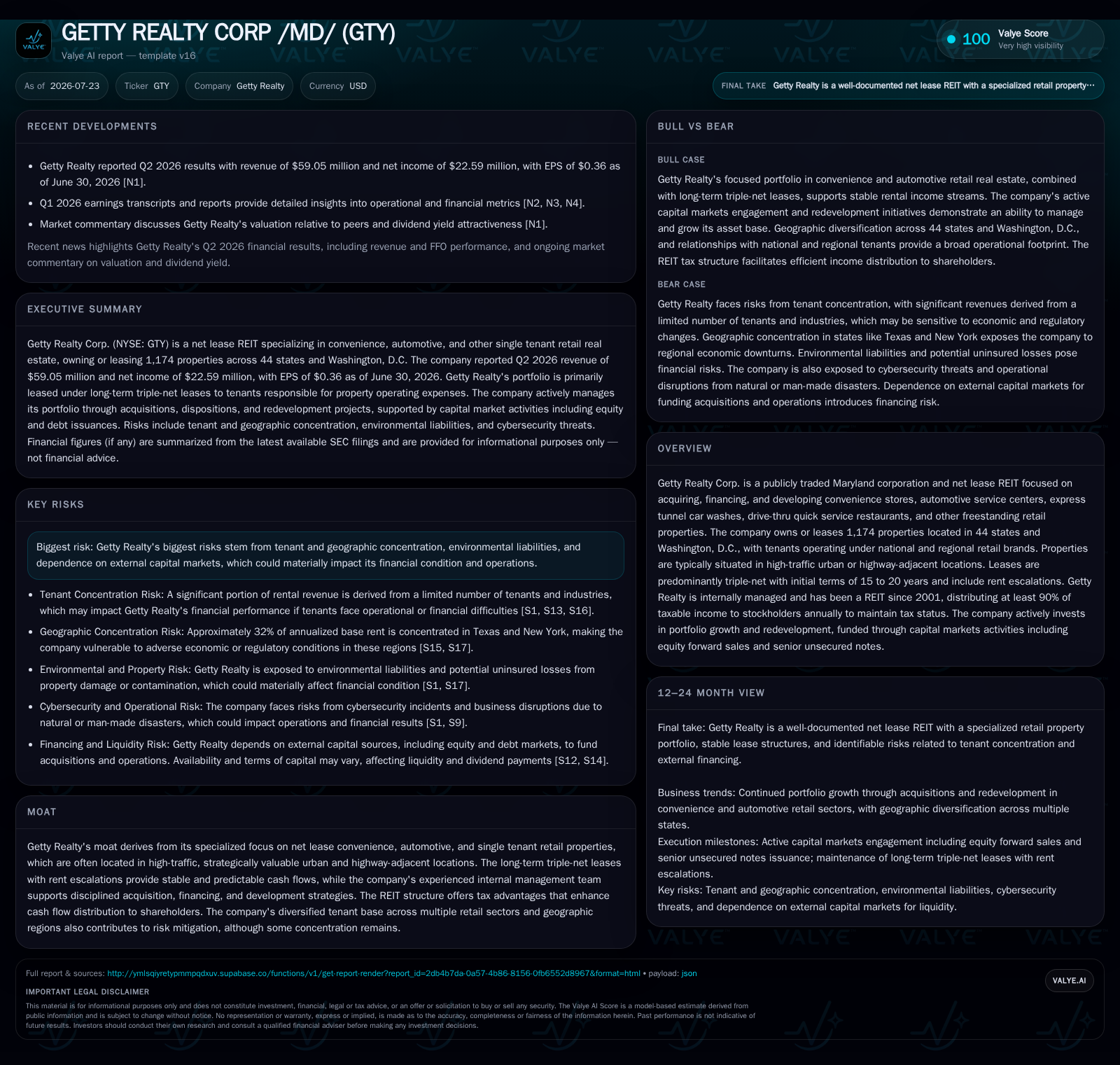
Getty Realty Corp., a net lease REIT specializing in single-tenant retail properties such as convenience stores and automotive service centers, reported its latest quarterly results confirming portfolio stability characterized by long-term triple-net leases with rent escalations. The company’s 1,174-property portfolio, spread across 44 states and D.C., delivers predictable cash flows underpinned by tenants’ responsibility for property expenses and maintenance. However, Getty faces risks from tenant and geographic concentration, environmental liabilities, and dependence on external capital markets to fund acquisitions and redevelopment. Strategic growth is driven by accretive acquisitions in high-traffic locations and disciplined capital deployment enabled by forward sale agreements and debt financing. Monitoring lease renewal rates, tenant creditworthiness, and capital access will be critical to assessing medium-term operational resilience.
Recent Operating Update
Getty Realty Corp.’s latest quarterly filing (10-Q dated July 23, 2026) confirms the company’s continued operation of a substantial net lease portfolio comprising 1,174 properties leased primarily under long-term triple-net (NNN) agreements. These properties, located across 44 states and Washington D.C., predominantly serve convenience stores, automotive service centers, express tunnel car washes, and drive-thru quick service restaurants [S2][S3][S1]. The portfolio’s strategic positioning at high-traffic urban intersections and highway-adjacent locations supports tenant business models reliant on strong consumer mobility and frequent visits.
The lease portfolio features weighted average remaining lease terms of approximately 9.9 years, excluding renewal options, consistent with typical net lease REIT standards that emphasize long-duration contracts to ensure cash flow stability [S1]. Under these triple-net leases, tenants assume responsibility for all property-related expenses, including real estate taxes, insurance, and maintenance, effectively insulating Getty from operational cost volatility and enhancing predictability of net operating income.
While Getty’s Q2 2026 results slightly missed external analyst estimates for funds from operations (FFO) and revenue, this shortfall appears attributable to timing and tenant mix factors rather than fundamental deterioration in rent collections or tenant credit quality [N1]. This underscores the relative resilience of the portfolio’s cash flow profile amid evolving retail sector dynamics.
Business Model Specifics
Getty Realty’s business model centers on acquiring, developing, and managing freestanding single-tenant retail properties optimized for triple-net leasing. The company’s tenant base primarily consists of operators in convenience retail, petroleum distribution with ancillary automotive repair services, express car washes, and quick-service restaurants, all sectors characterized by steady consumer demand and frequent transaction volumes [S1].
Revenue generation is driven by contractual rent payments under leases that incorporate periodic rent escalations, typically structured to offset inflationary pressures and preserve real income growth over time [S1]. The triple-net lease structure shifts operating expense risk—including environmental remediation obligations related to tenant operations—to tenants, except for pre-existing contamination known at lease inception, for which Getty maintains reserves [S1]. This arrangement reduces Getty’s exposure to cost fluctuations and supports stable net operating income.
The company’s internally managed platform oversees property acquisition, financing, development, and redevelopment activities. Capital deployment is supported by access to capital markets through mechanisms such as forward equity sales agreements executed in early 2026 and recent senior unsecured note issuances, enabling accretive portfolio growth while maintaining disciplined leverage [S5][S15]
Industry Structure and Competitive Positioning
Getty Realty operates within the net lease REIT sector specializing in single-tenant retail properties, a niche defined by long-term leases transferring most property-level risks to tenants. Comparable peers in this sector include Realty Income Corporation, STORE Capital, and National Retail Properties, which also focus on net lease portfolios but differ in tenant mix and geographic concentration.
Getty’s competitive differentiation lies in its concentrated expertise in convenience and automotive-related retail formats, sectors closely tied to U.S. consumer automobility trends. The company’s portfolio diversification across 44 states and D.C. mitigates geographic concentration risk, enhancing resilience against localized economic downturns [S1].
The triple-net lease model inherently limits Getty’s exposure to variable property expenses and tenant turnover costs, providing a more predictable rental income stream compared to multi-tenant retail landlords who bear greater operational risks.
Growth Drivers
Getty’s growth strategy emphasizes accretive acquisitions of properties in high-traffic urban and highway-adjacent locations that align with mobile consumer preferences for convenience and speed [S1]. Development and redevelopment initiatives further contribute to portfolio expansion by enabling the creation or enhancement of assets tailored to modern retail formats with high transaction velocity but relatively small footprints.
Capital market access remains a critical enabler of growth, with Getty leveraging equity issuance programs—including its ATM program—and debt capacity under existing credit facilities to fund acquisitions and development projects [S4][S26]. This financial flexibility supports disciplined capital deployment aimed at extending weighted average lease terms and enhancing tenant diversification.
Long-term triple-net leases with built-in rent escalations underpin the stability and growth of funds from operations, helping to mitigate inflationary risks and support sustainable distributions. The tenant base is gradually diversifying beyond core automotive-related sectors to include additional quick-service restaurant operators, broadening revenue sources.
Risks and Watchpoints
Tenant concentration within the automotive and convenience retail sectors presents a material risk, as these industries are sensitive to economic cycles affecting discretionary vehicle usage and fuel consumption [S1]. Adverse economic conditions could impair tenant cash flows and their ability to meet rent obligations, impacting Getty’s revenue stability.
Environmental liabilities related to fuel storage tanks and historical contamination remain a significant concern [S1]. Although tenants are generally responsible for contamination arising during their lease terms, Getty maintains reserves for known pre-existing environmental issues. Undiscovered contamination or remediation cost overruns could impose unexpected financial burdens
Getty’s reliance on capital markets for funding acquisitions and redevelopment exposes it to interest rate volatility and market access risks. Rising borrowing costs could compress acquisition yields and increase interest expense, while covenant restrictions in credit agreements limit leverage expansion without lender approval [S4]. Lease renewal rates and tenant creditworthiness are critical operating variables to monitor, as unfavorable renewals or tenant defaults would reduce income visibility.
Cybersecurity risks are actively managed given the reliance on information technology systems for rent collection and property management. The company’s Board and management maintain oversight of cybersecurity protocols to mitigate potential operational disruptions [S1].
Financial Profile Discussion
As of June 30, 2026, Getty Realty reported cash and cash equivalents of approximately $4.8 million against total debt of about $1.07 billion, resulting in net debt near $1.07 billion [F1]. This leverage level reflects ongoing capital deployment to support portfolio growth while maintaining financial flexibility.
Operating income for the latest reported period was approximately $127 million, with net income around $79 million, consistent with the stable expense profile afforded by triple-net leases [F1]. The company continues to distribute over 90% of its taxable income to shareholders, preserving its REIT status and avoiding federal corporate income tax [S1].
Capital raising activities in early 2026, including forward equity sales agreements, have bolstered liquidity and supported acquisition funding without materially increasing leverage [S5][S15]. Monitoring interest coverage ratios and debt to EBITDA metrics will be important to assess the impact of interest rate fluctuations on borrowing costs and earnings sustainability.
This analysis integrates Getty Realty’s filings through July 23, 2026 ([S1],[S2],[S3]) and financial data ([F1]) within the context of net lease REIT industry dynamics. It focuses on operational and financial factors shaping the company’s cash flow stability and growth prospects without offering investment advice.
Disclaimer: This is research-only, informational analysis and not investment advice. It may include AI-generated interpretation and general industry context. Always verify important details using primary sources.

Comments