
Oceaneering International Extends Debt Maturities Amid Mixed Segment Performance
Oceaneering's latest quarter reveals flat to improving activity in key offshore segments, offset by geopolitical headwinds in digital solutions, alongside proactive capital and liquidity management.
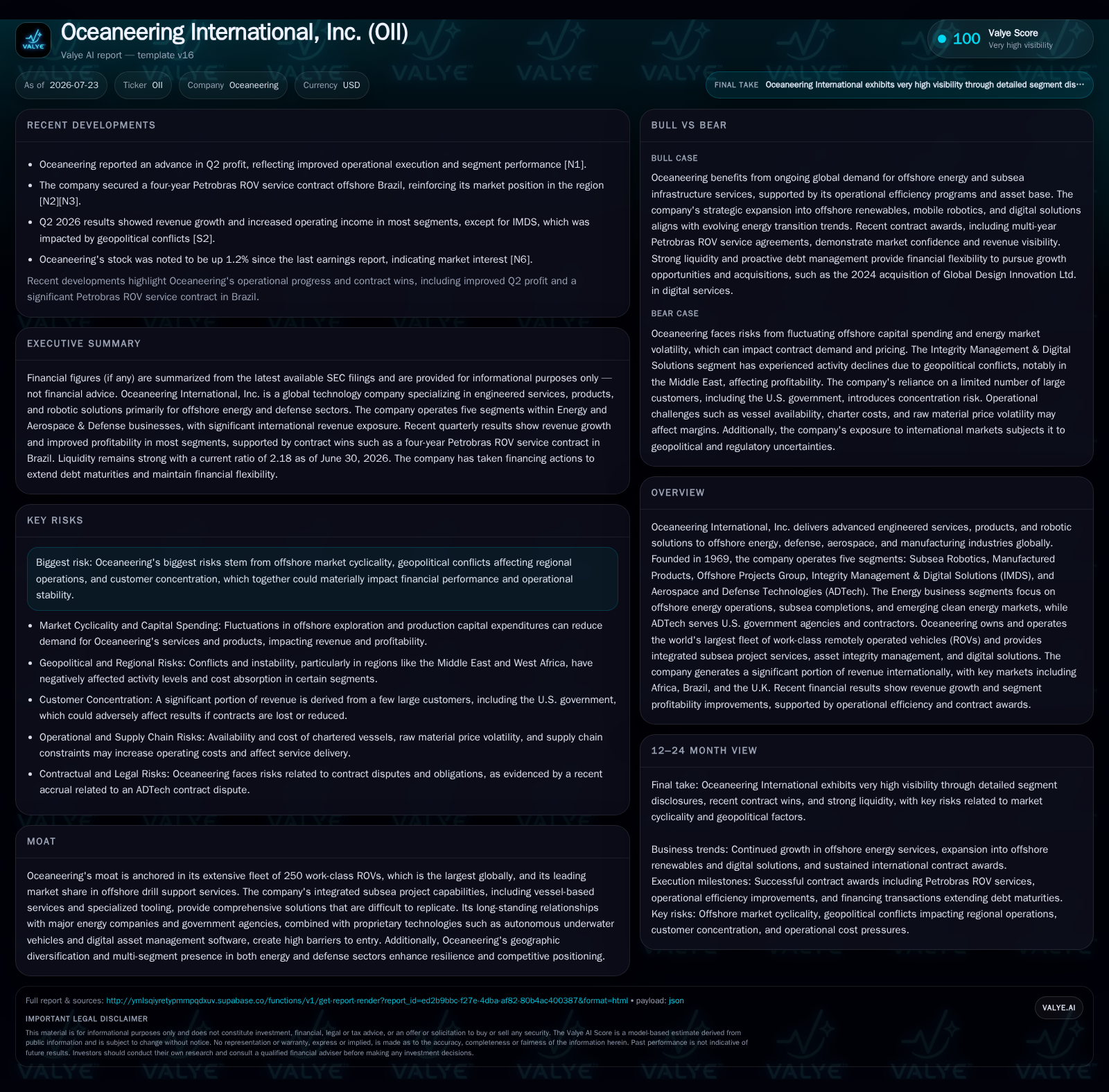
Oceaneering International reported a 10% revenue increase and 11% operating income growth in Q2 2026 driven primarily by Offshore Projects Group’s strong project execution, despite subdued ROV fleet utilization impacting Subsea Robotics. The Integrity Management & Digital Solutions segment faced declines due to Middle East geopolitical tensions. Recent financing actions extended debt maturities and strengthened revolving credit facilities, positioning the company with robust liquidity. Geographic diversification and multi-segment operations provide resilience, although offshore market cyclicality and regional conflicts remain key risks.
Recent Operating Update
Oceaneering International's second quarter ending June 30, 2026, reflected a nuanced operational performance shaped by offshore market dynamics and regional geopolitical factors [S2][S6]. Consolidated revenue increased 10% year over year to approximately $768 million, while operating income rose 11%, primarily driven by the Offshore Projects Group (OPG) segment's favorable project mix and strong execution, particularly in the U.S. Gulf of Mexico where subsea construction and inspection activities typically peak mid-year
The Subsea Robotics segment, which operates the world's largest work-class Remotely Operated Vehicle (ROV) fleet, experienced a decline in operating income due to a decrease in fleet utilization to 66% in Q2 2026 from 67% in the prior-year period [S2][S6]. This utilization rate averaged 63% for the first half of 2026, down from 67% a year earlier, reflecting softer vessel demand and shifting project schedules that directly impact revenue generation and margin expansion in this capital-intensive segment
The Integrity Management & Digital Solutions (IMDS) segment faced revenue declines driven by reduced Inspection, Maintenance, and Repair (IMR) activity in West Africa and disruptions linked to ongoing Middle East conflicts [S2][S6]. Given IMDS combines asset integrity management services with digital asset management software, these geopolitical headwinds have materially affected contract activity and revenue visibility in these regions
Business Model Overview
Oceaneering operates a vertically integrated business model delivering engineered services, subsea hardware products, and autonomous robotic solutions primarily to offshore energy customers, with additional exposure to aerospace and defense sectors. The company’s five segments include Subsea Robotics (ROVs and tooling), Manufactured Products (specialty subsea hardware), Offshore Projects Group (integrated offshore project management and vessel chartering), Integrity Management & Digital Solutions (asset integrity inspections and digital monitoring), and Aerospace & Defense Technologies (government mobility solutions) [S1].
Revenue is generated predominantly through long-term and project-based contracts with offshore operators, where ROV fleet utilization is a critical KPI as many contracts are billed based on hours deployed or project milestones. Manufactured Products provide essential subsea components sold under contract or spot sales, while OPG integrates multiple disciplines including ROV operations, subsea tooling, engineering, and vessel management to deliver comprehensive offshore project execution. IMDS enhances these offerings by providing digital asset management software that improves asset lifecycle visibility and operational efficiency.
This integrated approach differentiates Oceaneering from peers that may focus solely on subsea installation or drilling support, enabling bundled service offerings that reduce customer sourcing complexity and improve operational efficiencies.
Industry Structure and Competitive Position
The offshore engineering and subsea services industry is characterized by capital expenditure cycles driven by upstream oil and gas exploration and production activities. Providers must balance significant investments in specialized assets like work-class ROVs—which require ongoing technological upgrades—with fluctuating utilization rates sensitive to rig counts and vessel availability.
Oceaneering’s scale advantage is significant, operating one of the largest global work-class ROV fleets supported by specialized tooling capabilities. This scale creates high barriers to entry due to the substantial capital intensity and technical expertise required. Competitors such as DeepOcean operate smaller robotics fleets, while companies like Aker Solutions focus more on subsea hardware manufacturing without integrated robotics operations.
The Offshore Projects Group further distinguishes Oceaneering by offering integrated multi-disciplinary offshore project execution, a service model that many competitors segment across different providers. The Aerospace and Defense Technologies segment provides revenue diversification away from the cyclicality of oilfield services, albeit representing a smaller portion of total revenue.
Geographically, Oceaneering maintains a diversified footprint with over half of revenues generated internationally, including key offshore basins such as Brazil’s pre-salt fields—supported by recent Petrobras contract awards—as well as operations in West Africa, the U.K., Norway, and Asia-Pacific. This geographic diversification mitigates regional risks but exposes the company to geopolitical volatility, particularly in areas like West Africa and the Middle East [N3][N4][S1].
Growth Drivers
Several structural factors support Oceaneering’s medium-term growth prospects:
- Recovery in offshore exploration and production investment is expected to increase demand for ROV deployment supporting drilling rig operations.
- Growing emphasis on subsea infrastructure integrity management extends revenue streams through Inspection, Maintenance, and Repair (IMR) services, increasingly augmented by digital asset monitoring solutions.
- Expansion into emerging offshore renewable energy markets, such as offshore wind, leverages existing subsea robotics expertise.
- Strategic acquisitions, including the 2024 purchase of UK-based Global Design Innovation Ltd, enhance digital capabilities and cross-selling potential within the IMDS segment.
- Geographic diversification balances regional disruptions, with Brazil contracts strengthening South American presence and Africa offering long-term servicing opportunities despite political instability [S1][N3]
Risks and Watchpoints
Key risks for Oceaneering include the inherent cyclicality of offshore oil and gas capital expenditures, where fluctuations in global oil prices affect upstream operator budgets and service demand, particularly for higher-margin project work requiring extensive equipment mobilization [S2][N1]. Customer concentration among national oil companies increases sensitivity to contract renegotiations or delays, especially in geopolitically unstable regions impacting IMDS revenue.
Capital expenditure requirements for ongoing ROV fleet modernization remain substantial, and suboptimal fleet utilization could pressure returns on these strategic assets. Technological advancements in autonomous underwater vehicles (AUVs) may alter competitive dynamics, necessitating continuous innovation and investment.
Operational execution risks persist given the complexity of multinational offshore projects managed by OPG, where cost overruns or delays could erode profitability. Foreign currency exposure also adds volatility due to the company’s broad international revenue base.
Regulatory and environmental compliance costs may rise but could also create opportunities for differentiated, environmentally safer technologies that enhance competitive positioning over time.
What to Watch Next
Market participants should monitor several key indicators:
- Quarterly ROV fleet utilization rates as a proxy for offshore activity levels, particularly within the Subsea Robotics segment.
- Backlog and order intake in the Manufactured Products segment, signaling upcoming equipment demand.
- Contract renewals or expansions with major national oil companies such as Petrobras, indicating regional momentum.
- Capital expenditure trends relative to the 2026 guidance of $105–115 million focused on organic fleet upgrades, reflecting investment in technological competitiveness.
- Adoption rates of integrated digital asset management software within IMDS, indicating customer retention and digital solution penetration.
- Liquidity and leverage metrics to assess financial flexibility for opportunistic investments or share repurchases.
- Geopolitical developments in West Africa and the Middle East affecting IMDS order visibility.
- Progress in diversifying revenue contributions from Aerospace & Defense Technologies, supporting a less cyclical revenue base.
Financial Profile Discussion
As of June 30, 2026, Oceaneering reported cash and cash equivalents of approximately $688.9 million, with current assets totaling about $1.58 billion against current liabilities near $726 million, yielding a current ratio of approximately 2.18x, indicative of solid short-term liquidity coverage [F1][S2]. Net debt was negative roughly $201 million, reflecting cash balances exceeding total debt of approximately $487 million as of December 31, 2025, suggesting manageable leverage and financial flexibility [F1].
Operating margins remained steady near double digits, supported by portfolio shifts toward higher-margin Offshore Projects Group activities despite softness in Subsea Robotics revenue streams [S2][S6]. This balanced approach underscores Oceaneering’s focus on free cash flow generation while maintaining competitive asset bases across segments to sustain operational resilience amid macroeconomic and geopolitical uncertainties.
This analysis synthesizes publicly filed SEC documents including quarterly and annual reports alongside recent market disclosures. It provides an integrated view of Oceaneering’s operational performance, business model, industry context, and financial position without offering investment research views or price forecasts. The company’s exposure to offshore energy cyclicality and geopolitical risks remains significant, balanced by scale advantages, geographic diversification, and strategic digital investments.
Disclaimer: This is research-only, informational analysis and not investment advice. It may include AI-generated interpretation and general industry context. Always verify important details using primary sources.

Comments