
SLM Corp Balances Credit Risk and Capital Efficiency in Evolving Private Education Loan Market
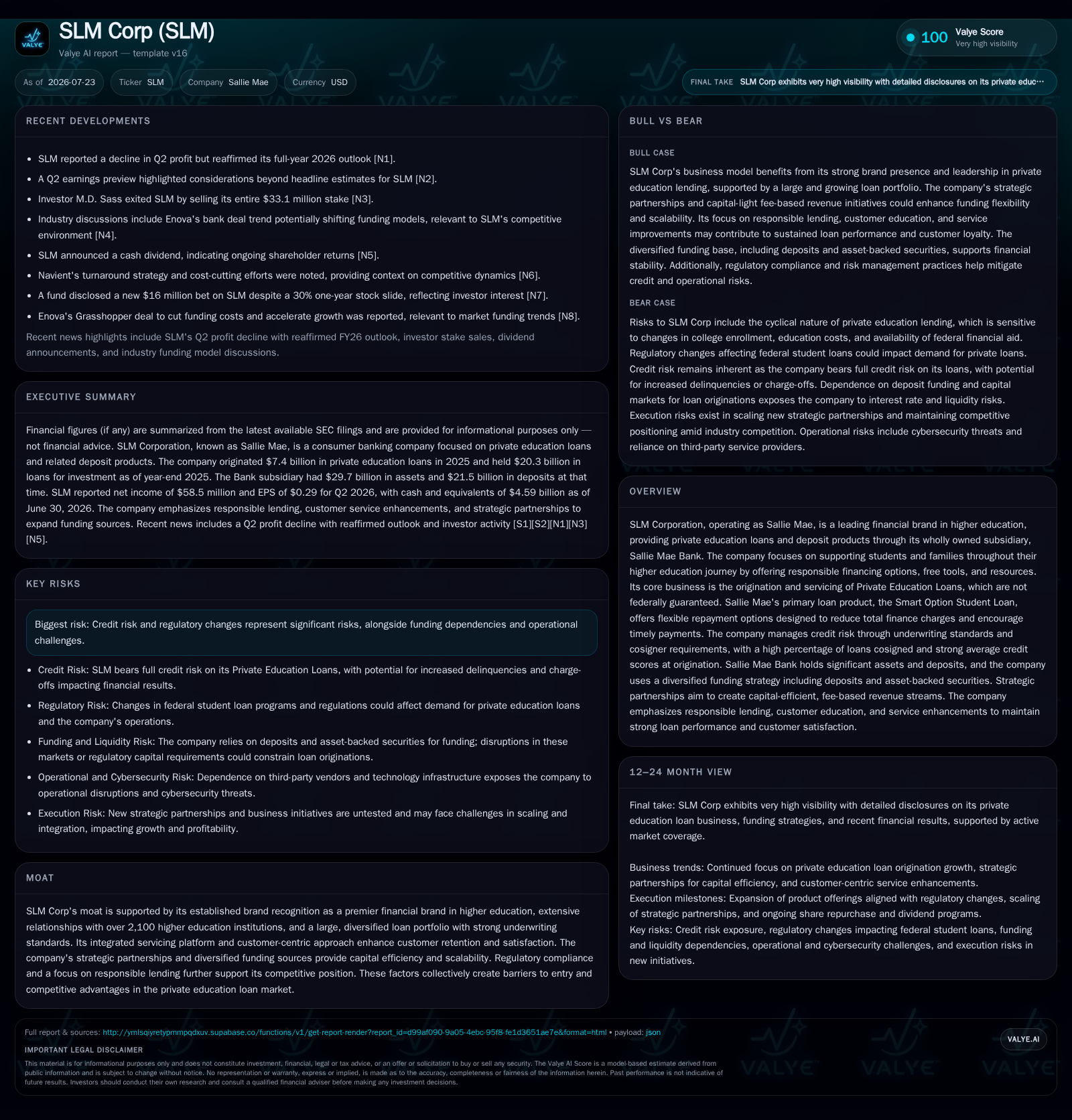
SLM Corp's Q2 2026 update underscores its credit risk management amid elevated charge-offs and leverages its banking subsidiary to support funding and margin optimization.
SLM Corporation, known as Sallie Mae, reported Q2 2026 results highlighting heightened credit losses but sustained deposit growth through Sallie Mae Bank. Its core private education loan origination focuses on strong underwriting with cosigner support, reflected in a high average credit score of 755 and over 90% cosigned loans originated in prior periods. Despite pressure from rising charge-offs and regulatory scrutiny, the company benefits from its recognized brand, diversified funding sources including deposits, and close institutional partnerships. Key challenges remain around charge-off trends and regulatory environment shifts. Monitoring loan origination volumes, delinquency rates, and deposit growth will be critical as SLM navigates these headwinds.
Recent Operating Update
SLM Corporation’s Q2 2026 10-Q filing highlights a challenging credit environment impacting its private education loan portfolio, with elevated net charge-offs pressuring earnings despite the loan portfolio size remaining stable at quarter-end [S2][N3]. This suggests that while origination volumes and portfolio balances have held steady, credit risk management is under stress, potentially reflecting macroeconomic headwinds or borrower-specific repayment difficulties. Concurrently, Sallie Mae Bank, the company’s wholly owned industrial bank subsidiary, continues to expand its deposit base, which serves as a lower-cost and stable funding source. This deposit growth supports diversification of funding beyond wholesale debt markets and contributes positively to net interest margin (NIM) expansion [S2][N1].
SLM’s revenue model primarily derives from interest income on outstanding private education loans, fees associated with loan origination and servicing, and net interest margin generated through Sallie Mae Bank’s deposit-taking activities [S1]. The company’s customer base consists mainly of undergraduate and graduate students and their families seeking supplemental financing for tuition, room and board, and other educational expenses not covered by federal aid.
A core strength of SLM’s underwriting approach lies in its rigorous credit risk management framework, which includes customized credit scoring models tailored to the student loan market and a strong emphasis on cosigner requirements. For loans originated in 2025, approximately 92.8% were cosigned, and the average FICO score at origination was a robust 755, reflecting high credit quality among borrowers and cosigners [S1]. This layered credit risk mitigation strategy is critical in managing default risk within a borrower segment that can be sensitive to economic cycles.
The integration of Sallie Mae Bank’s deposit products with the loan origination and servicing business enables SLM to internally source a significant portion of its funding, reducing reliance on external debt issuance. This funding mix enhances capital efficiency by converting retail deposits into low-cost loanable funds under regulatory oversight, thereby supporting margin stability and liquidity management.
Industry Structure and Competitive Position
The private education lending sector operates alongside federal student loan programs but is distinct in its credit-based underwriting and absence of government guarantees. Competitors in this space include established financial institutions such as Discover Financial Services’ education loan division and Wells Fargo Education Financial Services, as well as fintech companies like SoFi Technologies that focus on refinancing and niche lending products.
Regulatory and reputational risks are significant for SLM, given heightened public scrutiny of student lending practices and potential legislative changes that could impose stricter lending standards or increase compliance costs [S1]. Additionally, competition from federal student loan programs, which may adjust borrowing limits or terms, and alternative financing options continue to shape demand dynamics and competitive pressures.
Growth Drivers
Several macroeconomic and industry-specific factors underpin demand for SLM’s private education loan products despite cyclical headwinds:
- Rising Higher Education Costs: Tuition and related expenses continue to increase faster than family income, sustaining demand for supplemental private loans.
- Enrollment Trends: Changes in college enrollment directly affect the size of the borrower population eligible for private loans.
- Federal Aid Availability: Policy shifts or caps on federal student loans can redirect borrowers toward private lending alternatives.
- Expansion of Banking Services: Growth in Sallie Mae Bank’s deposit base broadens internal funding capacity, supporting margin enhancement.
- Technological Investments: Enhancements in underwriting analytics and loan servicing automation improve operational efficiency and scalability.
- Institutional Partnerships: Strong relationships with over 2,100 higher education institutions facilitate customer acquisition and retention through integrated financial aid collaborations [S1]
SLM closely monitors these factors through key performance indicators such as loan origination volumes, average credit scores and cosigner percentages at approval, delinquency and charge-off rates, deposit growth, and loan repayment trends.
Risks and Watchpoints
SLM’s business model entails several critical risks:
- Credit Risk: Elevated charge-off rates in recent quarters highlight borrower repayment challenges amid economic pressures [N3][N4]. Monitoring net charge-offs and delinquency trends, especially early-stage delinquencies, is essential.
- Regulatory and Legislative Risk: Potential changes in laws governing private education loans could increase compliance burdens or restrict product offerings.
- Reputational Risk: Negative publicity related to student lending practices could impair brand equity, affecting customer acquisition and retention [S1].
- Funding Risk: Although deposits provide stable funding, any slowdown in deposit growth or volatility in debt markets could constrain liquidity.
- Operational Risk: The complexity of servicing a large and diverse loan portfolio requires robust technology infrastructure; system failures could disrupt operations and regulatory compliance [S1].
- Competitive Pressure: Fintech entrants leveraging advanced data analytics and alternative underwriting models may challenge SLM’s market position.
- Macroeconomic Factors: Economic downturns, unemployment rates, and changes in borrower financial capacity can adversely affect repayment performance.
Key variables to monitor include quarter-over-quarter net charge-off rates, delinquency rates by loan vintage, deposit growth velocity, regulatory updates, and management commentary on market conditions.
What To Watch Next
Upcoming quarterly disclosures will be critical in assessing SLM’s ability to navigate credit challenges while maintaining growth:
- Loan origination volumes across borrower segments will indicate demand resilience or softness.
- Average credit scores and cosigner percentages at origination will reveal any shifts in underwriting discipline.
- Charge-off and delinquency rate trends relative to industry peers such as Navient and Discover will provide insight into portfolio quality.
- Deposit growth rates will reflect funding stability and margin support.
- Regulatory developments and compliance updates will clarify exposure to legislative risks.
- Progress in technology adoption and operational efficiency initiatives may influence future cost structures and scalability.
The interplay of these factors will determine whether current headwinds represent transient challenges or signal longer-term strategic adjustments.
Financial Profile Discussion
As of June 30, 2026, SLM reported approximately $4.59 billion in cash and cash equivalents against total debt of about $5.84 billion, resulting in net debt of roughly $1.26 billion [F1]. This capital structure reflects a balanced approach combining deposit-funded liabilities from Sallie Mae Bank with market debt issuances, maintaining liquidity and capital adequacy aligned with regulatory requirements and borrower risk profiles.
Capital allocation priorities include sustaining adequate loan loss reserves to buffer credit losses and investing in technology infrastructure to support scalable loan servicing and underwriting capabilities. These efforts are critical as the private education lending landscape evolves amid regulatory scrutiny and competitive innovation.
This analysis provides a detailed perspective on SLM Corporation’s current operating environment within the broader private education lending sector, emphasizing credit risk dynamics, funding strategies, and regulatory considerations without offering investment research views.
Disclaimer: This is research-only, informational analysis and not investment advice. It may include AI-generated interpretation and general industry context. Always verify important details using primary sources.

Comments