
JAB Acquisition Corp I Establishes Capital Foundation with $172.5 Million IPO Ahead of De-SPAC Execution
JAB Acquisition Corp I completed its IPO and sponsor private placement in June 2026, securing capital earmarked for an initial business combination within the typical SPAC timeline.
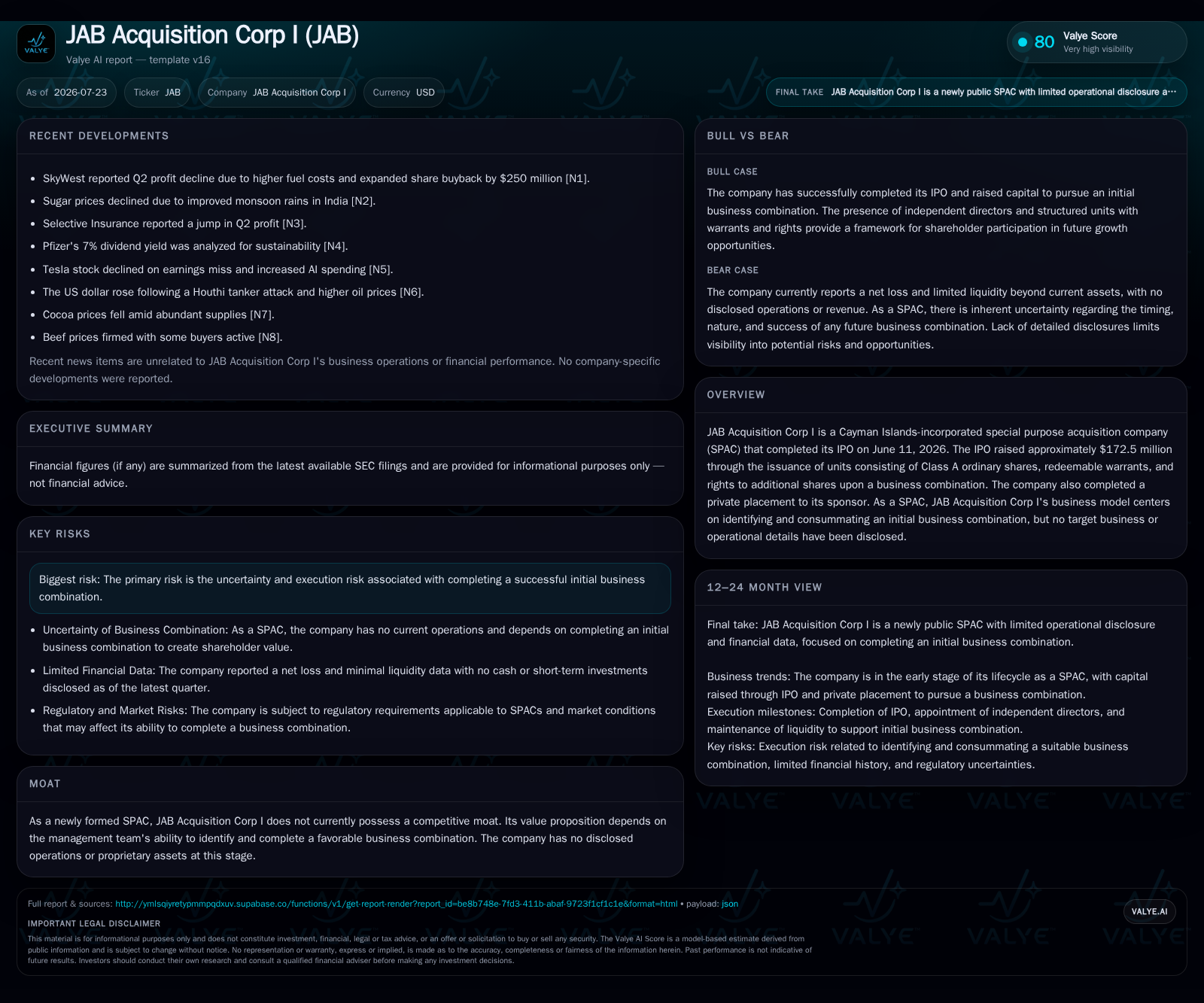
JAB Acquisition Corp I, a Cayman Islands-incorporated SPAC, closed its IPO on June 11, 2026, raising $172.5 million through units consisting of Class A ordinary shares, redeemable warrants, and fractional rights. A concurrent sponsor private placement added $2.6 million, aligning incentives for the upcoming de-SPAC phase. The company currently holds no operations or revenue, with capital held in a trust account to finance an acquisition target within the usual mandated timeframe. Key near-term factors include management’s ability to identify attractive targets, shareholder redemption levels impacting available capital, and securing PIPE financing to support deal size and valuation.
Recent Operating Update: IPO Completion and Capital Deployment Readiness
JAB Acquisition Corp I, a Cayman Islands-incorporated special purpose acquisition company (SPAC), completed its initial public offering (IPO) on June 11, 2026, successfully raising gross proceeds of $172.5 million through the issuance of 17.25 million units, including the full exercise of the underwriters’ 15% over-allotment option [S3][S8][S12]. Each unit consists of one Class A ordinary share (par value $0.0001), one redeemable warrant exercisable at $11.50 per share (subject to adjustment), and one right to receive one-fourth of an additional Class A ordinary share upon consummation of an initial business combination [S3][S7][S9].
Concurrently, the Sponsor completed a private placement of 260,000 units at $10.00 per unit, raising an additional $2.6 million under terms that include transfer restrictions until the completion of a business combination or certain limited exceptions [S8][S9]. The combined proceeds from the IPO and private placement are held in a segregated trust account, a standard SPAC mechanism designed to protect public shareholders’ capital until deployment in a de-SPAC transaction [S8][F1]. This trust account balance, which is the primary capital source for acquisition, is critical to maintaining investor confidence and ensuring disciplined capital allocation during the target evaluation phase.
As of the latest quarterly filing ending March 31, 2026, JAB reported minimal debt of approximately $48,895 and a current ratio near 1.03, reflecting a near-neutral liquidity position consistent with a newly formed SPAC holding cash in trust [F1]. The company has no operating revenues or assets aside from cash and equivalents held for future acquisition purposes.
Business Model and Capital Structure: Incentive Alignment and Dilution Dynamics
JAB’s business model centers on identifying and consummating a business combination within the typical SPAC timeframe of approximately 18 to 24 months post-IPO. Until such a transaction closes, the company operates without revenue, relying on the capital raised and held in trust to finance the acquisition. The structure of the units—combining ordinary shares, redeemable warrants, and rights—reflects common SPAC market conventions designed to balance investor equity exposure with potential dilution from warrant exercises.
The redeemable warrants, exercisable at $11.50 per share, serve as an incentive mechanism for both sponsors and public investors, aligning interests toward increasing post-merger equity value. However, warrant exercises can introduce dilution, impacting existing shareholders’ ownership percentages post-combination [S3][S7][S9].
The Sponsor’s private placement units are identical in economic terms but include registration rights and transfer restrictions that prevent transfer or sale until the business combination is completed, ensuring sponsor commitment throughout the de-SPAC process [S9]. This lock-up period is a key governance feature that mitigates potential conflicts of interest and supports alignment with public shareholders.
Industry Context: Competitive Positioning and Execution Imperatives
JAB operates within a competitive SPAC landscape characterized by a proliferation of vehicles targeting diverse sectors and deal sizes. Its mid-sized capital raise positions it among efficient SPACs aiming for selective and value-accretive acquisitions. This contrasts with larger, high-profile SPACs such as Pershing Square Tontine Holdings (PSTH), which pursue landmark deals with substantial capital bases, and sector-focused platforms like Social Capital Hedosophia Holdings (IPOA), known for technology-centric de-SPAC transactions leveraging specialized sponsor networks.
The SPAC industry’s key performance indicators (KPIs) include the percentage of shareholder redemptions, size and terms of PIPE (Private Investment in Public Equity) financing secured to supplement trust account funds, deal valuation multiples relative to comparable IPOs, and post-merger share price performance. While JAB has not disclosed specific target sectors or deal valuation metrics, its ability to secure PIPE financing and manage shareholder redemptions will be critical to maximizing available capital for acquisition and minimizing dilution.
Growth Drivers: Management Experience and Market Demand for Alternative Public Listings
JAB’s growth prospects depend heavily on the management team’s expertise in sourcing attractive private companies poised for accelerated public market access. Experienced management can enhance deal sourcing quality, valuation discipline, and execution speed, which are vital in a competitive SPAC environment.
Market demand for alternative listing routes remains robust, with private companies increasingly favoring SPAC mergers over traditional IPOs due to faster timelines, greater pricing certainty, and reduced regulatory burdens. This trend supports a healthy pipeline of potential targets for SPACs like JAB. Additionally, favorable macroeconomic conditions and liquidity availability bolster investor appetite for SPAC-backed listings and PIPE financing commitments, which are essential to closing larger or more complex transactions.
However, the growing number of SPAC sponsors intensifies competition for high-quality targets, increasing pressure on pricing and due diligence rigor. JAB’s mid-sized capital raise suggests a strategic focus on selective deals that balance speed and valuation considerations.
Risks and Watchpoints: Redemption Rates, Deadlines, and Regulatory Environment
Key risks for JAB include the failure to complete a business combination within the mandated timeframe, typically 18 to 24 months, which would trigger liquidation and return of funds to shareholders, potentially eroding market confidence [S2]. Shareholder redemption rights allow investors to redeem their shares prior to the business combination, which can materially reduce the capital available for acquisition and necessitate reliance on PIPE financing or smaller deal sizes, both of which may dilute existing shareholders.
Regulatory scrutiny of SPAC disclosures and valuation methodologies continues to evolve, posing compliance challenges that may affect transaction timing and structure. Market volatility can also impact share price dynamics, affecting the attractiveness of units and warrants and influencing shareholder redemption behavior.
Dilution from warrant exercises and sponsor promote structures remains a standard concern, as does the limited operating history and lack of revenue prior to combination, which place a premium on management’s deal sourcing and execution capabilities [S2]. Monitoring these risk factors is essential to understanding JAB’s potential for successful de-SPAC execution.
What to Monitor Next
Key indicators to watch include announcements of definitive agreements signaling progress toward a business combination, scheduling and outcomes of shareholder votes reflecting investor confidence, redemption statistics that affect deal capital availability, and PIPE financing commitments that underpin transaction scale and valuation.
Additionally, tracking management’s disclosures regarding target sectors, deal valuation multiples, and post-merger integration plans will provide insight into the potential for accretive equity value creation. The timing of the business combination relative to the SPAC’s expiration deadline will also be a critical factor in assessing execution risk.
This analysis synthesizes information from JAB Acquisition Corp I's SEC filings as recent as July 23, 2026 ([S2],[S3],[F1]) combined with industry-standard SPAC mechanics contextualized through sector knowledge layers. No forward-looking statements or investment advice are offered.
Disclaimer: This is research-only, informational analysis and not investment advice. It may include AI-generated interpretation and general industry context. Always verify important details using primary sources.

Comments