
Fly-E Group Faces Challenges Balancing Rapid Growth, Litigation, and Regulatory Compliance
Recent SEC updates reveal operational pressures amid legal risks and financial strain in Fly-E Group's electric mobility business.
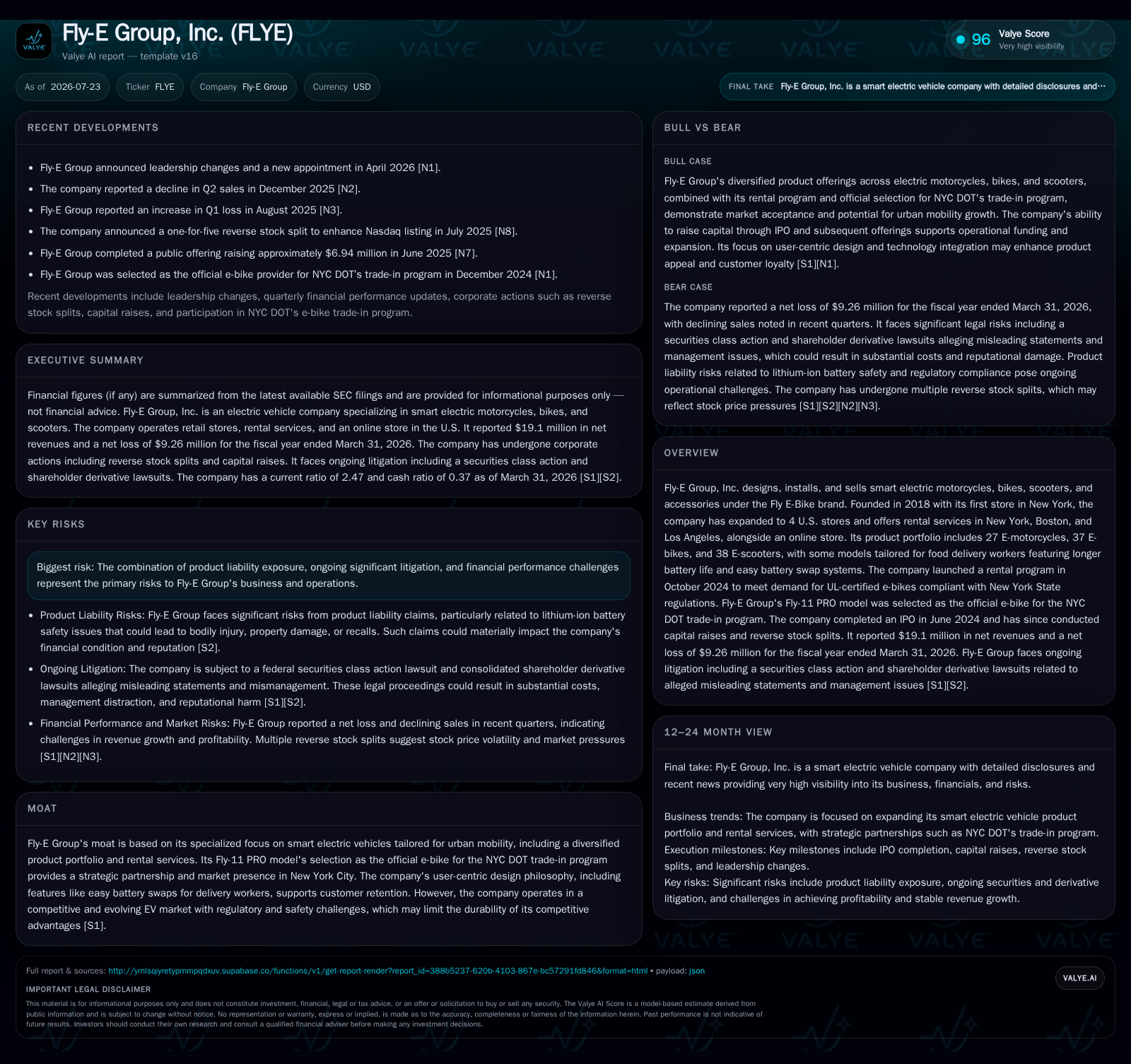
Fly-E Group, Inc. operates in the rapidly evolving electric mobility retail and rental industry, offering a diversified portfolio of smart E-motorcycles, E-bikes, and E-scooters principally through retail stores, distributors, and an online platform. Its recent quarterly filings show net revenues declining to approximately $19.1 million, with widening operating losses and ongoing SEC investigations coupled with securities litigation stressing the outlook. The company’s strength lies in its tailored products for urban mobility and delivery workers, supported by a strategic rental program featuring UL-certified e-bikes. Nevertheless, material risks from product liability exposure, regulatory compliance issues, and financial stress—including debt repayment defaults—pose significant constraints on sustainable growth.
Recent Operating Update
Fly-E Group, Inc. reported net revenues of approximately $19.1 million for the fiscal year ended March 31, 2026, reflecting a decline from $25.4 million in the prior year. This decrease was primarily driven by a significant reduction in retail sales revenue, which fell to about $6.9 million from $21.7 million, despite wholesale revenue growth to $11.6 million and rental services revenue increasing to $0.6 million [S1], [F1]. The operating loss widened to approximately $6.4 million, with a net loss of $9.3 million for the same period, underscoring ongoing challenges in scaling profitable operations [F1]. Cash and equivalents stood at roughly $2.5 million as of September 30, 2025, while total debt was approximately $6.0 million as of March 31, 2026, resulting in net debt near $3.4 million and a current ratio of 2.47x, indicating moderate short-term liquidity but limited financial flexibility [F1], [S7].
The company continues to operate an omnichannel retail model with four brick-and-mortar stores located in New York, Boston, Los Angeles, and Washington D.C., complemented by a network of 64 primarily domestic distributors that facilitate wholesale penetration beyond direct retail channels. An online store further supports sales, aiming to balance consumer reach with cost-effective marketing efforts [S1], [S6].
Business Model Analysis
Fly-E Group’s revenue streams are segmented into retail sales, wholesale distribution, and a growing rental program. Retail sales occur through branded stores and the online platform, while wholesale sales leverage the distributor network. The rental program, launched in October 2024, focuses on UL-certified e-bikes compliant with New York State regulations and is accessed via the Go Fly mobile app, offering flexible, subscription-like access to electric mobility vehicles without ownership commitments [S1], [S6]. This rental service aims to generate recurring revenue, smoothing the volatility inherent in unit sales.
The company’s product portfolio is diversified, encompassing 27 electric motorcycle models designed for higher-speed urban transit, 37 e-bike models including ruggedized versions tailored for last-mile delivery workers featuring longer battery life and an easy battery swap system, and 38 e-scooter models optimized for short-distance urban trips [S1]. The battery swap system, a key operational feature, allows delivery workers to replace depleted batteries quickly at retail locations, enhancing vehicle uptime and operational efficiency—a critical KPI in last-mile delivery fleet management.
Fly-E’s user-centric design philosophy incorporates continuous feedback loops from product performance data and customer input, enabling iterative improvements in powertrain technology, battery management, and vehicle ergonomics. This approach targets both lifestyle consumers and commercial users, particularly food delivery workers who represent a core customer segment benefiting from specialized product features such as stable rear seats for cargo and extended battery capacity [S6], [S12].
Brand positioning emphasizes a lifestyle and technology narrative, supported by experiential retail environments and a robust social media presence across platforms including Facebook, Instagram, TikTok, Xiaohongshu (Rednote), and WeChat. These channels are leveraged to educate users on e-mobility benefits and maintenance, fostering customer retention and community engagement, which are important KPIs for customer acquisition cost and retention rates in the sector [S6]
However, Fly-E faces significant product liability risks centered on lithium-ion battery safety. The potential for thermal runaway events leading to fires or malfunctions has resulted in ongoing class action litigation alleging misleading disclosures on battery safety and business prospects, initiated in September 2025. Concurrently, a U.S. SEC investigation launched in January 2026 is ongoing, with the company cooperating but facing regulatory scrutiny that could affect reputation and operational compliance [S1], [S8], [S10], [S21]. These risks could lead to costly recalls, increased insurance premiums, and damage to brand equity, all of which would negatively impact gross margins and operating results.
Industry Structure and Competitive Position
Fly-E operates downstream in the electric vehicle value chain, focusing on assembly and distribution rather than raw component manufacturing. The company sources a significant portion of vehicle components from China and the United States, assembling them at its Maspeth, New York facility. In the fiscal year ended March 31, 2026, Fly-E assembled approximately 2,714 electric motorcycles, 6,722 e-bikes, and 1,830 e-scooters, totaling over 11,000 units [S1]. This mixed sourcing exposes the company to supply chain risks including geopolitical tensions, shipping cost volatility, and component availability constraints common in the EV sector.
The competitive landscape includes diversified electric vehicle manufacturers such as Rad Power Bikes and NIU Technologies, which offer broad product portfolios and operate both direct-to-consumer and wholesale channels. Traditional motorcycle manufacturers like Harley-Davidson have entered the electric segment with models such as LiveWire, emphasizing technology innovation and brand heritage. Additionally, urban mobility rental operators like Lime and Bird exemplify app-driven fleet management models that leverage scale and utilization economics rather than unit sales alone.
Fly-E’s niche focuses on high-utilization commercial segments, particularly food delivery fleets in dense metropolitan areas. Its emphasis on regulatory compliance, including UL certification recognized by New York City’s Department of Transportation, and product features tailored to delivery workers partially insulates it from commoditized consumer markets but demands continuous investment in safety and regulatory adherence [S6], [S8].
Growth Drivers
Several secular trends underpin Fly-E’s growth potential despite current headwinds:
- Urbanization: Increasing urban density drives demand for efficient last-mile transportation solutions adaptable to congested city environments.
- Gig Economy Expansion: Growth in food and package delivery services creates demand for durable, high-utilization e-bikes with rapid battery swap capabilities to maximize operational uptime.
- Regulatory Incentives: Government mandates and incentives promoting eco-friendly transportation, including UL certification requirements, encourage adoption and provide market access advantages.
- Digital Platform Development: Enhancements to the Go Fly app and planned Fly E-Bike app aim to embed fleet management and customer engagement functionalities, supporting recurring rental revenues and improved customer retention.
- Social Media Marketing: Targeted campaigns on platforms popular with millennial and Gen Z consumers support brand awareness and community building around sustainability themes.
Operational watchpoints include monitoring product return and warranty claim rates related to battery safety, rental fleet utilization rates via the Go Fly app, retail store same-store sales growth, and progress on liquidity and financing arrangements. Any adverse regulatory rulings or legal settlements could impose capital outflows that constrain R&D investment critical for product innovation and competitive positioning.
What to Watch Next
Key near-term developments include the company’s response to Nasdaq Listing Rule compliance requirements, with a plan submission deadline of September 21, 2026, following recent deficiency notices tied to delayed filings that pose listing continuity risks [S3]
Financially, securing new equity or debt financing is critical to sustain working capital amid negative EBITDA margins exceeding one-third of revenues and rising accounts receivable balances, which increase credit risk and lengthen cash conversion cycles [F1], [S7].
Progress on the ERP system enhancements completed in May 2025 and iterative releases of the Fly E-Bike mobile app will be important indicators of the company’s ability to integrate omnichannel sales and rental services, potentially improving customer experience and retention [S5]
Monitoring rental average revenue per user (ARPU) growth and geographic expansion of the rental program beyond initial markets such as Boston will provide insight into the maturity and scalability of this recurring revenue stream.
Financial Profile Discussion
As of March 31, 2026, Fly-E Group reported total debt of approximately $6.0 million and net debt near $3.4 million, with cash and equivalents of about $2.5 million as of September 30, 2025 [F1]. Current assets of roughly $16.8 million against current liabilities of $6.8 million yield a current ratio of approximately 2.47x, indicating moderate short-term liquidity but limited cushion against operational and legal contingencies [F1].
Fly-E’s financial sustainability depends on stabilizing retail demand, scaling higher-margin rental revenues supported by proprietary technology platforms, and managing product liability exposures that could materially affect gross margins [S7]. The company’s ability to secure additional financing on acceptable terms will be critical to maintaining operations and investing in product development to remain competitive in the evolving urban electric mobility market
Disclaimer: This is research-only, informational analysis and not investment advice. It may include AI-generated interpretation and general industry context. Always verify important details using primary sources.

Comments