
Liberty Energy's Dual-Track Growth: Hydraulic Fracturing Advances and Distributed Power Expansion
Q2 results reveal operational strength in completions services alongside emerging regulatory risks to distributed power demand.
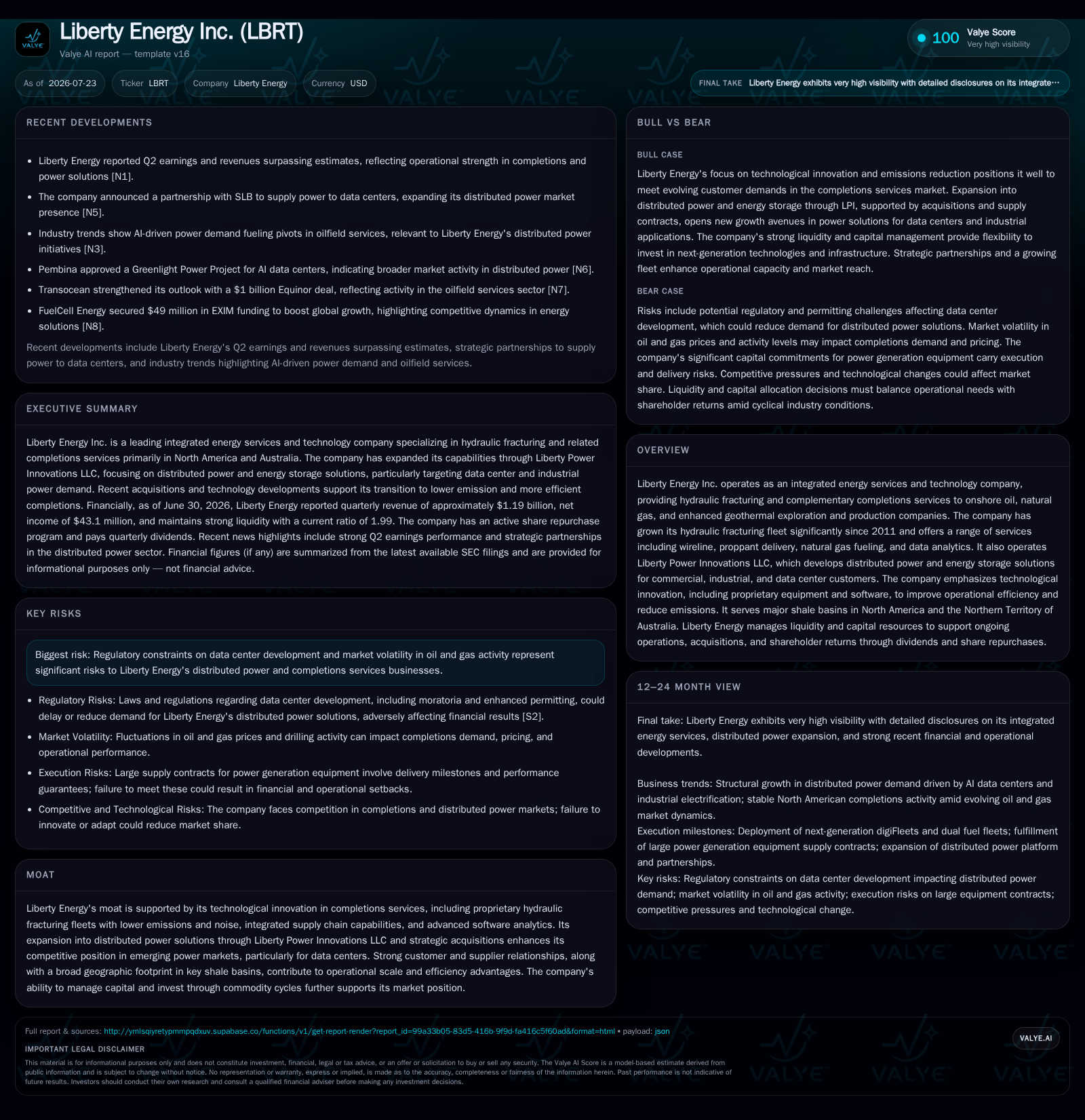
Liberty Energy posted stronger-than-expected second-quarter operating performance driven by robust hydraulic fracturing fleet utilization and expanding proprietary technology deployment. Concurrently, regulatory developments introducing moratoria on data center infrastructure pose growing challenges to its distributed power segment, a key growth focus via Liberty Power Innovations. The company’s integration of digital and dual fuel technologies supporting both traditional completions services and emerging commercial power markets distinguishes it competitively amid commodity cycle volatility. Monitoring near-term backlog trends and regulatory clarity will be critical for tracking execution momentum across Liberty’s dual energy-service platform.
Q2 Performance Highlights Underscore Operational Scale Expansion and Emerging Risks
However, Q2 filings also flagged heightened regulatory risk stemming from moratoria and escalating permitting requirements on new data center developments in certain jurisdictions. These constraints threaten near- and medium-term deployment pace for LPI's distributed power projects by potentially delaying customer investments or increasing compliance costs, thereby constraining revenue visibility for that segment [S2]. This dual dynamic – operational strength in completions coupled with regulatory headwinds in distributed power – frames the nuanced near-term outlook.
Technological Innovation Drives Service Differentiation Amid Industry Cyclicality
Liberty Energy's moat leans heavily on proprietary technology innovations designed to enhance completions efficiency while reducing emissions intensity—a key priority for upstream operators facing environmental scrutiny. Its digiFleets™ technology platform encompasses advanced frac pumps (digiFrac™), auxiliary equipment (digiPrime™), and integrated data analytics enabling optimized fracture design based on multi-variable reservoir modeling. These analytics-driven optimizations aim to maximize fracture stage count per well while balancing proppant volume delivery with operational cost control [S1]
Complementing this software advantage is the Quiet Fleet® design that materially lowers noise emissions relative to conventional fracturing fleets, facilitating operations in noise-sensitive regions or near communities. Moreover, Liberty deploys dual fuel dynamic gas blending (DGB) fleets able to seamlessly switch or blend between diesel and field-sourced natural gas. This innovation mitigates diesel dependency—reducing fuel costs and lowering combustion emissions—and provides operational flexibility particularly valued amid fluctuating fuel prices [S1].
Such technology investments underpin operational KPIs including improved fleet utilization rates through quicker turnaround times enabled by digiFleet-driven predictive maintenance, as well as lower emissions intensity per job supporting customer environmental goals. While Halliburton and Schlumberger also invest heavily in similar digital completions tools, Liberty’s integrated approach combining proprietary hardware designs with tailored fluid systems provides a distinctive value proposition within mid-sized players aiming to displace legacy competitors offering more commoditized services.
Distributed Power Segment Growth Positioned at Intersection of Energy Transition and Infrastructure Demand
Liberty Power Innovations LLC represents a deliberate diversification into fee-for-service distributed energy solutions aimed at commercial, industrial, mining, and critically, data center customers requiring high-reliability onsite power coupled with emissions-conscious fuel options [S1]. The 2025 acquisition of IMG Energy Solutions added engineering design capacity focused on scalable power system development along with enhanced software controls for integration with utility grids.
Following this acquisition, LPI has expanded natural gas fueling capabilities targeting larger-scale installations aligned with broader market trends favoring cleaner-burning fuels over diesel generators. These developments cater especially well to data centers—an expanding segment driven by AI workloads demanding continuous high-quality power supply—but are vulnerable to zoning moratoria impacting new construction timelines.
Although specific megawatt capacity deployed has not been publicly disclosed yet, the firm's stated pipeline formation signals an advancing commercialization stage beyond initial pilot phases. This positions Liberty at the intersection of traditional oilfield service cyclicality and the more defensive growth trajectory associated with infrastructure utility projects.
Competitive Position: Balancing Scale with Specialized Solutions in Integrated Services Markets
With about 40 active fracturing fleets as of late 2025—the largest operational base since inception—Liberty Energy holds substantial scale among mid-tier integrated oilfield service providers [S1]. Its geographic footprint spans key North American shale basins including Permian, Eagle Ford, Haynesville, Appalachia plus Northern Territory Australia operations enhancing diversification.
While neither matching Halliburton nor Schlumberger’s global reach nor capital resources fully, Liberty leverages its technological differentiators such as Quiet Fleet designs and digiFleets analytics to carve specialized niches attracting environmentally sensitive operators or those prioritizing efficient fracture complexity.
Simultaneously, its concurrent push into distributed power solutions sets it apart from pure-play oilfield service peers focused exclusively on upstream completions. LPI competes more directly with dedicated distributed energy system developers catering to commercial sites requiring integrated power plus fuel solutions—an area still nascent but poised for rapid growth amid rising enterprise sustainability mandates.
This combined asset base—ranging from supply chain integration across proppant delivery to digital monitoring platforms—affords operational flexibility helping balance customer concentration risks prevalent in shale-focused oilfield services.
Growth Catalysts: Fleet Utilization, Dual Fuel Adoption, and Market Diversification Opportunities
Key levers underpinning Liberty’s growth include maintaining or improving fleet utilization rates—critical given fixed operating costs associated with hydraulic fracturing equipment—and driving uptake of dual fuel DGB technology which enhances overall fuel economics amidst volatile diesel pricing regimes [S2], [S1].
Geographic expansion efforts beyond core U.S. plays into additional basins in Australia provide further capacity leverage while supporting customer diversification across regional markets sensitive to differing regulatory climates.
On the distributed power front, broadening LPI’s project pipeline alignment into AI-focused data centers leverages secular tailwinds related to growing cloud infrastructure needs despite regulatory headwinds slowing some new builds. The integration of natural gas fueling as part of combined offerings increases switching advantages versus competitor standalone generator providers.
Together these elements constitute a pragmatic growth portfolio balancing commodity exposure inherent in upstream completions against longer-dated visibility tied to commercial infrastructure deployments.
Regulatory Headwinds Impacting Data Center Development Pose Sector-Specific Challenges
The latest quarterly filing provided explicit caution regarding increased governmental scrutiny around data center infrastructure projects—including moratoria imposed by local authorities pending environmental reviews covering water use efficiency, noise control measures, traffic impacts—and stricter permitting processes nationally across several U.S. states affecting timely project commencement [S2]
Such regulatory actions have delayed some planned expansions or constrained project scope sizes potentially suppressing short- to medium-term demand for LPI’s distributed power solutions tailored toward these customers.
This emerging constraint introduces uncertainty in projecting revenue ramp for Liberty’s non-completions businesses requiring proactive mitigation through diversified end-markets or accelerated project pipeline progression where jurisdictional clearance exists.
"Watching Key Milestones" — Indicators for Execution Success in Both Completions and Distributed Power
Investors should closely monitor several leading indicators:
- Hydraulic fracturing fleet utilization rates and average job cycle times confirming sustained completions activity volume support margin stability;
- Adoption velocity of digital tools embedded within digiFleets indicating deeper client integration;
- Contract backlog growth specific to LPI projects demonstrating advancing commercialization;
- Regulatory developments nationally concerning data center zoning impacting near-term project timing;
- Capital expenditure pace reflecting ongoing investments into new fleet units or technology upgrades indicating confidence in demand trajectory;
- Commentary on proppant delivery volumes which often correlate closely with fracture stage intensity per completion job.
Tracking these metrics quarterly will provide clearer visibility into how effectively Liberty balances cyclical upstream dynamics against promising structural expansion of its solution suite.
Financial Profile Discussion: Capital Structure Comfort Amid Investment Program
As of June 30, 2026, Liberty Energy held $555 million in cash and equivalents against approximately $1.33 billion total debt yielding net debt of around $772 million while maintaining a current ratio close to 2x demonstrating adequate near-term liquidity coverage through working capital management [F1]
This balance sheet position underpins ongoing capital allocation toward hydraulic fracturing fleet expansion initiatives alongside technology upgrades including software-enhanced digiFleets platforms as well as funding growth-related acquisitions like IMG Energy Solutions expanding the distributed power footprint.
Operating income realized in recent periods reflects effective cost control amidst price competition common within oilfield services although margin pressures could emerge if commodity prices soften materially. Free cash flow generation remains a critical metric given the capital-intensive nature of equipment procurement and deployment.
Disclaimer: This analysis is based solely on publicly available information as of July 23, 2026. It is intended strictly for informational purposes without any investment research view or advice.
Disclaimer: This is research-only, informational analysis and not investment advice. It may include AI-generated interpretation and general industry context. Always verify important details using primary sources.

Comments