
How LTC Properties Embraced RIDEA to Transform Growth and Risk Profiles
LTC Properties’ adoption of the RIDEA structure in 2025 catalyzed a significant revenue surge while reshaping its operational and financial risk dynamics.
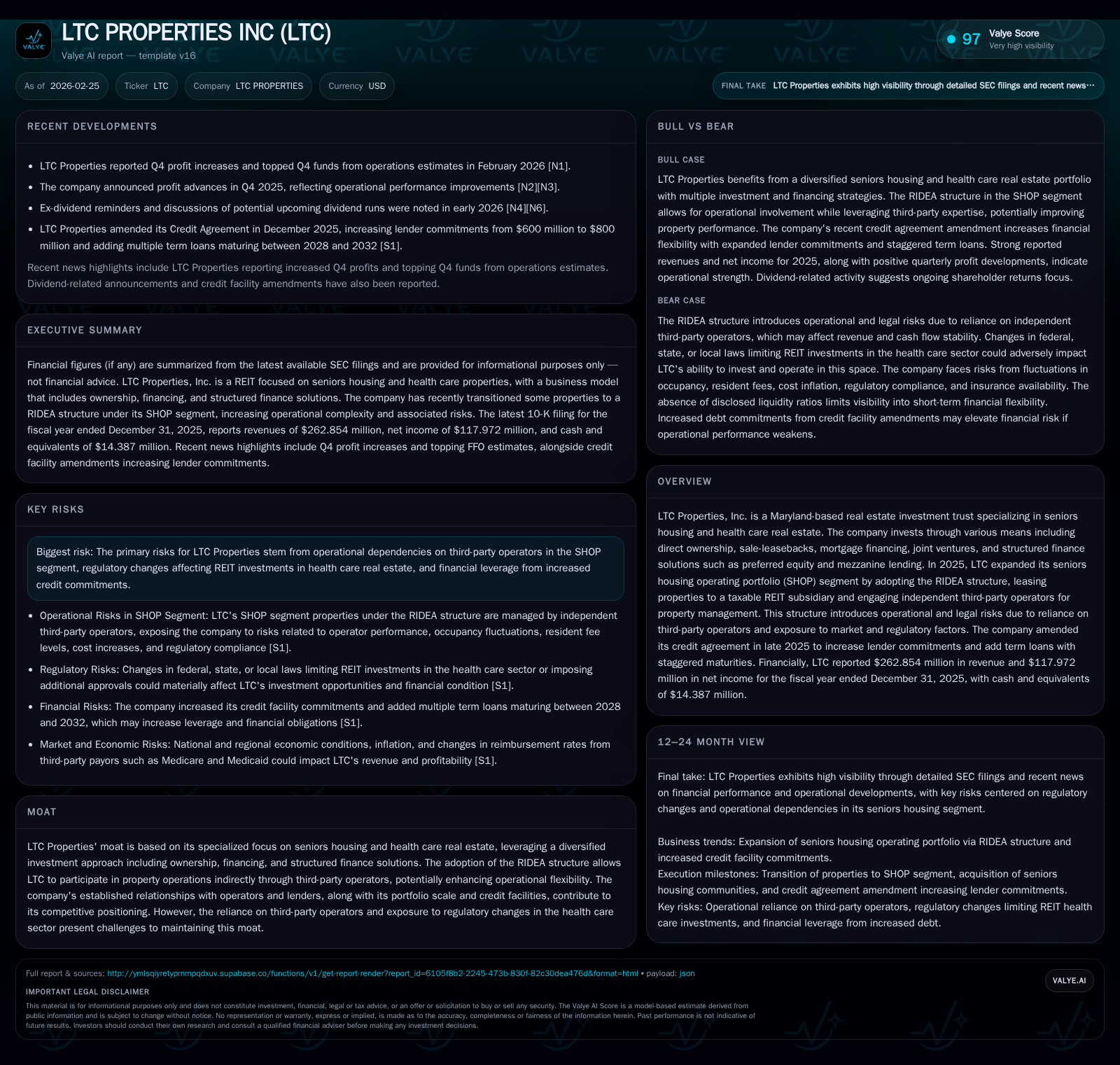
In 2025, LTC Properties Inc. achieved a near 400% increase in revenue driven primarily by its strategic shift to the RIDEA model within its Seniors Housing Operating Portfolio (SHOP). This structure leverages taxable REIT subsidiaries and independent third-party operators, enabling LTC to participate indirectly in property operations but also introduces new operational and legal risks. The company concurrently amended its credit agreements to bolster financial flexibility amid a more leveraged capital structure. While net income and operating cash flow grew moderately, regulatory uncertainties and reliance on external operators present key risks going forward.
From Incremental Growth to a Quantum Leap: LTC’s Historical Financial Trajectory
LTC Properties demonstrated steady growth through the early 2020s before executing a transformational shift in its business approach in 2025. Annual revenues advanced modestly from $47.8 million in FY2022 to $52.6 million in FY2024 — representing generally stable operations within seniors housing and health care real estate [F1]. However, this trend abruptly accelerated last year with total revenues ballooning to $262.9 million in FY2025, marking an extraordinary year-over-year (YoY) increase of approximately 400% driven by fundamental strategic changes rather than simple organic growth [F1].
Operating income followed a similar trajectory: it decreased slightly from $99.1 million in FY2022 to $90.0 million in FY2023 but rose thereafter to $92.4 million in FY2024 before surging to $204.7 million in FY2025 — an uplift of over 120% YoY [F1]. This jump reflects an enhanced profitability profile linked closely to new structural and portfolio shifts within the company's seniors housing operations.
Net income exhibited more muted movement relative to revenue and operating income increases but still climbed from $89.7 million in FY2023 to roughly $118.0 million in FY2025 (+29.6% YoY), indicating positive bottom-line effects from operational changes [F1]. Concurrently, operating cash flow strengthened consistently over this period, rising from $105.6 million in 2022 to nearly $136.0 million by late 2025 (+8.6%), underscoring underlying cash-generative capabilities amid evolving portfolio dynamics [F1].
Historical performance (annual)
| FY | Rev ($mm) | Net ($mm) | CFO ($mm) | OpInc ($mm) | Rev YoY | Net YoY |
|---|---|---|---|---|---|---|
| 2025 | 263 | 118 | 136 | 205 | +399.9% | +29.6% |
| 2024 | 53 | 91 | 125 | 92 | +4.8% | +1.5% |
| 2023 | 50 | 90 | 104 | 90 | +4.9% | -10.3% |
| 2022 | 48 | 100 | 106 | 99 |
Note: Omitted columns lack sufficient annual XBRL coverage in the provided tags (need ≥2 annual points): Capex, Buybacks, FCF. Source: SEC companyfacts cache [F1].
Capital returns and efficiency (annual)
| FY | Div ($mm) | ROE% |
|---|---|---|
| 2025 | 107 | 11.0 |
| 2024 | 101 | 9.5 |
| 2023 | 95 | 10.2 |
| 2022 | 92 | 12.1 |
Source: SEC companyfacts cache [F1].
Note: Capital expenditures (Capex) data is not available from provided tags; share buyback activity has not been material post-2022.
RIDEA Adoption: Revolutionizing Seniors Housing Investment and Operating Risk
The pivotal driver behind LTC Properties’ substantial growth was its adoption of the REIT Investment Diversification and Empowerment Act (RIDEA) structure starting mid-2025 [S2]. Under this framework, LTC leases qualified healthcare properties on arm's-length terms to a taxable REIT subsidiary (TRS), which then contracts eligible independent third-party operators for day-to-day management duties [S2].
This arrangement allows LTC via its TRS to earn management fees while sharing operational risk with external entities rather than directly managing properties under triple-net leases as before [S2]. The transition involved terminating legacy master leases—such as those with Anthem Memory Care LLC and New Perspective Senior Living LLC—and converting multiple memory care plus an assisted living community into its Seniors Housing Operating Portfolio (SHOP) under RIDEA governance [S2].
Additionally, eight seniors housing communities were acquired during the same period expanding the SHOP segment further [S2].
While RIDEA offers enhanced flexibility and potential upside participation beyond passive ownership or financing models typical of seniors housing REITs, it introduces distinct legal and operational risks: dependence on independent operators’ expertise; compliance with healthcare regulations; exposure to occupancy rate fluctuations; inflationary pressures on costs; insurance adequacy concerns; and liabilities inherent to property operations remain material considerations affecting earnings stability [S2], [S9].
This hybrid asset-plus-operation model contrasts with traditional triple-net lease structures where landlord-facing tenant risk is lower but upside participation is limited.
Unpacking Financial Performance Drivers for FY2025
Q4-2025 disclosures corroborate that SHOP segment adoption materially boosted revenues relative to prior years’ triple-net lease frameworks [N1], [N2], [N3]. Combined with contributions from recent acquisitions within SHOP, LTC reported adjusted FFO per share exceeding estimates alongside improved net profit margins versus Q4-24 comparables.
The doubling of operating income (+121%) aligns with increased direct involvement through SHOP properties generating both rent and management fees tied to property-level results [F1]. This higher operating leverage exposes earnings sensitivity to occupancy rates, expense management efficiency, and resident fee setting by third-party operators—core metrics intrinsic to the SHOP model’s viability.
Leverage metrics evolved concurrently with these revenues as interest expenses rose modestly due to additional term loans introduced alongside portfolio expansion efforts enabled by amendments to credit facilities detailed below [S4]–[S7].
Capital Structure Realignment: Credit Amendments Enhancing Liquidity Amid Expansion
In late 2025, LTC amended its credit arrangements through a third-amended and restated credit agreement that increased lender commitments and introduced term loans with staggered maturities designed for debt servicing flexibility and liquidity runway extension amidst expansion activities [S4]–[S7].
These refinements prevent large lump-sum refinancing needs simultaneously—a tactical advantage given tightening credit markets for specialized REITs.
Interest coverage ratios remain solid while leverage ratios are higher compared with prior years due primarily to upfront capital requirements for SHOP portfolio growth alongside acquisition financing support.
This capital structuring reflects a balancing act between seizing accretive growth opportunities via expanded operational involvement while maintaining prudent liquidity buffers against rising complexity risks.
Shareholder Returns: Dividends Steady While Buybacks Remain Dormant
Dividend payments increased modestly in FY2025 totaling approximately $107 million—up about 7% from FY24—demonstrating continued commitment despite evolving risk profiles [F1], [N4], [N6]. This rise corresponds proportionally with equity base expansion driven by retained earnings growth plus capital raises supporting acquisitions.
No material share repurchase activity has been reported since pre-2023 periods indicating cautious capital deployment amid strategic transitions or conservatism given debt servicing priorities.
Approximate return on equity (ROE), calculated as net income ($117.97 million) divided by stockholders' equity ($1.07 billion), stands near 11%, consistent with peers managing tradeoffs between stable rental cash flows versus exposure inherent in direct operation or structured segments like SHOP [F1].
Operational Risk Spotlight: Dependency on Third-Party Operators Within SHOP Segment
Despite holding oversight rights over TRSs under RIDEA, LTC remains liable for properties operated by independent third-party managers selected based on eligibility criteria governing taxable REIT subsidiaries (TRSs) [S2], [S9].
Management fee structures incentivize operators but also expose LTC indirectly to external factors such as labor market tightness impacting staffing costs or insurance premium spikes related to liability claims.
Financial difficulties among lessees could lead to lease defaults requiring timely remediation including replacement operator sourcing—a process fraught with timing uncertainty that affects income stream continuity closely monitored by investors.
These contingent liabilities underscore how RIDEA adoption presents fundamentally different risk-return dynamics relative to traditional triple-net leasing where landlord-facing tenant risk is comparatively lower.
Monitoring Milestones: Key Indicators for Investors Going Forward
Investors should closely watch upcoming quarterly earnings reports for continued performance trends within the SHOP segment compared against traditional leased property segments such as senior loans or mortgage portfolios.
Regulatory developments warrant vigilant tracking given legislative proposals potentially limiting REIT stakes or imposing new oversight requirements impacting health care real estate investments—any enactment would materially affect growth avenues available for LTC [S2], [S9].
Further asset acquisitions or transitions into RIDEA/SHOP models will indicate management’s conviction balanced against emerging operational outcomes; success would validate strategy whereas failures might trigger deleveraging or reassessment.
Updates on credit facility utilization and covenant compliance will serve as barometers for financial health underpinning ongoing disciplined capital allocation amid sector cyclicality.
Disclaimer: This analysis is informational based on publicly available data including SEC filings ([F1],[S#]) and recent news ([N#]). It does not constitute investment advice or recommendations.
Disclaimer: This is research-only, informational analysis and not investment advice. It may include AI-generated interpretation and general industry context. Always verify important details using primary sources.

Comments