
LXP Industrial Trust's Net-Lease Industrial Portfolio Supports Stable Cash Flows but Faces Merger Uncertainties
LXP reports strong portfolio occupancy and FFO beat in Q2 2026 while navigating merger-related operational constraints.
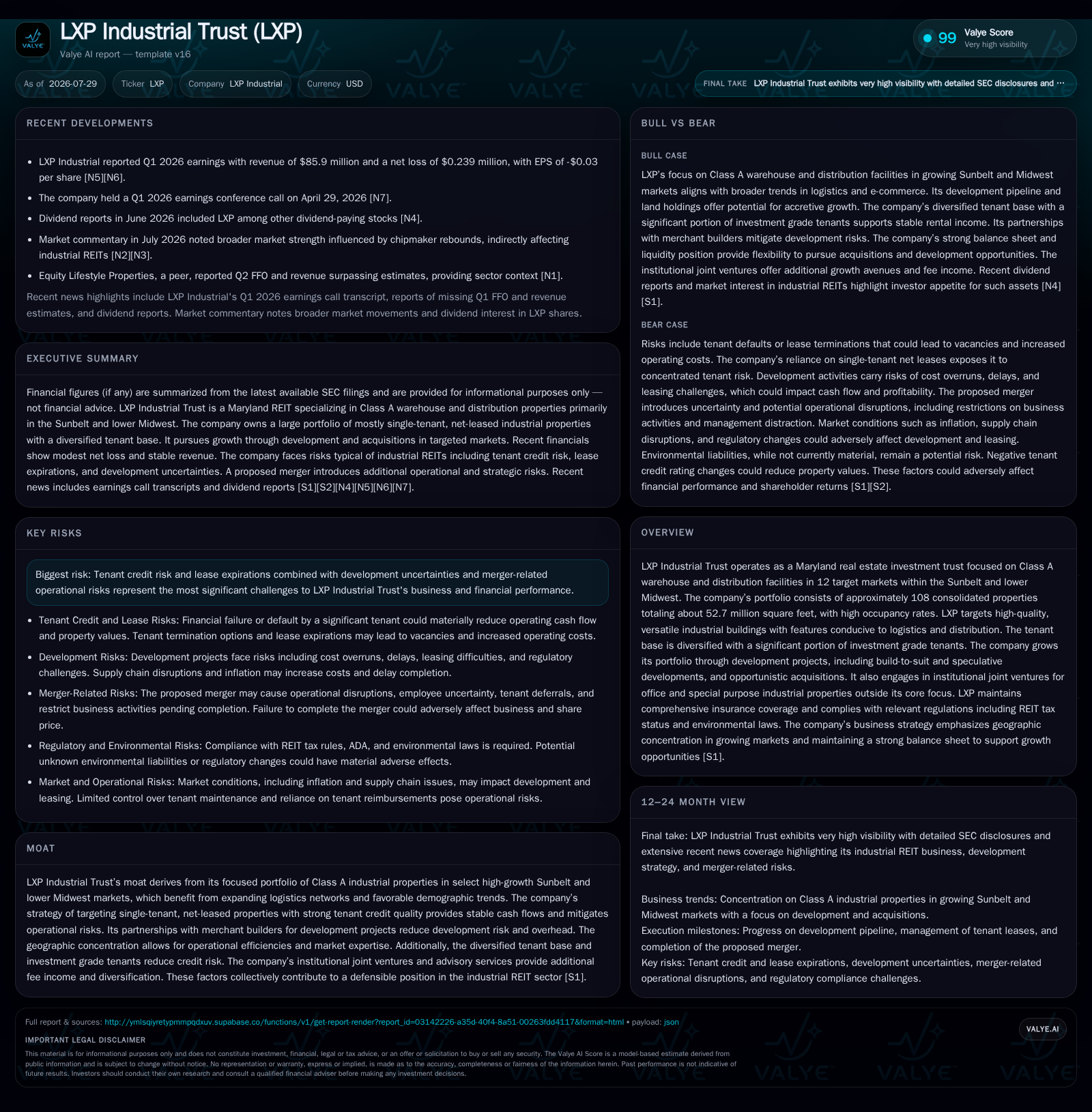
LXP Industrial Trust, a Maryland REIT specializing in Class A industrial warehouses in key Sunbelt and Midwest markets, reported solid Q2 2026 operating results highlighted by high portfolio occupancy and FFO exceeding expectations. The company’s strategy centers on long-term net leases with single tenants of strong credit quality, supported by development partnerships that mitigate risk and enhance growth potential. However, near-term operating flexibility is constrained due to its announced merger agreement, introducing execution uncertainty and potential disruption to tenant and employee relationships. LXP’s geographic focus combines moat benefits with concentration risks, while tenant credit and lease maturity profiles remain critical cash flow stability factors going forward.
Recent Operating Update Highlights
LXP Industrial Trust reported second-quarter results for the period ending June 30, 2026, demonstrating operational resilience amid the complexities of an ongoing merger process. The company’s portfolio consists of approximately 108 consolidated Class A industrial warehouse and distribution properties totaling about 52.7 million square feet, with a strong occupancy rate near 97% as of the end of 2025 [S2], [S1]. Funds From Operations (FFO) for Q2 exceeded analyst expectations, underscoring the stability of LXP’s rental income streams and effective portfolio management [N2], [S3]. However, management highlighted that the recently announced merger agreement has introduced near-term uncertainties, including potential disruptions to leasing activity and employee retention challenges, which could affect operational momentum until the transaction closes [S23], [S24]. These factors create a dynamic environment balancing steady property fundamentals against merger-related execution risks.
Business Model Specifics
LXP operates as a Maryland real estate investment trust (REIT) specializing in Class A industrial properties leased predominantly under net lease agreements. In these net leases, tenants assume responsibility for real estate taxes, insurance, utilities, repairs, and other operating expenses, which provides LXP with predictable and stable rental income while minimizing exposure to property operating cost fluctuations—a key margin protection feature in the industrial REIT sector [S1]. The portfolio is primarily composed of single-tenant buildings leased on long-term contracts to tenants with generally strong credit profiles, reducing vacancy risk and turnover-related costs.
A cornerstone of LXP’s growth strategy is its partnership model with merchant builders for both build-to-suit and speculative developments. These partnerships shift entitlement and cost overrun risks to experienced builders, allowing LXP to focus capital allocation on land acquisition and leasing while leveraging builder expertise to accelerate project delivery. The company holds approximately 514 acres of developable land across its 12 target Sunbelt and lower Midwest markets, supporting organic growth through new construction alongside opportunistic acquisitions consistent with its geographic concentration [S1].
LXP’s geographic focus on select Sunbelt and Midwest markets enables it to capitalize on favorable demographic and economic trends such as population growth, expanding transportation infrastructure, reshoring of manufacturing, and labor market strength. This regional concentration provides operational efficiencies and local market expertise but also introduces concentration risk should adverse local economic or regulatory developments occur [S1].
Industry Structure & Competitive Positioning
Within the industrial REIT sector, which primarily owns warehouses, distribution centers, and logistics facilities leased mostly on a net basis, LXP distinguishes itself as a net lease specialist focused on single-tenant properties. This contrasts with multi-tenant industrial REITs, which typically have higher leasing frequency and tenant diversification but greater property management complexity. LXP’s portfolio strategy emphasizes long weighted average lease terms (WALT), often exceeding seven years, which enhances cash flow visibility but limits flexibility to capture rising market rents quickly.
Peers such as Prologis and Duke Realty operate more diversified multi-tenant portfolios, balancing leasing risk across multiple tenants but facing higher operational costs and volatility. LXP’s single-tenant net lease model reduces leasing commissions and re-leasing costs due to lower turnover frequency but increases reliance on the credit quality of individual tenants. Tenant credit risk is a critical factor because a default or bankruptcy by a major tenant could result in immediate vacancy and full responsibility for property operating expenses, including taxes and maintenance, until re-leasing occurs [S1]. The company actively monitors lease expirations and tenant credit profiles to manage these risks.
Growth Drivers Distinctive to LXP
Several secular trends underpin demand for LXP’s industrial real estate assets. The continued expansion of e-commerce drives increased need for warehouse and distribution space near population centers, aligning with LXP’s Sunbelt and Midwest market focus where last-mile delivery efficiency is paramount. Additionally, reshoring of manufacturing operations to domestic locations supports demand for logistics infrastructure proximate to labor pools.
LXP’s build-to-suit development program captures value by securing tenants early in the development cycle, enabling higher returns compared to acquiring existing fully leased properties. Joint ventures with merchant builders further diversify development risk and provide access to additional capital, facilitating portfolio diversification into complementary industrial property types beyond core holdings [S1].
Employment growth in key metropolitan areas within LXP’s target regions correlates with increased commercial activity, reinforcing occupancy stability and supporting rental rate resilience. These demographic and economic tailwinds contribute to the company’s ability to maintain high occupancy and achieve favorable leasing spreads.
Risks & Watchpoints
Despite structural advantages, several risks merit close attention:
- Merger Execution Risk: The pending acquisition by Leopard REIT LLC imposes operational constraints, including restrictions on capital allocation and dividend payments until closing. Delays in shareholder approval or closing conditions could prolong these constraints or jeopardize the transaction, impacting near-term financial performance [S2], [S23], [S24].
- Tenant Credit & Lease Renewal Risk: The single-tenant net lease model concentrates risk in individual tenant financial health. Tenant bankruptcies or early lease terminations could lead to vacancies where LXP assumes full property operating expenses and incurs leasing commissions and tenant improvement costs, affecting net operating income (NOI) [S1].
- Development Execution Risk: While partnerships with merchant builders mitigate some development risks, fluctuations in construction costs, labor availability, or entitlement delays could increase capital expenditures or extend project timelines, impacting future yield accretion.
- Geographic Concentration Risk: Concentration in 12 Sunbelt and Midwest markets enhances local expertise but exposes LXP to regional economic downturns, regulatory changes, or labor market disruptions that could disproportionately affect portfolio cash flows.
- Interest Rate Sensitivity: Elevated interest rates increase debt service costs, potentially compressing adjusted funds from operations (AFFO) margins unless offset by rental escalations embedded in leases that pass through inflation-related cost increases.
What To Watch Next
Key near-term milestones include progress on the merger transaction, notably shareholder vote outcomes anticipated later in 2026 and subsequent integration planning. Monitoring leasing activity during this period will be critical to assess tenant confidence and retention amid merger-related uncertainties.
Operational KPIs to track include weighted average lease term (WALT), tenant retention rates, leasing spreads on renewals versus expiring leases, and occupancy levels relative to historical averages. These metrics will provide insight into portfolio health and leasing momentum.
Additionally, development pipeline progress against targeted delivery schedules will indicate the sustainability of organic growth, particularly as macroeconomic factors influence construction costs and timelines.
Financial Profile Discussion
Going forward, adjusted funds from operations (AFFO) will be a key metric to evaluate as it reflects the company’s ability to generate cash flow after capital expenditures necessary to maintain the quality of its Class A industrial assets. Rental income growth, leasing spreads, and capital expenditure efficiency will directly influence AFFO trends.
This analysis is based exclusively on disclosures from LXP Industrial Trust's latest SEC filings through July 29, 2026 ([S1], [S2], [S3]) supplemented by verified company facts ([F1]) without incorporating speculative projections. It aims to provide buy-side caliber insight into the company’s operational posture amid its ongoing corporate transaction environment relative to industrial REIT sector dynamics.
Disclaimer: This is research-only, informational analysis and not investment advice. It may include AI-generated interpretation and general industry context. Always verify important details using primary sources.

Comments