
Masco Corp’s Strategic Resilience Amid Market Contraction and Cost Inflation
Examining how Masco navigates declining volumes, tariff pressures, and operational restructuring to preserve its competitive edge.
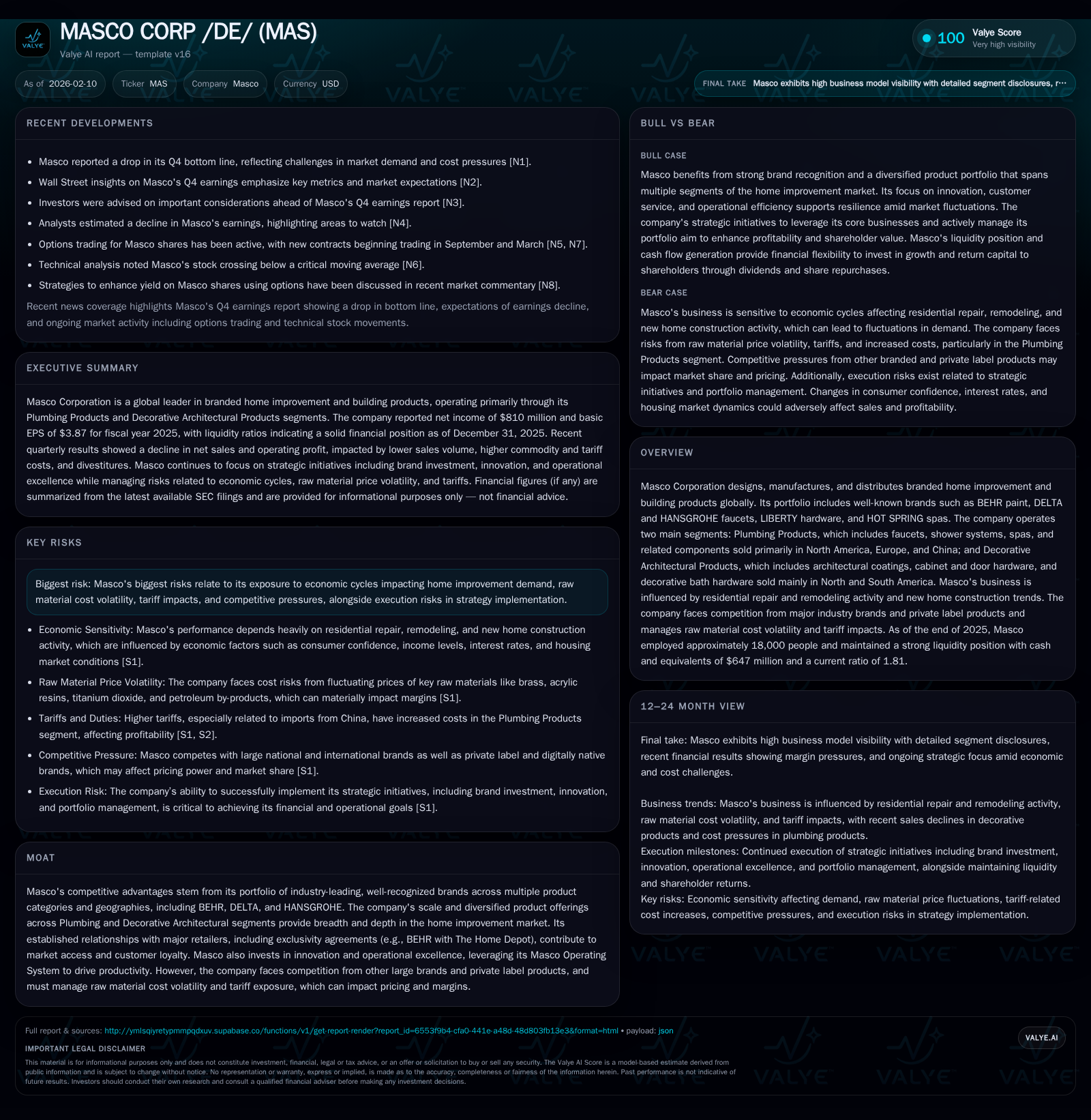
Masco Corporation reported a 3% decline in net sales for 2025 amid weaker residential repair and remodeling demand, despite leveraging price increases within its Plumbing Products segment. The company faces rising raw material costs especially due to China tariffs, prompting restructuring efforts and a segment realignment integrating Liberty Hardware into Plumbing to enhance operational synergies. Leveraging strong brand moats like BEHR, DELTA, and HANSGROHE alongside continuous improvement via the Masco Operating System underpins margin resilience and strategic positioning. However, near-term headwinds from market softness and cost volatility persist, requiring disciplined capital allocation and innovation focus to sustain long-term growth.
Masco's Revenue Trends in a Shifting Market Landscape
Masco Corporation concluded fiscal year 2025 with net sales at $7.56 billion, marking a 3% decrease compared to the previous year. This contraction is principally driven by a 4% decline in sales volumes across its portfolio, highlighting the impact of softer demand in the residential repair and remodeling markets — the company's primary end-markets [S1][N1]. Interestingly, this volume pressure was partially offset by pricing durability, particularly within the Plumbing Products segment where prices rose by an estimated 2%, illustrating management's active response to elevated cost structures.
Diving deeper into segmental performance reveals that the Plumbing Products segment remains a bulwark against the overall decline due to its geographic diversity spanning North America, Europe, and China. However, even this segment experienced top-line headwinds as macroeconomic factors dampened consumer spending power. Meanwhile, Decorative Architectural Products saw challenges consistent with seasonality trends compounded by market softness.
The quarterly cadence underscores these dynamics: Q4 earnings reflected continued volume weakness paired with persistent cost inflation — masking intrinsic strength in brand equity but spotlighting prevailing market discomfort [N4][N1]. These trends align with broader industry cycles where housing market contractions typically chill renovation expenditures.
Dissecting the Cost Pressures: Tariffs, Commodities, and Labor
A salient pressure point for Masco throughout 2025 has been elevated input costs fueled partly by recently enacted tariffs targeting Chinese imports. These tariffs disproportionately impacted the Plumbing Products segment due to its reliance on global supply chains sourcing components from affected regions [S2]. The resultant margin compression necessitated a multifaceted response involving pricing actions — which contributed to top-line offsetting effects — alongside operational efficiency drives.
Beyond tariffs, commodity inflation across metals and plastics essential to faucets, cabinetry hardware, and bath fixtures introduced additional cost layers. Labor cost inflation further compounded expense bases as Masco invests in workforce stability amid tight labor markets.
Management disclosed ongoing efforts to mitigate these headwinds through cost savings programs, re-engineering sourcing strategies, and selective price increases without substantially impairing demand elasticity [S1][S2]. Nevertheless, these levers have limits given competitive pressures from private labels and other major brands keeping price elasticity sensitive.
Strategic Moves: Restructuring and Segment Realignment Insights
In direct response to both external and internal productivity challenges, Masco initiated restructuring actions late in 2025 marked by an $18 million charge recorded in Q4. Expectations are set for a cumulative $50 million charge through 2026 as these initiatives fully unfold [S1]. The restructuring aims revolve around streamlining operations via plant consolidations, headcount reductions, and business rationalizations designed to sharpen operational focus and reduce redundancies.
A strategic highlight is the announced integration of Liberty Hardware into the Plumbing Products segment effective Q1 2026. Historically part of the Decorative Architectural Products segment, Liberty’s portfolio—comprising cabinet hardware and shower doors—offers synergies when combined with Delta Faucet’s plumbing-focused lineup. This realignment anticipates optimizing go-to-market strategies while tightening production efficiencies under one umbrella [S1].
Such structural recalibrations underscore Masco's commitment to enhancing enterprise agility amidst fluctuating demand and input cost environments.
Brand Strengths as Moats: BEHR, DELTA, and HANSGROHE in Review
Masco’s enduring competitive advantage roots itself firmly in its portfolio of premium brands. BEHR paint enjoys exclusive retail placement at The Home Depot — a relationship that not only secures pipeline stability but also fosters strong customer loyalty through integrated marketing programs [valye_report_excerpt]. Likewise, plumbing stalwarts DELTA and high-end luxury HANSGROHE fashion faucets provide geographic breadth covering key markets across North America, Europe, and Asia.
These brands stand as formidable barriers against private label encroachment or price wars owing to decades-long consumer trust built on quality innovation and design leadership. Brand equity allows some latitude in pricing power essential when offsetting raw material inflationary pressures.
Furthermore, cross-product category diversification (plumbing fixtures paired with decorative hardware) mitigates risks isolated within specific remodel subsegments or regional downturns — creating multiple revenue pillars contributing collectively to Masco’s moat.
Operational Excellence via the Masco Operating System
The "Masco Operating System" represents more than just a catchphrase—it is an ingrained continuous improvement methodology permeating all facets of operations from manufacturing floor efficiencies to supply chain optimization. This system propels incremental productivity growth which is critical given revenue pressures amplified by rising costs [S1][S2].
In practice, it involves rigorous performance measurement frameworks coupled with empowering frontline teams to identify waste reductions or process enhancements. Over time this approach supports margin preservation even when top-line growth slows.
As evidenced during recent quarters marked by elevated tariff costs and labor inflationary challenges, this operating discipline enabled Masco to sustain gross margins close to historical norms despite adverse conditions (gross margin contracted only around 70 basis points year-over-year) [S2][N5]. Such resilience underscores the effectiveness of embedding operational excellence as a core pillar supporting financial outcomes.
Capital Allocation, Shareholder Returns, and Financial Health
From a capital stewardship perspective 2025 reflected balanced priorities between reinvesting for growth and returning capital to shareholders. Net income totaled $810 million supported by solid operating cash generation enabling approximately 8.5 million shares repurchased alongside a roughly 7% dividend increase completed during the year [F1][S1].
Liquidity positions remain robust with cash plus equivalents at $647 million paired with a current ratio of approximately 1.8x—testament to prudent working capital management amidst uncertainty [F1].
This financial fortitude provides requisite flexibility for continued innovation spending while maintaining confidence in meeting obligations despite near-term softness.
Risk Frontiers: Economic Sensitivities and Competitive Dynamics
Masco operates within realms highly sensitive to macroeconomic variables directly influencing home improvement expenditures. Consumer confidence fluctuations tied to interest rate trajectories or employment levels can materially sway discretionary remodel spending patterns impacting demand volumes [valye_report_excerpt].
Tariff-induced cost variability introduces another layer of uncertainty demanding agile responses lest profitability be eroded beyond pricing elasticity limits.
Competition remains fierce from both other branded incumbents with scale advantages as well as growing penetration by private label products which exert downward price pressure particularly on value segments.
Execution risk looms large over transformational initiatives such as Liberty integration; missteps could delay synergy realization or destabilize customer relationships.
Thus risk management requires constant recalibration aligned closely with evolving economic signals combined with strategic innovation investment sustaining differentiation.
Outlook for Home Improvement Demand and Product Innovation
Looking ahead demand drivers remain anchored by continuing residential repair & remodel activity which historically exhibits more resilience than new home construction during cyclical downturns [valye_report_excerpt]. Nonetheless uncertain macro outlooks cloud near-term visibility with cautious consumer spending patterns observed entering 2026.
Product innovation remains focal—targeting evolving consumer preferences towards sustainability features or smart fixtures which may unlock incremental growth avenues. Capital investments directed toward R&D alongside channel expansion reinforce readiness for demand shifts while fostering long-term brand relevance.
Continued leverage of exclusive retail partnerships coupled with innovative offerings seeks to capture wallet share even amid fluctuating volumes.
Valuing Masco through Its Strategic Growth Catalysts
Masco stands at an inflection point where its intrinsic strengths—dominant brands across plumbing and decorative categories combined with disciplined operational rigor—face headwinds from macro softness and inflationary pressures. The company’s strategic responses via restructuring charges aimed at efficiency gains alongside segment realignments embody proactive management stewardship prepared to defend margins.
Financially solid footing allows sustained shareholder return policies balancing reinvestment needs fostering innovation critical for future-proofing growth engines.
While cyclical risks linked closely to residential remodeling trends warrant vigilance given their outsized influence on results; potential upside exists if normalization occurs post economic tightening phases intertwined with continued brand moat exploitation.
Overall valuation perspectives should integrate these balanced considerations recognizing that Masco’s journey encapsulates navigating transitional market contexts fortified by strategic discipline rather than relying solely on cyclically driven tailwinds alone.
This analysis is based on publicly available information from company filings and industry sources as of early 2026. It does not constitute investment advice or recommendations but aims to provide thorough contextual understanding of Masco Corporation’s operational posture within its sector environment.
Disclaimer: This is research-only, informational analysis and not investment advice. It may include AI-generated interpretation and general industry context. Always verify important details using primary sources.

Comments