
ModuLink’s Strategic Pivot: Integrating Robotics to Unlock MiC Potential
ModuLink’s recent quarterly filing highlights a strategic acquisition and operational recalibration amid liquidity challenges, shaping its future in modular integrated construction.
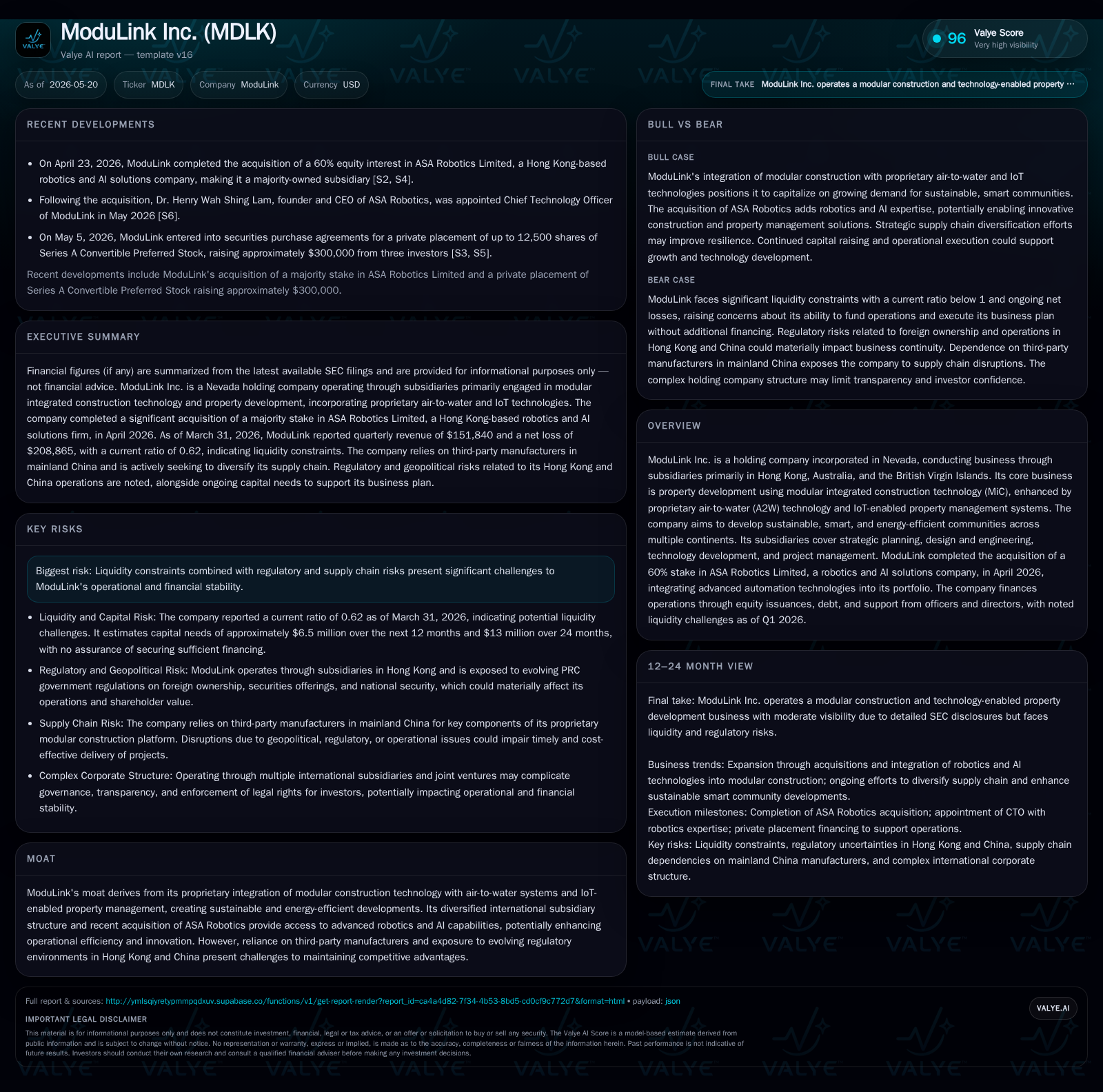
In its latest 10-Q filed May 20, 2026, ModuLink Inc. disclosed a shift from active modular integrated construction (MiC) projects to groundwork and feasibility work, signalling near-term operational delays. The company completed the acquisition of a majority stake in ASA Robotics Limited in April 2026, aiming to embed robotics and AI capabilities into its modular construction ecosystem. Financially, ModuLink remains liquidity constrained with a current ratio below one and heavily reliant on insider funding and convertible preferred stock issuance. These developments mark a pivot point balancing innovative technology integration against execution and financing risks in the competitive property development sector.
Recent Operating Developments: Quarterly Update and Strategic Moves
ModuLink’s most recent quarterly filing dated May 20, 2026 (10-Q) reveals a key operational pivot impacting near-term growth prospects. The company states that it has not undertaken new MiC projects since 2024 and is now primarily engaged in foundational activities such as regulatory planning, site selection, and feasibility studies rather than active construction [S2], [S1]. This pause in physical development shifts the immediate business focus toward groundwork intended to position future projects for execution once adequate funding is secured.
Complementing this strategic repositioning is the April 23, 2026 completion of acquiring a controlling 60% stake in ASA Robotics Limited, a Hong Kong-based robotics and AI solutions company [S4], [S5]. This move integrates advanced automation capabilities within ModuLink's existing portfolio aligned with its broader technology-driven vision. Concurrently, ModuLink has raised capital via private placement of Series A Convertible Preferred Stock in early May 2026 [S3], [S11], reflecting urgent financing needs. This stock converts into common shares upon liquidity events such as an uplisting or strategic transaction, underscoring financial constraints.
Together these developments suggest ModuLink is navigating near-term execution challenges while building technological differentiation through robotics integration.
Business Model Overview: Modular Integrated Construction and Technology Integration
At the core of ModuLink’s business model is property development using Modular Integrated Construction (MiC), which streamlines building by assembling prefabricated units off-site [S1]. This method targets reductions in construction time, cost, waste generation, and labor intensity compared to conventional methods.
Strategically layered onto MiC is proprietary Air-to-Water (A2W) technology embedded into developments to sustainably generate potable water from atmospheric moisture—positioning ModuLink’s properties as energy-efficient and environmentally conscious. Additionally, an IoT-powered property management system aims to enable real-time monitoring and control over building operations to enhance security, adaptability, and maintenance efficacy [S1]. These combined technologies form ModuLink’s reported value proposition: delivering smart, green communities suitable for evolving urban demands.
Revenue primarily accrues from property development contracts with two large customers based in Hong Kong accounting for nearly all revenues in fiscal year 2025 [S1]. These customers engage ModuLink for design, engineering, project management services alongside provisioning modular units sourced externally. As the company remains early-stage without consistent project launches since 2024, meaningful recurring revenue streams have yet to fully materialize.
Competitive Landscape and Industry Structure in Property Development
The broader market for homebuilding exhibits typically low barriers to entry yet intense competition for prime land parcels, skilled labor pools, raw materials, and financing access—all impacting ModuLink’s prospects [S1]. Geographic concentration especially in Hong Kong and China introduces regulatory complexities that can delay permitting or inflate costs. Competitors employing traditional construction methods may offer lower upfront pricing or quicker delivery absent additional technology layering.
ModuLink attempts to generate competitive moats through the unique integration of MiC with embedded A2W systems and IoT-based smart management — a combination not broadly replicated among local players [S1]. However, dependence on third-party manufacturers for modular units limits direct control over supply chain continuity or customization flexibility.
The industry structure also pressures timing; delaying projects risks cost escalation while aggressive pricing to secure contracts could hurt margins given fixed overhead charges related to proprietary R&D investments.
Integrating Robotics: The ASA Robotics Acquisition and Its Implications
Acquiring a majority stake in ASA Robotics Limited represents a significant inflection point as ModuLink moves beyond traditional modular building into automation-enhanced property tech [S4], [S5]. ASA Robotics specializes in robotics design powered by artificial intelligence that can improve onsite assembly efficiency or enable smart building maintenance solutions post-construction.
This strategic buy expands ModuLink's capability set potentially allowing it to lower labor costs—a critical factor given the skilled workforce shortages common in modular construction—and shorten project timelines through automated assembly or inspection technologies. Moreover, integrating real-time data analytics from robotics can complement IoT systems offering enhanced predictive maintenance or resource optimization within buildings.
Challenges lie ahead concerning smooth integration of widely differing corporate cultures between real estate development and robotics hardware/software firms. Execution risk increases as synergies remain theoretical until proven in live construction environments.
Growth Drivers: Project Pipeline, Technological Synergies, and Market Expansion
Longer-term demand drivers for ModuLink rest on its ability to secure funding enabling project kickoffs expected within the next 18 months—chiefly two planned MiC ventures in Vancouver contingent on capital availability [S1]. These projects will test scalability of its modular plus A2W plus IoT approach outside Asia into North American markets.
Technological synergies arising from ASA Robotics acquisition could provide operational efficiencies enabling tighter margins or differentiated customer offerings thereby attracting wider client bases focused on sustainability metrics. Globally rising ESG mandates make energy-efficient water generation coupled with smart IoT management increasingly attractive features within residential properties.
Continued advancement could also open partnership avenues with governments or private developers seeking innovative community-building solutions responsive to climate resilience demands [S1], [S4].
Risks and Constraints: Liquidity Challenges, Customer Concentration, and Regulatory Environment
ModuLink operates under acute liquidity stress highlighted by a current asset position of approximately $519K against current liabilities around $835K as of March 31, 2026—a current ratio near 0.62 indicating working capital deficits [F1]. Such financial tightness necessitates ongoing reliance on shareholder support including recent convertible preferred stock issuances raising $300K gross proceeds but posing potential dilution if conversions occur after liquidity events [S3], [S11].
Revenue concentration risk remains high; two customers contributed over 99% of revenues in fiscal year 2025 without binding long-term contracts rendering income streams vulnerable to customer decisions or fluctuating market conditions at their end-users’ level [S1]. Terminations or demand slowdowns could abruptly reduce orders jeopardizing cash flow.
Regulatory environments especially across Hong Kong mainland China regions remain complex with evolving standards affecting permitting timelines and compliance costs [S1]. Further exposure exists regarding supply chain dependencies both for raw building materials sourced internationally as well as robotics components critical post-acquisition.
Milestones to Watch: Project Kickoffs, Funding Events, and Technology Rollout
Key operational milestones include:
- Securing required funding within the next 18 months to commence one to two MiC projects slated for Vancouver—progress here would validate strategic pivot from groundwork phase into active construction execution [S1].
- Successful integration phases of ASA Robotics technology into existing modular construction workflows; pilot projects demonstrating efficiency gains would be pivotal indicators [S4], [S5].
- Regulatory approvals from relevant local authorities necessary before breaking ground—progress announcements or permit grants will signal diminishing regulatory uncertainty risks [S1].
- Monitoring further financing rounds or conversion triggers related to Series A Preferred Stock that may alter share structure dynamics if liquidity events materialize such as uplisting or strategic sale transactions [S3], [S11].
Financial Health Snapshot: Capital Position and Liquidity Insights
This financial status underscores critical dependence on continuing shareholder injections exemplified by recent capital raises through convertible preferred shares which offer a flexible but ultimately dilutive means of financing pending definitive liquidity outcomes such as exchange uplisting or transactional sales [S3], [S11]. Without improved cash flow from new project starts or additional equity/debt infusion, the firm faces persistent funding challenges that could impair operational continuity or slow planned expansion.
This analysis strictly adheres to disclosed SEC filings through May 20, 2026 ([S1]-[S13]) supplemented by Companyfacts data ([F1]). It does not offer investment advice but aims to provide an informed perspective based solely on verifiable documents relating to ModuLink Inc.'s recent operational shifts, strategic actions including robotics acquisition, competitive positioning within property development leveraging MiC technology innovations alongside key risks constrained by financial health considerations.
Disclaimer: This is research-only, informational analysis and not investment advice. It may include AI-generated interpretation and general industry context. Always verify important details using primary sources.

Comments