
Marcus & Millichap Posts Narrowed Losses Amid Legal Risks and Private Client Market Shifts
Despite modest revenue growth and a leading position in $1M-$10M commercial real estate brokerage, MMI faces ongoing operating losses and exposure from significant litigation.
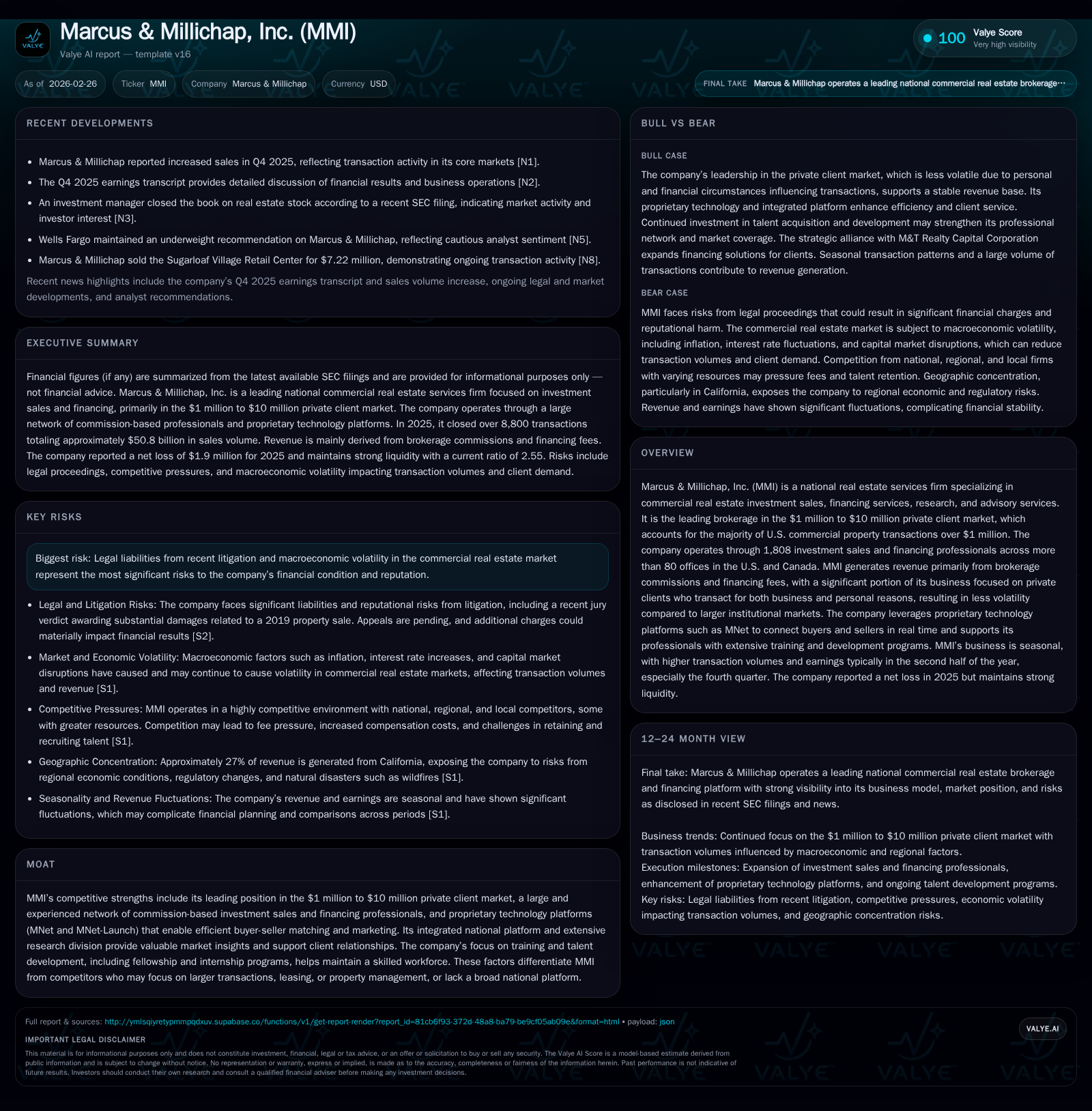
Marcus & Millichap, Inc. commands a leading position serving private clients in the commercial real estate market segment between $1 million and $10 million, focusing on investment sales and financing. Despite revenue stabilization and slight growth in 2025 after steep declines in prior years, the company continues to report operating losses. Its highly commission-driven business model benefits from less cyclical volatility relative to larger institutional-focused competitors, but significant litigation risks and economic factors like interest rates remain key headwinds. MMI leverages proprietary technology platforms and a broad national presence with over 1,800 professionals, yet ongoing capital allocation favors dividends and modest buybacks even as profitability recovers only slowly.
Company Overview and Market Position
Marcus & Millichap, Inc. (MMI) is a prominent national real estate services firm concentrated on commercial real estate investment sales, ancillary financing services, advisory, and research functions. It specializes notably in a fragmented but high-volume segment: commercial properties priced between $1 million to $10 million — known as the private client market — which represents over 80% of U.S. commercial property transactions exceeding $1 million [S1][S17].
With a network comprising approximately 1,808 commission-based investment sales and financing professionals spread across more than 80 U.S. and Canadian offices, MMI commands scale unmatched by regional competitors focused on local markets or larger institutionally focused brokerages that prioritize multi-million-dollar deals [S1]. The company's strength lies not only in its coverage breadth but also its proprietary technology infrastructure like MNet and MNet-Launch that enable rapid buyer-seller connections and streamlined marketing campaigns [S18].
Past Growth and Historical Performance
Marcus & Millichap’s revenue journey reflects broader industry cyclicality exacerbated by macroeconomic turbulence between 2022-2024. After peaking revenue levels earlier (e.g., $238M reported for FY2019), the company saw significant declines during inflation rises, elevated interest rates, and credit tightening impacting commercial real estate transactions markedly [S1][F1]. Specifically:
Historical performance (annual)
| FY | Net ($mm) | CFO ($mm) | OpInc ($mm) | Capex ($mm) | Net YoY |
|---|---|---|---|---|---|
| 2025 | -2 | 67 | -14 | 8 | +84.6% |
| 2024 | -12 | 22 | -33 | 8 | +63.7% |
| 2023 | -34 | -72 | -59 | 9 | -132.7% |
| 2022 | 104 | 14 | 137 | 12 |
Source: SEC companyfacts cache [F1].
Capital returns and efficiency (annual)
| FY | Div ($mm) | Buybacks ($mm) | FCF ($mm) |
|---|---|---|---|
| 2025 | 21 | 25 | 59 |
| 2024 | 20 | 1 | 14 |
| 2023 | 20 | 39 | -82 |
| 2022 | 60 | 29 | 2 |
Source: SEC companyfacts cache [F1].
Note: Revenue figures beyond FY2019 unavailable; YoY percentages reflect available data where applicable.
From a high-water mark of positive operating income and net income in 2022 coinciding with relatively stable macro conditions before recent inflationary surges, MMI experienced steep operating losses through FY2023-24 as transaction volumes plummeted [F1]. Despite this downturn, management’s efforts resulted in a modest top-line recovery of about +3% in FY2025 supported by increased transaction counts (8,818 closed deals totaling ~$50.8 billion volume) [S1][N2].
Operating income improved significantly from a loss of nearly $33M in '24 to about a $14M loss '25 but has yet to return to profitability [F1]. The operating margin compression is partly due to higher commission costs driven by variable compensation structures tied directly to transaction volume [S1]. Similarly, net losses followed an improving trajectory though bordering break-even at -$1.9M for FY25 [F1].
Cash flow dynamics reveal an important operational recovery: CFO swung from negative levels (-$72M) during the worst year (FY23) back into strong positive territory at $66.7 million for FY25 reflecting improved collections timing and better expense control [F1]. Capital expenditures hovered around $7-9 million annually primarily funding technological infrastructure including enhancements to MNet systems essential for competitive differentiation [S11][F1].
Dividend payments have been maintained near ~$20 million annually even amid losses—a signal of commitment toward shareholder returns alongside targeted share repurchases which accelerated notably to $25 million in FY25 from under $1 million prior year [F1]. This dual approach underscores confidence in long-term prospects despite near-term headwinds.
Future Growth Prospects
MMI’s primary growth driver hinges on the segment's structural advantages within the private client market where investors transact smaller deals with faster turnover incentivized by personal circumstances beyond pure investment strategy (e.g., changes triggered by death or partnership restructurings). This partially insulates MMI's commission revenue from greater volatility that afflicts institutional segments where capital market disruptions often delay large transactions for extended periods [S1][S17].
Additionally, the company’s technology platforms continue evolving—specifically MNet’s capability for real-time matching auctions—enhancing deal velocity by broadening buyer pools instantaneously across geographies [S18][S11]. Such tools enhance agent productivity given MMI's reliance on independent contractor commission-driven professionals nationwide.
The research division also supports growth by providing approximately 1,500 annual publications covering ten major property types while gaining frequent media citations enhancing brand prestige [S18]. This thought leadership aids client retention by integrating data-driven insights directly into client advisory processes.
MMI is expanding specialty verticals like multi-tenant retail franchises and non-traditional niches such as seniors housing or manufactured housing developments—a diversification attempt designed to capture shifting investor demand trends and mitigate concentration risk within any single sector [S14].
However, growth could remain capped or face headwinds due to several factors:
- Economic cycles remain critical; inflationary pressure limits client willingness to transact while interest rate hikes elevate borrowing costs reducing refinancing activity [S15].
- Increasing legal liabilities arising from litigations such as the October 2025 Boone County Missouri verdict—involving punitive damages initially aggregating roughly $34 million but recently reduced to an estimated maximum ~$24 million pending appeals—present downside risks jeopardizing near-term earnings stability and reputation [S6][S7][N1].
- Competitive fragmentation creates pressure on commission rates despite scale advantages; many local/regional players compete aggressively for private clients who often have personalized needs not easily commoditized.
- Regulatory complexities across different states' licensing regimes add overhead burdens particularly concerning dual agency conflicts when representing both buyers and sellers simultaneously [S23][S24].
Forecasts / Milestones / Expectations
Explicit forward guidance is limited; however quarterly commentary indicates cautious optimism about mid-cycle recovery based on stabilization of transaction volumes during Q4/2025 results reported February ‘26 [N1][N2]. Watch for progress on ongoing litigation appeals later this year as outcomes could drastically affect contingent liabilities recorded.
Monitoring developments around interest rate trends by central banks remains critical since changes could swiftly alter deal flow dynamics within MMI’s clientele segments.
Continued enhancement or rollout of technology tools aimed at agent productivity represents another milestone sector peers typically emphasize; any announcements or adoption metrics related to further enhancements will be signals worth tracking.
Returns / Capital Allocation
Latest fiscal data reveal marginally negative Return on Equity (ROE), approximately -0.3% computed as net income divided by equity base (~$603 million) reflecting subdued earnings despite sizable equity capital employed [F1].
Operating cash flow generation is robust compared to accounting earnings: positive free cash flow calculated near $58.8 million highlights operational cash discipline even amid reported GAAP losses due largely to non-cash charges or provisions including litigation accruals [F1].
Dividends remain attractive with distributions close to $20 million annually versus net income deficits indicating either funded by reserves or cash flows sustained through operational improvements.[F1]
Buybacks accelerated sharply during FY25 reaching above $25 million; a sizeable boost relative to previous years suggests management attempts at shareholder value optimization while stock may be trading under pressure due partly to cyclical uncertainties.
Capital expenditures show stable ongoing investment supporting core technology infrastructure without excessive discretionary spend that could strain cash resources significantly.
Industry Context Analysis
The U.S commercial real estate brokerage market serving sub-institutional investors faces cyclical demand governed primarily by economic cycles influencing asset transactions volume rather than pricing alone. The average deal size focus implies MMI must close high volumes concomitant with sensitive commission margins.
Technology disruption has pressed incumbents toward digital marketing platforms and automated client matchmaking; here MMI’s longstanding investment into proprietary systems like MNet provides an edge over fragmented local brokers reliant mainly on personal networks.
Litigation risk remains endemic given complex fiduciary duties brokers owe clients combined with layered seller/buyer relationships in dual agency scenarios heightening regulatory scrutiny.
Conclusion
Marcus & Millichap stands out as the dominant brokerage firm focused sharply on private client commercial real estate markets under a business model that cushions it somewhat from large swings typical of institutional-level deals but exposes it to volume sensitivity amid economic downturns.
While recent years have weighed heavily on financial results due primarily to macroeconomic shocks compressing deal pipelines, operational indicators suggest emerging stabilization bolstered by their broad agent network and entrenched technological advantage.
Legal challenges pose material uncertainty requiring active management attention with potential financial consequences beyond recorded reserves if final judgments confirm punitive awards.
Capital deployment balancing dividends and share repurchases amidst modest current losses signals confidence underpinned by solid cash flows rather than earnings alone.
Investors should monitor transaction volumes normalized post-pandemic cycle shifts alongside regulatory/legal developments closely given their outsized impact on near term profitability prospects.
This analysis is based solely on publicly available documents including Marcus & Millichap’s SEC filings as of February 26, 2026 ([S1]-[S29]), recent earnings disclosures ([N1],[N2]), and financial statement data retrieved via companyfacts ([F1]). It does not constitute investment advice.
Disclaimer: This is research-only, informational analysis and not investment advice. It may include AI-generated interpretation and general industry context. Always verify important details using primary sources.

Comments