
MannKind Corp Expands Niche Biopharma Portfolio with Technosphere Platform and scPharma Acquisition
MannKind leverages its proprietary inhalation technology and strategic collaborations to grow revenues while navigating regulatory and manufacturing risks.
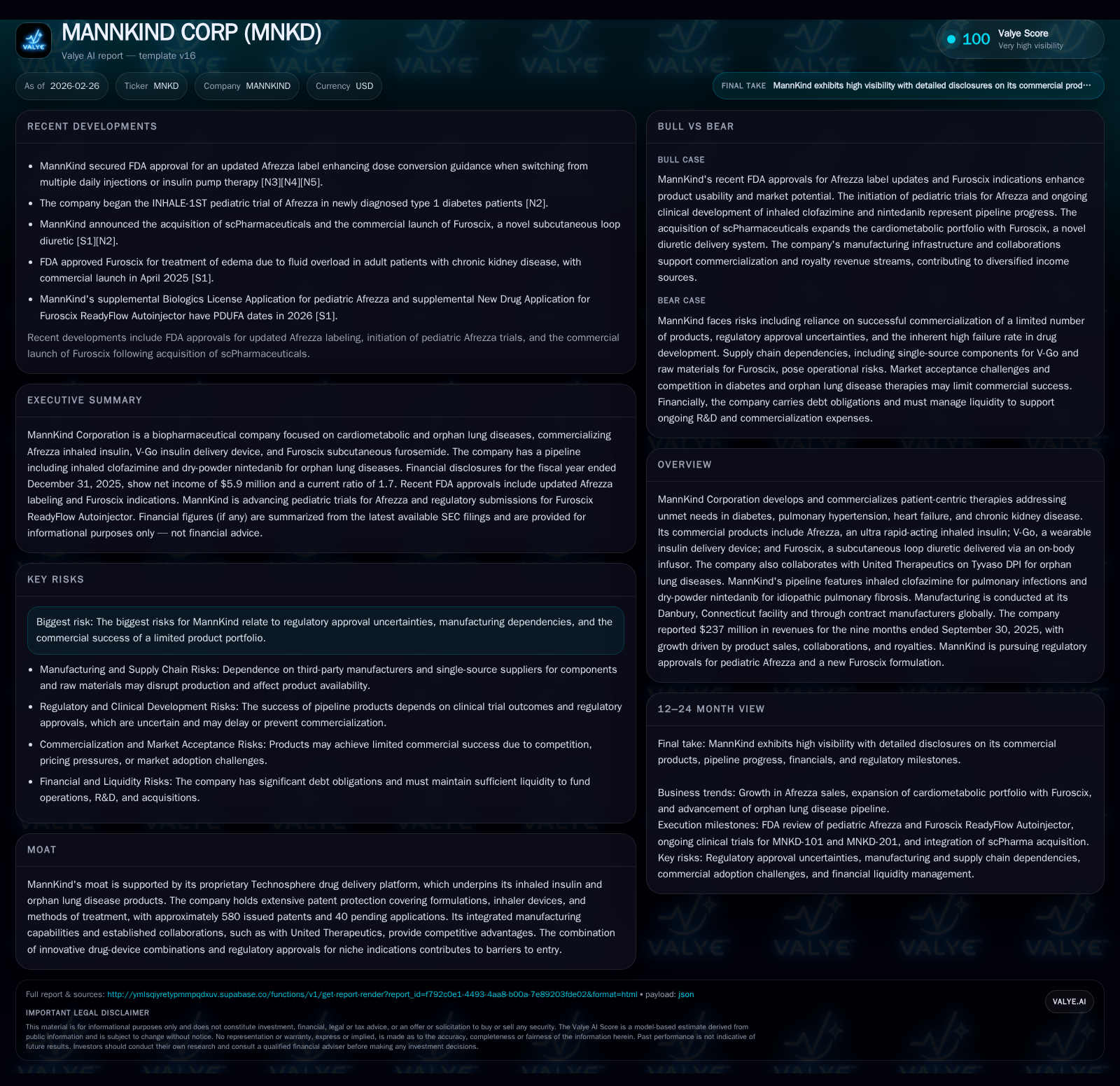
MannKind Corporation develops inhaled therapies and devices targeting diabetes, pulmonary hypertension, heart failure, and chronic kidney disease. Historically, its growth has been underpinned by Afrezza inhaled insulin sales, the acquisition of V-Go, royalties from United Therapeutics’ Tyvaso DPI, and more recently the 2025 scPharma acquisition. With FDA label updates and pediatric Afrezza trials underway, MannKind aims to expand Afrezza adoption. However, commercial success remains concentrated in a limited product portfolio, exposing MannKind to regulatory uncertainties and manufacturing dependencies. Financially, the company shows positive operating income in 2025 but negative equity persists post-heavy investments and acquisitions.
Company Overview
MannKind Corporation operates within niche therapeutic areas addressing unmet needs across cardiometabolic diseases — notably diabetes — as well as orphan lung diseases, heart failure, and chronic kidney disease. Central to the company’s commercial offering is Afrezza®, an ultra rapid-acting inhaled insulin leveraging MannKind's proprietary Technosphere® drug delivery platform. This technology involves delivering insulin via inhalable dry powder through a compact inhaler device designed for patient convenience.
Additionally, MannKind acquired the V-Go wearable insulin delivery device business in May 2022 from Zealand Pharma, adding a mechanical basal-bolus system that minimizes multiple daily injections for insulin-dependent customers [S2]. Their portfolio further expanded via the October 2025 acquisition of scPharmaceuticals Inc., which introduced Furoscix — a subcutaneous loop diuretic for heart failure administered through an on-body infusor — along with an advanced respiratory disease pipeline [S2][N5].
Beyond direct product sales, MannKind benefits from collaborations such as its partnership with United Therapeutics Corporation (UT) for Tyvaso DPI (treprostinil) inhalation powder targeting pulmonary arterial hypertension (PAH) and interstitial lung disease associated with pulmonary hypertension (PH-ILD). MannKind manufactures Tyvaso DPI at its Danbury facility and receives royalties plus manufacturing margins on UT’s net sales [S2].
Historical Financial Performance
MannKind historically suffered from inconsistent revenue streams until Afrezza gained traction post-FDA approval in mid-2014. From FY2016 to FY2017 revenue shrank sharply before stabilizing around the low millions mark due primarily to initial commercialization challenges for Afrezza.
Key drivers behind recent historical growth have been:
- Incremental product sales from Afrezza.
- Acquisition contributions via V-Go added since mid-2022.
- Royalty and manufacturing revenue linked to UT's commercialization of Tyvaso DPI.
- Milestone payments tied to strategic partnerships.
The following table summarizes critical financial metrics over recent years highlighting a volatile journey culminating in recent operating profitability:
Historical performance (annual)
| FY | Net ($mm) | CFO ($mm) | OpInc ($mm) | Capex ($mm) | Net YoY |
|---|---|---|---|---|---|
| 2025 | 6 | 18 | 39 | 5 | -78.7% |
| 2024 | 28 | 43 | 73 | 10 | +331.1% |
| 2023 | -12 | 34 | 9 | 42 | +86.3% |
| 2022 | -87 | -81 | -64 | 8 |
Source: SEC companyfacts cache [F1].
Capital returns and efficiency (annual)
| FY | FCF ($mm) | ROE% |
|---|---|---|
| 2025 | 14 | -11.5 |
| 2024 | 33 | -35.0 |
| 2023 | -8 | 4.8 |
| 2022 | -88 | 34.9 |
Source: SEC companyfacts cache [F1].
Note: Revenue series inconsistent between public records; recent growth driven largely by acquisitions and partnerships rather than organic sales expansion [F1][S2]. Operating income turned positive again in FY2023–25 after steep losses prior.
Operating cash flow reflects improving core business stability while capital expenditure declined markedly after peak investment phases related to manufacturing scale-up and acquisition integrations.
Proprietary Technology & Competitive Moat
MannKind's Technosphere platform constitutes its key competitive advantage. The company holds an extensive patent portfolio with roughly 580 issued patents plus about forty pending applications covering various aspects including formulations of dry-powder drugs, inhaler device intellectual property rights, methods of use, and treatment regimens [S25]. Such protection restricts generic competition effectively—a crucial factor given the specialized nature of inhaled therapeutics.
This platform allows development not just of Afrezza but also orphan lung disease products like Tyvaso DPI and newer pipeline candidates such as inhaled clofazimine for respiratory infections and dry-powder nintedanib targeting idiopathic pulmonary fibrosis (IPF) — advancing through clinical stages globally [S2]. The integrated manufacturing capabilities at Danbury further reinforce barriers by enabling control over production quality while facilitating collaborative supply agreements.
Concomitant investments into brand trademarks spanning corporate (MannKind®), key product names (Afrezza®, Furoscix®, V-Go®), and technology marks help solidify market recognition amidst competition from large pharma houses including Novo Nordisk A/S (injectable insulins), Eli Lilly & Co., Sanofi S.A., AstraZeneca PLC (GLP-1 analogs), among others [S21][S25].
Current Product Portfolio & Pipeline Outlook
Commercial Products:
- Afrezza: Rapid acting inhaled insulin indicated for adults with diabetes; faces competition primarily against injectable mealtime insulins but offers differentiation via ease of administration.
- V-Go: Wearable basal-bolus insulin patch system reducing injection burden for patients requiring continuous subcutaneous infusion.
- Furoscix: Subcutaneous loop diuretic delivered through on-body infusor targeting heart failure symptoms; added via scPharma acquisition.
- Tyvaso DPI: Orphan lung disease treatment commercialized by United Therapeutics; MannKind receives royalties plus manufacturing margins.
Pipeline Programs:
- MNKD-101 (Inhaled Clofazimine): For non-tuberculous mycobacterial lung infections; designated orphan drug and Fast Track by FDA; global Phase 3 ongoing with enrollment extending into 2026.
- MNKD-201 (Dry-powder Nintedanib): Candidate for idiopathic pulmonary fibrosis; Phase 1 completed with favorable safety; global Phase 2 anticipated commencing early 2026.
Also notable is MannKind's entry into pediatric trials evaluating Afrezza efficacy in newly diagnosed Type 1 diabetes patients reflecting strategy to broaden label indications amid ongoing commercial expansion efforts [N5].
Growth Drivers & Constraints
Growth Drivers:
- Regulatory gains such as the January 2026 FDA approval updating Afrezza labeling provide clearer dose conversion guidance when switching from injectable regimens potentially enhancing physician prescribing confidence [N1][N6].
- Pediatric trial initiation anticipates future label expansion improving addressable market opportunity.
- Portfolio diversification through scPharma acquisition lessens dependency on singular products elevating cross-indication opportunities.
- Recurring royalty streams from UT collaboration stabilize revenue amidst developmental uncertainty elsewhere.
Constraints & Risks:
- Concentrated revenue base implies limited buffer against setbacks impacting any one product line.
- Manufacturing dependencies both internally at Danbury facility and external contract manufacturers expose supply chain risks potentially denting gross margins or market availability [S6].
- Regulatory hurdles persist particularly around late-stage clinical efficacy confirmation and market acceptance of pipeline drugs such as MNKD-101 or MNKD-201 [S24].
- Debt profile includes $325 million principal outstanding under Blackstone Credit Facility carrying restrictive covenants which may limit operating agility during growth investments or downturns; convertible notes maturing March 2026 pose refinancing considerations [S4][S9][S18].
Financial Condition & Capital Allocation
At December 31, 2025 MannKind reported approximately $74.8 million in cash and equivalents against current liabilities exceeding $171 million yielding a current ratio near 1.7 supporting near-term liquidity adequacy [F1]. Total borrowings increased materially post-scPharma deal courtesy of an additional $250 million delayed draw term loan under their credit facility raised October 2025 to fund acquisition costs plus extinguishment of pre-existing scPharma debt obligations [S4][S18].
Operating income was $38.8 million in FY2025 representing a decline versus prior year attributable largely to integration costs alongside ongoing R&D spend sustaining pipeline momentum. Net income was positive at $5.86 million after volatile historical swings between large losses recorded in earlier years owing partly to research expenses amortization plus noncash impacts related to equity instruments [F1]. Operating cash flow remained solid but decreased compared with FY2024 highs consistent with normalized working capital deployment amid expanding commercial footprint. Capital expenditures nearly halved year-over-year reflecting completion of major fixed asset investments related to manufacturing scale expansions completed prior periods [F1].
No dividends were declared reflecting capital retention preference typical among biopharma firms investing heavily in development pipelines. Limited buyback activity exists historically but not recently suggesting management focus remains on growth initiatives rather than shareholder distributions given leverage profile. Approximate return on equity remains negative being constrained by historical accumulated deficits exceeding $51 million equity deficit at end-2025 although trajectory hints improving profit generation capability albeit still nascent compared to established peers [F1].
Key Milestones To Watch (Analysis)
While explicit forward-looking guidance was not disclosed within available filings or press releases, an investor or stakeholder should monitor:
- Enrollment progress and interim data readouts from MNKD-101 Phase 3 study through mid-to-late calendar year 2026.
- Initiation pace and patient recruitment metrics for MNKD-201 Phase 2 trial slated for early 2026 start.
- Commercial adoption statistics for Afrezza post-label update focusing on new patient starts transitioning from injectable insulins including pediatric cohorts evaluated by INHALE-1ST trial results expected within next several quarters [N5][N6].
- Earnings performance trends reflective of integration synergies from scPharma acquisition weighted against incremental interest cost burden amid leverage levels.
- Any regulatory announcements pertaining to expanded labeling or approvals related to pipeline assets or Furoscix utilization enhancements.
Industry Context (Analysis)
Inhaled insulin remains a niche yet potentially disruptive alternative within diabetes management dominated traditionally by injectable analogs marketed by giants such as Novo Nordisk or Eli Lilly. While convenience factors favor innovation adoption especially among younger or injection-reluctant patients, technical challenges regarding dosing precision remain inherent barriers unlike established parenteral approaches. Additionally competing modalities including GLP-1 receptor agonists command considerable attention due to demonstrated metabolic benefits plus cardiovascular event risk reduction thus shaping multi-drug regimen paradigms impacting insulin usage patterns overall. Orphan lung disease therapeutics benefit substantially from accelerated regulatory pathways yet require demonstrating durable efficacy coupled with manageable safety profiles poised against high unmet needs often underserved by mainstream pharmacotherapies making partnerships like MannKind’s collaboration model particularly meaningful strategically. In heart failure therapeutics domain cordless infusion devices like Furoscix represent promising convenience-driven alternatives gaining traction versus legacy hospital infusion systems fostering outpatient treatment models that could reduce healthcare resource utilization burden if uptake scales successfully.
Conclusion
MannKind Corporation leverages a proprietary Technosphere platform underpinning its inhaled therapeutics franchise complemented by strategic collaborations and selective acquisitions broadening both product reach and clinical pipelines addressing diabetes complications and orphan respiratory conditions alongside cardiovascular niches. Historical financial performance showcases strides back toward profitable operations fueled partly by acquisitions yet balanced against debts accrued emphasizing operational execution plus pipeline advancement imperative going forward. Recent FDA label updates enhancing usability guidance combined with pediatric development paths present tangible growth avenues while sector-specific competitive pressures remain pronounced underscoring continuing risks requiring careful management of manufacturing integrity alongside capital structure discipline.
This report synthesizes publicly available information up to February/March 2026 without providing investment advice or price targets.
Disclaimer: This is research-only, informational analysis and not investment advice. It may include AI-generated interpretation and general industry context. Always verify important details using primary sources.

Comments