
Movado Group Advances Digital Marketing and Maintains Strong Liquidity
The latest quarter highlights strengthened brand momentum and robust financial health against a competitive watch industry backdrop.
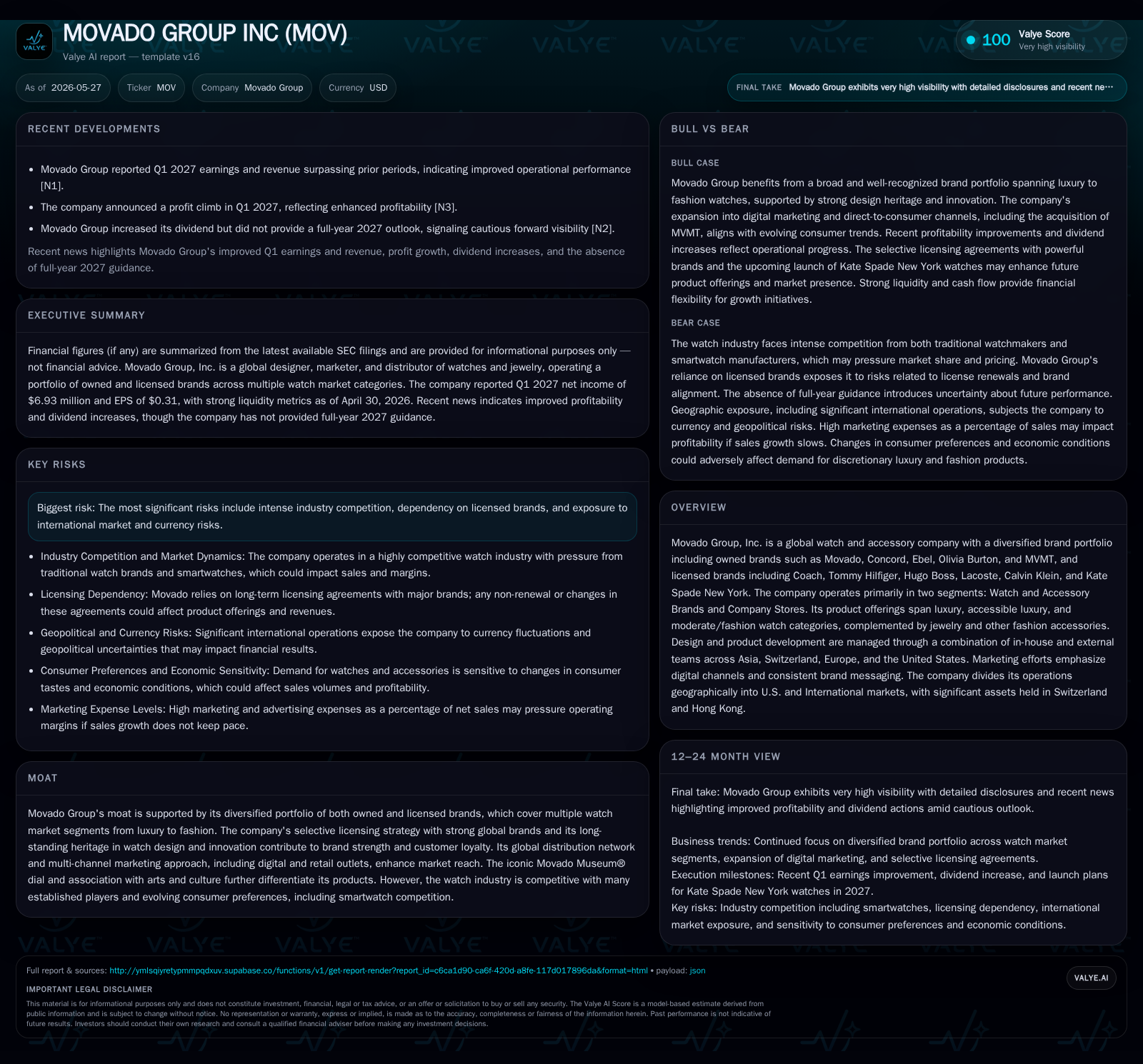
Movado Group's Q1 2026 results show revenue and earnings surpassing expectations without drawing on its revolving credit facility, signaling operational resilience. The firm's mixed portfolio of owned and licensed watch brands spans multiple market segments, supported by expanding digital marketing efforts to engage diversified consumer bases. Industry pressures from smartwatch competition and licensing dependencies pose ongoing challenges, but new license agreements like Kate Spade aim to fuel growth. With a strong liquidity position and conservative leverage, Movado is well-positioned to sustain brand investments amid evolving global demand dynamics.
Q1 2026 Operating Update Highlights
Movado Group’s first quarter ended April 30, 2026 revealed a solid performance characterized by earnings and revenue surpassing consensus estimates as reported in their May 27 filings [S2][N1]. Notably absent were any severance accruals this quarter—a positive contrast to $0.6 million accrued the prior year period—reflecting maintained operational control over costs despite ongoing market challenges [S2]. The company’s defined benefit pension plan in Switzerland represents a noteworthy but non-material area of accounting complexity; its assets are valued through Level 3 inputs that lack observable market data but do not currently weigh heavily on near-term cash flows or earnings volatility [S2].
Further bolstering confidence is Movado’s maintenance of a fully undrawn $100 million senior secured revolving credit facility set to mature in October 2026. This capacity offers financial flexibility with no balances owed as of quarter-end while preserving covenant compliance typical for credit lines of this nature [S2][S4]. The firm also declared a $0.35 per share dividend during the quarter amounting to approximately $7.7 million paid, demonstrating shareholder return commitment despite withholding formal FY27 outlook guidance at this time [N3].
Business Model and Brand Portfolio Dynamics
Movado’s business model centers around designing, sourcing, marketing, and distributing watches across multiple globally recognized brands spanning distinct price tiers—from luxury (Ebel, Concord) through accessible luxury (Movado) to fashion-oriented offerings (MVMT, Olivia Burton) [S1]. Supplementing watch sales is a growing accessory segment comprising jewelry under several brand umbrellas.
A core strength lies in the combination of owned trademarks such as Movado Museum®-style signature dials with exclusive long-term licensing agreements for powerhouse labels like Coach, Tommy Hilfiger, Hugo Boss, Lacoste, Calvin Klein, and most recently Kate Spade New York—whose license commences collection launches in spring 2027 [S1][N3]. This selective licensor approach mitigates portfolio risk by partnering only with brands exhibiting durable market prominence.
Design is globally distributed: creative development occurs internally alongside partnerships with external designers spread throughout watchmaking hubs in Switzerland and emerging Asian manufacturing locales; this affords Movado agility in product innovation tailored to region-specific customer preferences [S1]. The layered brand architecture supports a balance where premium products provide margin strength whilst fashion styles drive volume growth.
Competitive Environment and Industry Context
The watch industry faces bifurcated dynamics where established mechanical and quartz timepieces contend with burgeoning smartwatch demand impacting traditional watch segments unevenly. Movado’s footprint sits within this complex arena offering varied product mixes targeting different demographic segments—from millennials attracted by MVMT’s digitally native direct-to-consumer approach to seasoned collectors favoring Concord’s heritage craftsmanship [S1].
Relative to peers entrenched solely in high-luxury or mass-market fashion watches, Movado’s hybrid strategy allows some insulation through diversification although it concurrently necessitates managing disparate supply chains and channel strategies. Amid pricing pressure prevalent in mid-tier watches driven by ecommerce rationalization & competitor promotional intensity, Movado leverages omnichannel marketing investments aimed at sustaining brand loyalty and awareness across age cohorts [S1][N4]
Digital Marketing and Customer Engagement Strategies
Responding to rapidly evolving consumer buying behaviors—particularly digital-first interactions—Movado escalates focus on refining its digital presence via social media influencer collaborations, retail media networks within partner platforms, and targeted online advertising campaigns designed for brand-specific storytelling coherence [S1]. These efforts resonate especially with younger consumers gravitating towards experiential purchasing modes complimented by online personalization.
Such digital initiatives integrate tightly with traditional retail distribution points including flagship stores owned under the Company Stores segment plus wholesale partners worldwide, enhancing feedback loops between consumer data analytics and product development pipelines [S1]. Capturing the attention of fashion-conscious millennials while maintaining heritage appeal amongst affluent older segments reflects an ongoing strategic balancing act.
Growth Drivers: Licensing Expansion and Product Innovation
In addition to organic growth driven by product refreshes across owned brands like Olivia Burton’s mix of watches & jewelry lines and MVMT’s accessory expansions, the recent acquisition of Kate Spade license rights positions Movado for incremental volume gains starting calendar year 2027 launches [N3][S1]. Expanding licensed portfolio exposure leverages established marketing ecosystems while providing upside from newer collections that tap into broader lifestyle trends.
Multi-geographical design collaborations spanning Asia for competitive cost advantage combined with Swiss-based quality oversight enhance both innovation velocity and premium positioning capabilities. This geographic diversity supports rapid response capabilities amid shifting consumer tastes or supply chain disruptions common within globalized watch manufacturing [S1].
Risks and Operational Challenges: Competition and Regulatory Factors
Key risks stem from intensifying smartwatch penetration diminishing addressable market size for traditional watches over time. Licensed brand dependency poses contract renewal uncertainties potentially affecting future revenue streams if licensors opt not to extend partnerships or request renegotiation under less favorable terms [S1]
Furthermore, Movado’s Swiss subsidiary operations expose it to currency fluctuations given significant assets denominated in Swiss Francs; management employs derivative instruments such as foreign currency forward contracts to hedge these exposures mitigating earnings volatility but not eliminating macro risk entirely [S4][S14]
Information security shines as a critical governance priority—especially given direct-to-consumer digital sales channels—with the Audit Committee actively overseeing cybersecurity management including maturity scorecards reported quarterly incorporating IT leadership expertise certified in risk controls & governance frameworks [S1]. While no significant breaches have been disclosed recently, sustained investment is essential given evolving cyber-threat landscapes.
Near-Term Catalysts and What Investors Should Monitor
Monitoring the successful rollout of the Kate Spade licensed collection throughout fiscal year 2027 will be instructive regarding product-market fit beyond existing portfolio brands [S5][N3]. Additionally, potential tariff recoveries from approximately $10 million paid under U.S. International Emergency Economic Powers Act tariffs merit watching—resolution clarity could materially improve cost structures if refunds are realized following Customs rulings currently under review using gain contingency accounting rules
Operational execution around supply chain stabilization post-tariff adjustments along with continued efficiency gains from prior cost-saving initiatives will further influence profit trajectory going forward [S2][N3]. Statements on dividend policy signal board confidence but absence of explicit full-year guidance suggests vigilance around macroeconomic uncertainties.
Summary Financial Position and Capital Structure
At quarter-end April 30, 2026 Movado held approximately $225 million in cash equivalents against negligible debt levels affirming a net cash position exceeding $215 million based on available data [F1][S2][S4]. The company maintains access to an undrawn $100 million revolving credit facility with customary covenants expiring October 2026 offering substantial liquidity buffer if required. Current assets totaling over $514 million versus liabilities near $113 million offset yield a robust current ratio approximating 4.56 indicative of sound short-term financial health supporting operating flexibility including dividends or selective reinvestments
Interest expense remained minimal around $0.1 million for the quarter consistent year-over-year reflecting low leverage environment conducive for maneuvering amid industry cyclicality; pension plan asset valuations remain complex but non-disruptive cash-wise currently due to their Level 3 fair value inputs classification [F1][S2]
This analysis synthesizes information from recently filed SEC disclosures as well as public news reports without providing investment advice or research views. Readers should consider external factors alongside company disclosures when evaluating prospects.
Disclaimer: This is research-only, informational analysis and not investment advice. It may include AI-generated interpretation and general industry context. Always verify important details using primary sources.

Comments