
Corvex Transitions Post-Merger: Operational Snapshot and Growth Prospects
Corvex’s Q1 2026 report reveals initial operational outcomes from a March merger alongside leadership strengths and liquidity status.
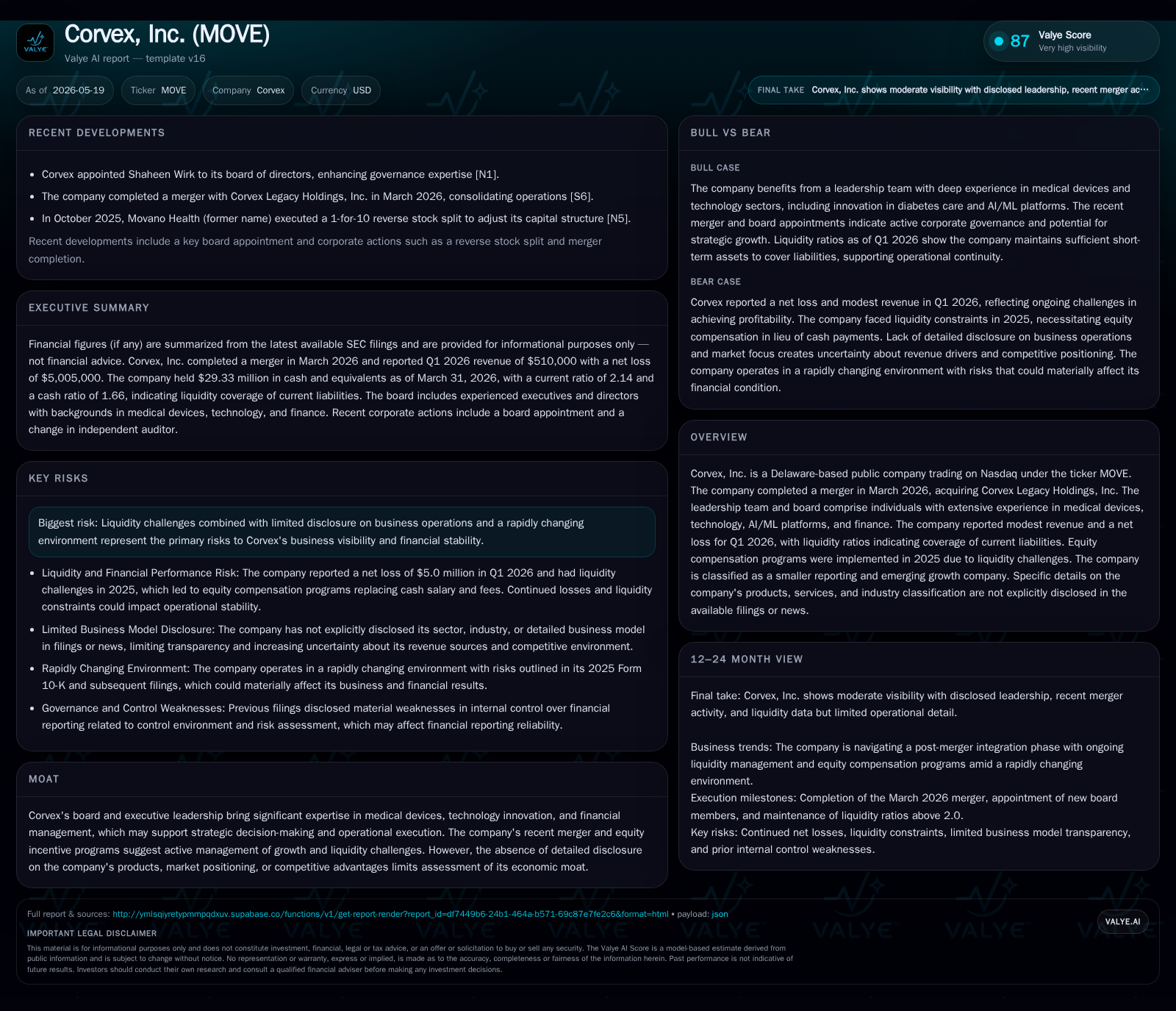
Corvex, Inc. finalized its merger with Corvex Legacy Holdings, Inc. in March 2026, marking a key inflection point for the company’s strategic trajectory. The latest quarterly filing shows the business generating modest revenue yet operating at a net loss, with liquidity supported by a strong current ratio and substantial cash reserves. Leadership comprises seasoned professionals in medical devices and technology innovation, suggesting potential to leverage expertise to drive growth amid limited disclosure on product specifics. Key risks include ongoing liquidity pressures and opaque business details that challenge external assessment, while near-term milestones hinge on integration progress and improved transparency.
Q1 2026 Operating Update: Merger Execution and Results
Corvex’s Q1 2026 filings ([S2],[S3]) detail the completed acquisition of Corvex Legacy Holdings in March 2026, transitioning the company into a combined entity. The pro forma statements indicate modest top-line revenues as of March 31, 2026, accompanied by a net loss reflective of ongoing integration costs and pre-revenue scale dynamics typically observed in emerging growth firms. Importantly, the company reported a solid liquidity position with cash and equivalents at approximately $29.3 million as of quarter-end ([F1]), coupled with current assets exceeding current liabilities yielding a current ratio of about 2.14—an indicator of short-term financial adequacy.
The filings highlight adoption of equity compensation programs initiated in 2025 as partial response to liquidity challenges, pointing to strategic cash conservation amidst expenditure on operational scaling.
Business Model Overview: Structure and Current Transparency Challenges
While detailed disclosures regarding Corvex’s core products or service lines are notably sparse ([S1],[S2],[S3]), foundational insights can be inferred from corporate communications and merger-related documentation. The company operates as a combined entity after merging with its legacy holding firm early in 2026. The absence of explicit product or market definitions restricts clear categorization but suggests involvement in technology-driven sectors potentially orbiting medical devices or AI/ML platform development suggested by leadership expertise.
Revenue likely emanates from licensing, development contracts, or early-stage product commercialization efforts with customer bases perhaps limited given emerging status. The opacity around revenue mechanics, pricing strategies, and end-user profiles currently impedes comprehensive valuation or competitive benchmarking.
Governance and Leadership: Expertise Driving Strategic Direction
The company’s board features Chair Emily Wang Fairbairn, bringing over four decades in institutional asset management and capital markets ([S1]). Such pedigree affords strong strategic oversight especially crucial during transformative phases like mergers. Alongside Ms. Fairbairn are executives experienced in medical technology innovation and AI-driven platforms, promoting governance that potentially balances financial discipline with cutting-edge development initiatives.
This blend aligns well with post-merger demands that require deft navigation of integration complexities while fostering innovation pipelines—a vital competency for sustaining growth trajectories in dynamic tech-centric industries.
Industry Context and Competitive Positioning Insights
As an emerging growth entity engaged in sectors indicated by leadership backgrounds (i.e., medtech plus AI/ML), Corvex operates within a competitive arena marked by rapid technological evolution and regulatory sensitivities. Typical industry value chains here emphasize high R&D intensity, substantial compliance requirements (FDA or equivalent bodies for medtech), long development cycles, and significant barriers to entry driven by intellectual property and certification processes.
Customer acquisition often hinges on demonstrating clinical efficacy or technological superiority; switching costs may be elevated if products integrate deeply into existing workflows. Capacity constraints can arise from specialized manufacturing or specialist talent shortages.
Despite lacking direct peer disclosures ([S1],[S2]), these general sector dynamics suggest Corvex faces competitive pressures typical of an early-stage player striving for foothold against incumbents and agile innovators alike.
Growth Drivers: Leveraging Merger Synergies and Management Experience
The March 2026 merger is a central pillar underpinning Corvex’s growth narrative ([S2],[S3]). By combining resources with Corvex Legacy Holdings, the company aims to achieve expanded operational scale, broaden R&D capacity, and enhance platform capabilities—potentially accelerating time-to-market for products/services.
Board-level expertise supports this ambition by steering resource allocation toward prioritized development areas while managing financial risks inherent at this stage ([S1]). Expected KPIs monitoring these drivers might include backlog buildup, licensing agreements secured, milestone completions in product development, or user adoption rates if applicable.
Though explicit metrics remain undisclosed due to confidentiality or developmental phase nature, these factors collectively form the scaffold for anticipated upwards trajectory once integration solidifies.
Risks and Constraints: Liquidity Pressures and Disclosure Gaps
Key risks documented in recent filings ([S2],[S1]) revolve around liquidity pressures evidenced by reliance on equity compensation to mitigate cash outflows—a sign of constrained operating cash flow generation capacity. This situation imposes trade-offs between attracting talent via stock incentives versus potential dilution concerns.
Furthermore, scant transparency regarding core operations limits stakeholder visibility into business sustainability or differentiation factors, increasing execution risk amid fast-evolving technological landscapes that require nimble adaptation.
Regulatory uncertainties inherent in technology or medical device sectors compound these challenges by potentially elongating development cycles or elevating compliance costs.
Key Near-Term Milestones and Watchpoints
Upcoming quarters will be critical for assessing operational integration progress post-merger as well as management’s ability to clarify product-market positioning through enhanced disclosures ([S2],[S3]). Attention should focus on:
- Revenue progression beyond initial modest levels indicating commercial traction,
- Reduction or stabilization of net losses signaling operational efficiency gains,
- Cash burn rate trajectories informing runway adequacy,
- Potential announcements of partnerships, regulatory approvals or licensure agreements that concretize market entry intent,
- Evolution of equity compensation impacts on shareholder structure.
These indicators provide tangible markers to evaluate whether foundational investments convert into scalable business momentum.
Financial Profile Summary
At quarter-end March 31, 2026, Corvex maintained approximately $29.3 million in cash and equivalents versus total debt estimated at under $300 thousand from prior data points ([F1]). The company’s current ratio stood at about 2.14, reflecting a balance of current assets to current liabilities ([F1]).
The net loss remains substantive relative to revenue scale reported as modest (in the low hundreds of thousands); thus preserving capital while progressing toward profitable operations remains management’s immediate financial balancing act ([F1],[S2],[S3]).
This analysis synthesizes publicly available SEC filings up to May 19, 2026, focusing exclusively on evidence-supported insights without conjecture beyond confirmed disclosures. Readers should consider evolving developments from forthcoming reports for continued assessment.
Disclaimer: This is research-only, informational analysis and not investment advice. It may include AI-generated interpretation and general industry context. Always verify important details using primary sources.

Comments