
Millrose Properties’ Homesite Option Platform Drives Early Scale Amid Heavy Leverage
Post-Spin-Off, Millrose leverages a proprietary option platform and strategic land acquisitions to fuel growth while managing significant indebtedness.
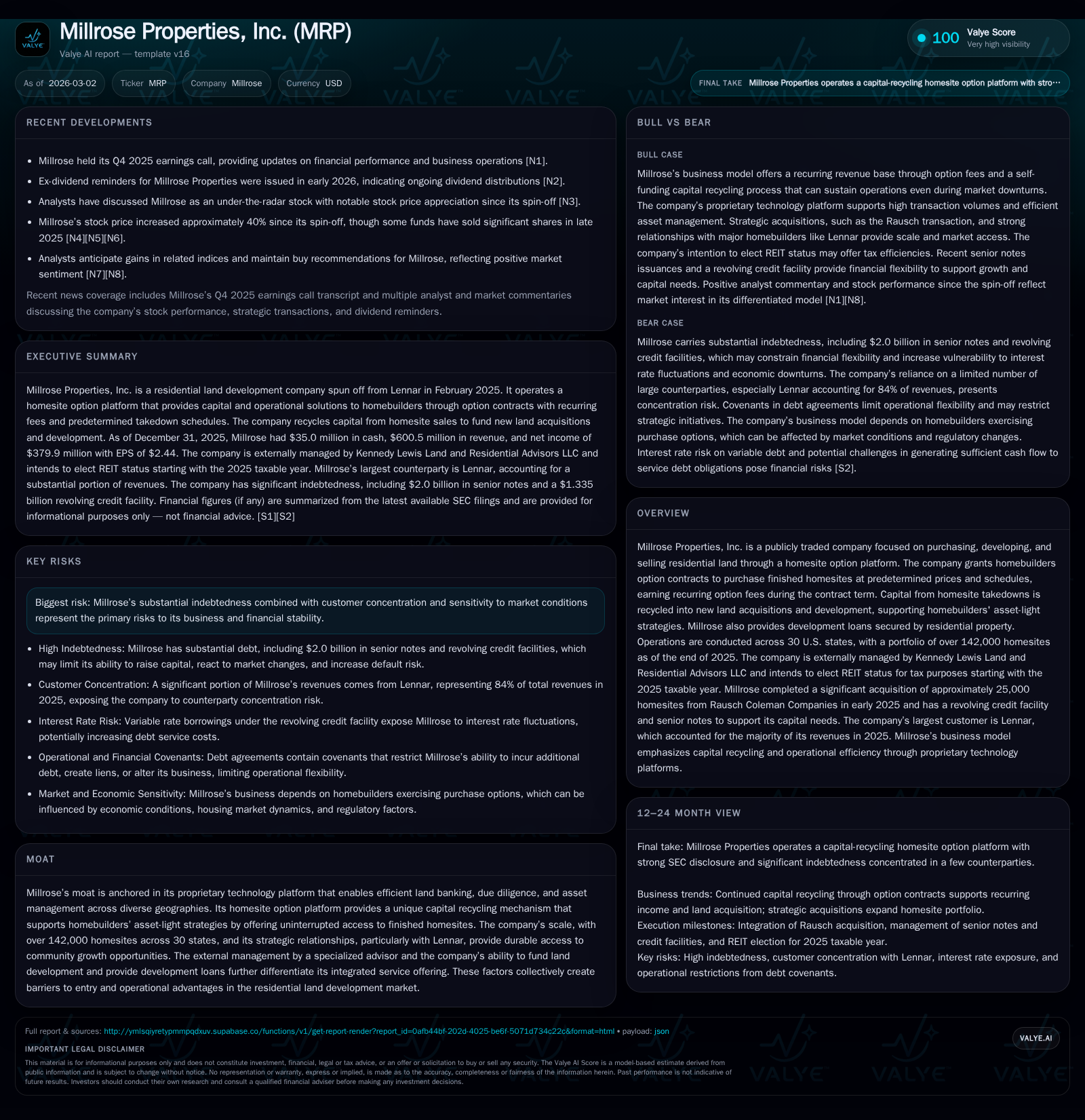
Millrose Properties, Inc. became an independent publicly traded company in early 2025 after spinning off from Lennar, inheriting a sizeable portfolio of residential homesites and cash. The company’s homesite option contracts provide homebuilders asset-light access to finished land, generating recurring fees and enabling capital recycling into new land acquisitions. Millrose expanded its footprint with a major 25,000-home acquisition in 2025 and maintains a substantial loan portfolio supporting residential development. Despite strong revenue of $600 million and net income of $380 million in 2025, the company carries over $2 billion in debt, reflecting leverage-related risks amid market sensitivity. Millrose declared stable dividends with no share repurchases since the Spin-Off.
Company Overview and Business Model
Millrose Properties, Inc. emerged as an independent publicly traded company on February 7, 2025, following its spin-off from Lennar Corporation [S1]. Incorporated on March 19, 2024 under Maryland law, Millrose operates a distinctive business model focused on acquiring and developing residential land parcels that it leases via option contracts directly to homebuilders. These contracts grant builders rights to purchase finished homesites at fixed prices over predetermined schedules, enabling builders to pursue asset-light strategies by shifting land ownership risk onto Millrose while generating recurring option fees over contract life [S1].
At Spin-Off, Lennar contributed approximately $5.5 billion of land assets representing about 87,000 homesites alongside roughly $1 billion in cash (inclusive of builder deposits) to seed Millrose's operations. In June 2025, Millrose completed a significant acquisition of RCH Holdings, adding about 25,000 homesites for $859 million cash consideration [S1], expanding the portfolio to over 142,000 homesites across thirty U.S. states.
Millrose also offers secured development loans tied to single-family residential projects as a complementary revenue source, enhancing capital solutions for developers [S1]. The company is externally managed by Kennedy Lewis Land and Residential Advisors LLC under a management agreement.
Historical Financial Performance
Although operationally independent only since early 2025, Millrose’s financials reflect the transition from Lennar’s consolidated results pre-Spin-Off. For the fiscal year ended December 31, 2025:
Historical performance (annual)
| FY |
|---|
| 2025 |
Source: SEC companyfacts cache [F1].
(Source: [F1])
Revenue arises primarily from recurring fees on option contracts with homebuilders and interest income from development loans. Operating margins approximate 81%, reflecting fee-based income rather than traditional homebuilding costs [F1]. Net income margin stands near 63%, offset partially by interest expense linked to leverage.
Management declared quarterly dividends throughout 2025 growing from $0.38 per share in Q1 up to $0.75 per share declared for Q4 [S18]. No share repurchases have been reported since Spin-Off.
Capital Structure and Leverage
Millrose’s capital structure is dominated by significant leverage primarily through senior unsecured debt instruments:
- Senior Notes: $1.25 billion at a fixed coupon rate of 6.375% maturing August 2030;
- Senior Notes: $750 million at a fixed coupon rate of 6.25% maturing September 2032;
- Revolving Credit Facility: Commitments totaling $1.335 billion with borrowings of approximately $110 million at year-end;
- Previous Delayed Draw Term Loan fully repaid during second half of 2025;
- Purchase money mortgages totaling roughly $33 million related to acquired communities [S4–S9].
Proceeds from bond issuances were used primarily to repay prior short-term credit facilities and fund acquisitions such as the RCH Holdings transaction [S12]. Debt agreements contain customary restrictive covenants including limits on leverage ratios (maximum leverage ratio around or below ~0.4x), minimum interest coverage ratios, tangible net worth requirements, and governance provisions such as management continuity clauses [S7][S13][S16].
Liquidity is supported by approximately $35 million cash on hand plus available revolver capacity estimated near $1.2 billion as of December-end [S5][S7]. Interest expense related to the Revolving Credit Facility was about $17 million for the year while Senior Notes incurred roughly $49 million in interest charges [S6][S8].
Growth Prospects and Strategic Drivers
Millrose’s growth depends heavily on expanding its portfolio of optioned homesites both numerically and geographically through ongoing land acquisitions and capital recycling via exercised option takedowns by homebuilder counterparties [N1][S1]. Its proprietary technology platform supports streamlined underwriting and asset management across multiple states enhancing scale efficiencies.
Early partnerships remain focused notably on legacy Lennar relationships but are broadening toward other large homebuilder clients such as New Home which received up to $700 million of land banking capital support for its Landsea acquisition in mid-2025 [S1]. This demonstrates how Millrose funds land deals aligned closely with builder expansion plans.
Offering secured development loans further deepens integration beyond land ownership into capital solutions for residential community construction — potentially driving incremental fee streams if loan utilization increases alongside growth.
Looking forward beyond initial standalone operations:
- Execution milestones include scaling benefits across all regions,
- Maintaining or expanding contractual relationships with Lennar and others,
- Prudently managing upcoming debt maturities given large repayments due,
- Capital recycling speed tied directly to pace of option takedown activity,
- Market demand environment remains sensitive posing both opportunities if single-family housing recovers sharply or risks if downturns impact takeout activity.
Risks and Challenges
Key risks include concentrated exposure stemming from legacy Lennar ties despite ongoing diversification efforts — customer concentration risk remains material given historical patterns [N1][S10]. Elevated indebtedness limits flexibility; covenant restrictions constrain corporate actions while refinancing options could become costlier or restricted under adverse market conditions [S16][S22].
Macroeconomic fluctuations impacting U.S. residential housing demand directly affect builder appetite for finished homesite purchases or development loans potentially reducing recurring fee income or delaying capital recycling cycles [N1][S10]. Further considerations include:
- Potential supply/demand imbalances depressing valuations relevant for borrowing base calculations limiting revolver availability,
- Counterparty credit risk on development loans requires monitoring though all were current at latest report date [S21],
- Operational dependency on external manager Kennedy Lewis Land elevates governance risk given management continuity provisions embedded within financing covenants [S13].
Returns and Capital Allocation Overview
With net income near $380 million against equity implying an approximate return on equity of around 6.5%, initial profitability represents a solid foundation considering early-stage standalone operations post Spin-Off [F1]. The steady dividend stream growing progressively through calendar year reflects management’s intent to return capital regularly aligned with REIT-like distribution norms although no share repurchase programs have been pursued yet [S18].
Cash flow details remain limited but positive operating performance combined with leveraged financing suggests sufficient cash generation presently for debt servicing alongside dividends.
Capital allocation appears prioritized towards maintaining balance sheet metrics while supporting organic growth through debt-financed acquisitions demonstrating investor confidence despite elevated leverage levels.
Summary Outlook Considerations
Millrose Properties innovates within the nascent homesite option market niche—a tailored solution enabling homebuilders scalable access to essential real estate inventory without full ownership burdens. The combination of technology-enabled platform management plus capital recycling mechanisms creates tangible competitive advantages difficult to replicate quickly.
Geographic diversification across thirty U.S states mitigates localized shocks but does not eliminate exposure to overall U.S residential housing cycles historically volatile.
Heavy reliance on financial leverage underscores importance of disciplined balance sheet maintenance amid rising interest rates or economic slowdowns potentially impairing refinancing options or counterparty strength.
Monitoring should focus on:
- Quarterly updates on homesite takedown volumes underpinning fee recognition,
- Development loan performance,
- Debt covenant compliance especially ahead of revolver maturity,
- Evolution in customer diversification beyond initial Lennar exposures.
Overall, Millrose's integrated approach blending asset ownership with service-oriented land options delivers a compelling strategy combining scale with capital efficiency but carries attendant risks typical for rapidly growing companies managing substantial leverage post-spin transition.
This analysis synthesizes publicly filed financial disclosures and recent earnings commentary without offering investment advice or recommendations.
Disclaimer: This is research-only, informational analysis and not investment advice. It may include AI-generated interpretation and general industry context. Always verify important details using primary sources.

Comments