
Marsh & McLennan's Strategic Expansion and Operational Resilience in a Volatile Risk Landscape
An in-depth analysis of Marsh & McLennan Companies’ growth trajectory, segment performance, and strategic positioning amid evolving global risks.
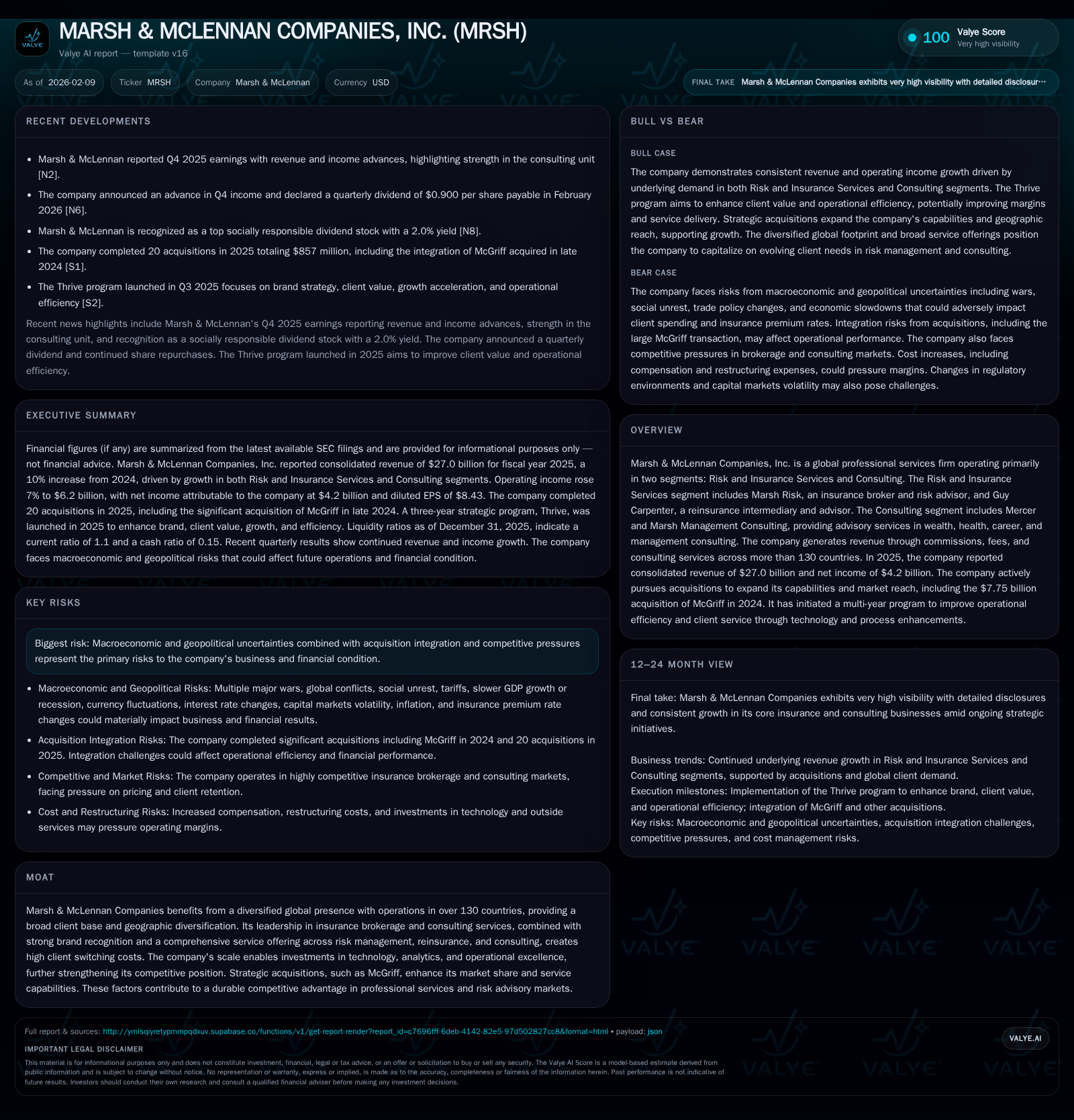
Marsh & McLennan Companies (MRSH) navigates a complex and uncertain global risk environment by leveraging its expansive multi-segment platform across more than 130 countries. The company reported solid revenue growth in 2025, driven by the Risk and Insurance Services segment, particularly Marsh Risk, and reinforced by steady gains in consulting through Mercer and Marsh Management Consulting. The $7.75 billion acquisition of McGriff strategically deepened MRSH’s U.S. market presence, while ongoing operational programs support margin resilience despite increased expenses. Macroeconomic headwinds and geopolitical tensions remain key uncertainties, but sustained investment in technology and analytics bolster the firm’s durable competitive moat.
Navigating Global Complexity: Marsh & McLennan's Expansive Reach
In an era marked by heightened geopolitical tensions, market volatility, and fluctuating regulatory landscapes, Marsh & McLennan Companies has fortified its position as a global leader in professional services encompassing risk management and consulting. The company’s presence in over 130 countries establishes a broad client base that spans industries and geographies, setting a formidable foundation for diversified revenue streams [S1]. This wide geographic footprint not only cushions the company against regional shocks but also enables it to harness growth opportunities wherever they emerge.
Such scale is critical as clients face increasingly complex risks—ranging from supply chain disruptions to climate-related exposures—which demand sophisticated risk transfer strategies combined with advisory expertise. The company's dual-segment structure, dividing operations into Risk and Insurance Services alongside Consulting, supports tailored solutions across the risk spectrum.
Core Business Review: Risk and Insurance Services Segment Performance
At the heart of Marsh & McLennan’s growth engine lies the Risk and Insurance Services segment that posted a robust $17.3 billion revenue haul in 2025, reflecting a nominal 12% increase with underlying revenue growth at 4% [S1]. This uptick was driven primarily by Marsh Risk’s exceptional performance with revenues rising 15%, signaling strong client demand for insurance brokerage and risk advisory services amidst rising insurance premium costs tied to inflationary pressures [S1][N2]. Meanwhile, Guy Carpenter also contributed solidly with a 6% revenue gain (5% underlying), bolstering reinsurance broking capabilities.
This segment’s operating income climbed steadily to $4.6 billion from $4.4 billion the year prior—a moderate increase reflecting rising operating expenses possibly linked to integration of acquisitions like McGriff [S1][N5]. Importantly, Marsh Risk’s outsized revenue growth underscores its leadership position as clients recalibrate their insurance portfolios against shifting risk landscapes.
Consulting Services Momentum: Driving Enhanced Client Value
Complementing the brokerage business is the steady expansion of the Consulting segment which recorded revenues of $9.8 billion in 2025; a reported increase of 7%, with underlying growth at approximately 5% [S1]. This segment includes Mercer—specializing in wealth, health, and career advisory—and Marsh Management Consulting focused on organizational strategy.
Mercer delivered an 8% revenue bump while Marsh Management Consulting grew 6%, signifying strong demand for human capital and management consulting services even amid economic uncertainties [S1][N2]. Operating income climbed from $1.8 billion to $1.9 billion throughout the year—reflecting incremental efficiencies even as compensation costs rose across the firm [S2]. These results hint at successful cross-selling initiatives leveraging MRSH’s breadth to offer end-to-end client solutions.
The Strategic Impact of McGriff Acquisition
In November 2024, MRSH strategically acquired McGriff for $7.75 billion in cash consideration—a bold move expanding its U.S.-centric insurance brokerage footprint significantly [S1]. Although full-year contributions were limited given the late acquisition timing, early integration outcomes appear positive as McGriff’s strengths complement Marsh Risk’s existing capabilities especially in commercial lines.
This transaction underscores MRSH's commitment to scale through transformative acquisitions that enhance client offerings while deepening market penetration in key territories [valye_report_excerpt]. The large price tag reflects high confidence in anticipated synergies including expanded cross-selling opportunities within an evolving insurance distribution ecosystem.
Financial Stewardship: Balancing Growth with Operational Efficiency
Marsh & McLennan’s financial stewardship shines through measured profitability gains amid increased expenses—a delicate balance accentuated by strategic restructuring efforts. Total consolidated operating income expanded by $406 million or 7%, reaching $6.2 billion despite a notable rise in operating expenses prompted by higher compensation outlays and other costs [S1][F1].
The company implemented a multi-year efficiency program called Thrive aimed at simplifying operations while investing in technology enhancements [S2]. Restructuring charges amounted to $222 million related mainly to severance and lease exits; these upfront costs are expected to generate longer-term operational leverage.
MRSH also demonstrated disciplined capital deployment returning approximately $3.7 billion to shareholders through dividends ($1.7 billion) and share repurchases ($2 billion) during the year [S1][N10][N11]. This approach preserves financial flexibility while supporting shareholder returns amidst competitive industry dynamics.
Diluted earnings per share increased moderately by 3% reaching $8.43 on improved net income of roughly $4.2 billion for fiscal year 2025—highlighting incremental accrual from both organic growth and acquisition activities [F1].
Risks on the Horizon: Macroeconomic and Geopolitical Headwinds
While MRSH navigates successfully through current cycles, multiple macroeconomic uncertainties persist as potential disruptors. The firm explicitly cites global conflicts—including several major wars—social unrest movements, inflationary trends impacting premium pricing, currency volatility against a backdrop of changing interest rates as primary external risks [S1][valye_report_excerpt].
Insurance premium rates are sensitive to these variables; for example, prolonged inflation can increase claims severity yet may simultaneously support higher premium renewals benefiting brokers’ commissions [analysis]. Moreover, geopolitical conflicts may introduce volatility into capital markets affecting clients’ hedging needs and consulting engagements.
MRSH’s diversified global footprint partially mitigates country-specific shocks but exposure remains non-trivial given widespread economic interconnections.
Shareholder Returns and Capital Allocation in a Competitive Landscape
Investor appetite for steady income from high-quality service firms is reflected in MRSH’s dividend yield exceeding two percent post Q4 earnings announcement [N11][N13]. The Board declared a quarterly dividend of $0.900 per share payable February 2026—a signal of confidence in sustained cash flows.
Simultaneously, robust share repurchase programs totaling around $2 billion underscore management's commitment to enhancing shareholder value while balancing necessary reinvestment into core businesses [N10][N12]. Strategies utilizing options trades aiming to boost yields above typical levels (up to ~5.8%) have attracted attention among income-focused investors interested in customized exposure profiles [N14].
This prudent mix caters both to patient income investors as well as those prioritizing growth potential via acquisition-fueled expansion.
Technology, Analytics, and the Competitive Moat
MRSH leverages its scale to invest aggressively in technology platforms underpinning superior client analytics, underwriting insights, and risk modeling capabilities embedded across its offerings [valye_report_excerpt][S1]. Initiatives such as the Thrive program focus on digital transformation aimed at operational excellence enabling both cost savings and enhanced service delivery.
By embedding advanced data science into consulting frameworks alongside brokerage functions, MRSH creates high switching costs for clients who benefit from integrated solutions addressing complex risk profiles holistically.[analysis] This ability differentiates it from smaller competitors less able to fund continuous innovation cycles.
Tech investments thus form an integral pillar reinforcing MRSH’s durable competitive advantage allowing it to sustain leadership in evolving markets where data-driven decision making is paramount.
Forward Path: Sustainability Initiatives and Long-Term Vision
Although explicit sustainability disclosures remain limited within current filings, it is consistent with industry norms that MRSH pursues ESG-aligned strategies reinforcing brand integrity amid socially responsible investment trends [valye_report_excerpt][analysis]. An emphasis on responsible corporate citizenship complements its role advising clients broadly on governance risk frameworks tied to environmental transitions.
A strong ESG profile supports talent attraction vital for consultancies dependent on human capital. It also bolsters client trust essential for long sales cycles prevalent in risk advisory engagements [analysis].
Looking forward, ongoing commitment toward sustainability will likely intertwine closely with technology adoption efforts—especially where advances enable quantification of climate risks or social impact metrics—further solidifying Marsh & McLennan’s holistic approach toward resilient growth within volatile environments.
Disclaimer: This analysis is intended solely for informational purposes based on publicly available data as of February 2026. It does not constitute investment advice or recommendations.
Disclaimer: This is research-only, informational analysis and not investment advice. It may include AI-generated interpretation and general industry context. Always verify important details using primary sources.

Comments