
Marvell Technology Inc (MRVL) Equity Analysis: AI Data Center Growth Amid Concentration and Technological Risks
Marvell’s semiconductor leadership in AI-driven data center infrastructure is bolstered by strategic acquisitions and advanced interconnect innovations, yet customer concentration and AI-driven disruption pose critical challenges.
Marvell Technology is capitalizing on accelerating AI data center demand through a diversified semiconductor portfolio enhanced by recent acquisitions in photonics and switching technologies. Its fabless model integrates advanced IP and software to serve hyperscale cloud and communications markets. While reported liquidity position and profitability support continued R&D investment, the company faces substantial risks from revenue concentration among a few customers, supply chain dependencies on advanced nodes, and rapid AI-enabled shifts in semiconductor design. The path forward hinges on successful integration of new technologies, navigating geopolitical trade risks, and sustaining technology leadership against evolving competitive pressures.
Marvell Technology, a fabless semiconductor supplier specializing in data infrastructure solutions, is strategically positioned at the nexus of AI-driven data center expansion and advanced networking. Its portfolio—spanning custom ASICs, high-speed interconnects, scale-up switches, and photonic fabrics—targets hyperscale cloud and communications customers whose infrastructure demands are rapidly evolving. Recent acquisitions have enhanced Marvell's technological breadth, especially in photonics and PCIe/CXL switching. However, the company’s significant customer concentration and reliance on external foundry partners for advanced process nodes introduce operational and market risks. The key question is whether Marvell can sustain its competitive edge through innovation and integration amid the accelerating pace of AI-driven semiconductor design transformation and shifting geopolitical landscapes.
Latest Operating Snapshot
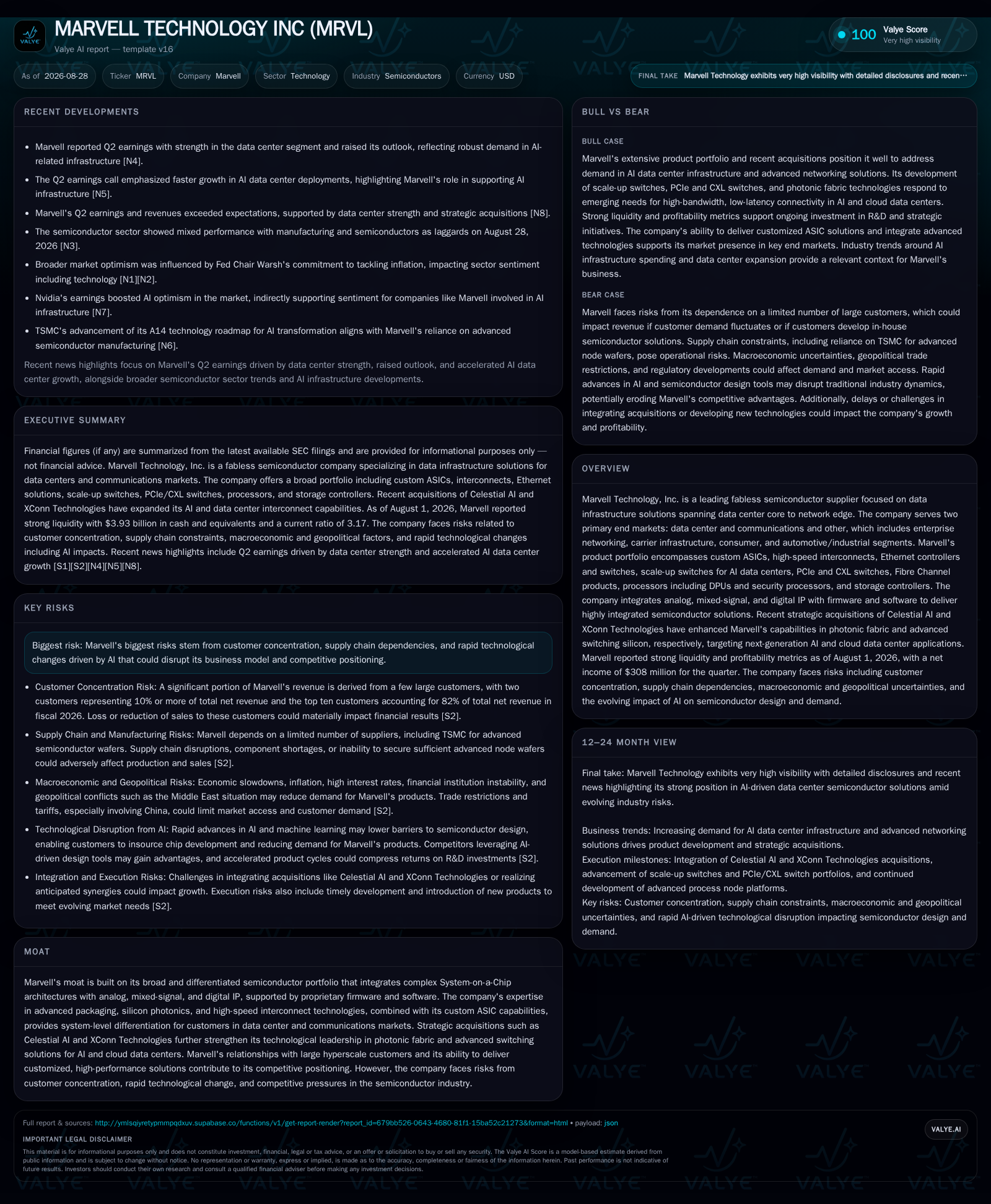
As of August 2026, Marvell reported robust financial performance with net income of $308 million and a reported liquidity position position, including $3.93 billion in cash and equivalents and a current ratio of 3.17 [S2]. This reflects solid operating cash flow and the company’s ability to fund ongoing R&D and strategic acquisitions. The Q2 earnings beat and raised outlook were primarily driven by strength in the data center segment, especially AI infrastructure deployments, which underscores Marvell’s increasing relevance in high-growth markets [N4][N5][N8].
Marvell’s revenue is heavily concentrated; two customers each represent 10% or more of total net revenue, and the top ten customers account for 82% of revenue in fiscal 2026 [S2]. The end markets span data center and communications, with notable divestiture of the automotive Ethernet business in 2025, indicating a strategic focus shift towards higher-growth AI and cloud data center opportunities [S1]. Recent acquisitions of Celestial AI and XConn Technologies have expanded Marvell’s photonic fabric and PCIe/CXL switch capabilities, positioning it to address scale-up networking demands in AI data centers [S1].
Business Model and Unit Economics
Marvell operates a fabless semiconductor model, developing integrated semiconductor solutions that combine analog, mixed-signal, and digital IP with proprietary firmware and software. Revenue streams derive mainly from sales of custom ASICs, interconnect components, Ethernet controllers and switches, processors, and storage controllers tailored to data center and communications customers [S1]. Pricing is influenced by product complexity, customization level, and volume commitments from large hyperscale customers, who demand high-performance, low-latency connectivity solutions.
Capital intensity is moderate relative to integrated device manufacturers due to outsourcing of manufacturing to foundries like TSMC, which poses supply chain dependencies but lowers fixed capital requirements. Operating leverage potential exists if Marvell can scale sales of high-margin, software-enhanced ASIC and switch products, leveraging fixed R&D costs across larger volumes. However, customer concentration could amplify revenue volatility, and rapid technological change may compress product lifecycles, limiting margin expansion opportunities.
Moat, Competition and Counterforces
Marvell’s moat is anchored in its broad, differentiated semiconductor portfolio integrating complex SoC architectures with advanced packaging, silicon photonics, ultra-high-speed SerDes, and proprietary firmware/software. This system-level integration caters to demanding AI and cloud data center customers requiring tailored, high-performance solutions. Strategic acquisitions of Celestial AI and XConn Technologies enhance its competitive position in photonic fabric and PCIe/CXL switching—critical technologies for AI scale-out networking [S1].
Nonetheless, the company faces intense competition from established semiconductor suppliers like Broadcom, Intel, Nvidia, and emerging AI-accelerated design entrants. Customer concentration risks and supply chain reliance on TSMC limit bargaining leverage. The rapid evolution of AI-driven semiconductor design tools could enable customers to internalize chip development, eroding Marvell’s traditional value proposition. Additionally, geopolitical trade restrictions may constrain access to key markets and customers.
Bull Case
In a bullish scenario, Marvell successfully leverages its expanded portfolio and advanced technologies to capture the accelerating AI data center infrastructure spend. The integration of Celestial AI’s photonic fabric and XConn’s PCIe/CXL switching silicon enables Marvell to offer differentiated, high-bandwidth, low-latency solutions critical for hyperscale AI workloads. Continued investment in advanced process nodes (3nm and 2nm platforms) and scale-up networking products fuels competitive advantage and drives strong volume growth.
Confirming evidence includes consistent revenue growth from data center customers, successful integration of acquisitions yielding synergies, and market share gains against peers. Falsification would involve persistent delays in product launches, failure to maintain technological leadership, or loss of major customers to in-house solutions or competitors.
Base Case
The base case envisages Marvell maintaining stable growth driven by steady demand from data center and communications markets, with moderate expansion in AI-related infrastructure spend. The company gradually integrates its acquisitions and continues incremental technology improvements without dramatic market share shifts. Customer concentration remains a double-edged sword, providing revenue visibility but posing downside if a major customer reduces demand.
Marvell’s fabless model and reported liquidity position enable ongoing R&D investment, but supply chain constraints or macroeconomic headwinds may temper growth. The firm sustains its moat through incremental innovation and strong customer relationships, while competitive pressures and AI-driven semiconductor design changes create manageable risks rather than existential threats.
Bear Case
In a downside scenario, Marvell’s heavy reliance on a few large customers leads to significant revenue volatility if one or more reduce orders or insource chip design, facilitated by AI-powered tools lowering design barriers. Supply chain disruptions—particularly availability of advanced node wafers from TSMC—could impair production and delay product launches. Geopolitical trade restrictions might limit market access, especially in China, further depressing demand.
Acquisition integration challenges or failure to commercialize advanced technologies like photonic fabric and scale-up switches would exacerbate growth pressures. Confirming evidence includes declining customer orders, margin compression, product delays, or increased competitive displacement. Conversely, evidence of expanding customer engagements or successful new product ramp-ups would falsify this bear thesis.
What Matters Next
Key performance indicators to monitor include: 1) Revenue growth and margin trends in the data center and AI infrastructure segments, reflecting adoption of advanced products; 2) Customer order patterns and concentration metrics, especially from top two and ten customers; 3) Progress on integration and commercialization of Celestial AI and XConn Technologies acquisitions; 4) Development milestones and customer adoption of 3nm and 2nm semiconductor platforms; 5) Supply chain stability with TSMC and other foundry partners, including wafer availability and lead times; 6) R&D expenditure levels and innovation pipeline breadth; 7) Impact of geopolitical and trade developments on market access; and 8) Competitive positioning relative to peers in AI networking and semiconductor design innovation.
Disclosure or updates on these metrics would provide clarity on Marvell’s ability to sustain growth and navigate risks. Additionally, monitoring broader semiconductor sector trends and AI infrastructure investment cycles will contextualize Marvell’s performance trajectory.
Disclaimer: This is research-only, informational analysis and not investment advice. It may include AI-generated interpretation and general industry context. Always verify important details using primary sources.

Comments