
Middlesex Water’s Capital Program and Regulatory Framework Shape Revenue Growth and PFAS Compliance Costs
Regulated utility status underpins Middlesex Water’s stable revenues as infrastructure investments and PFAS compliance drive capital allocation.
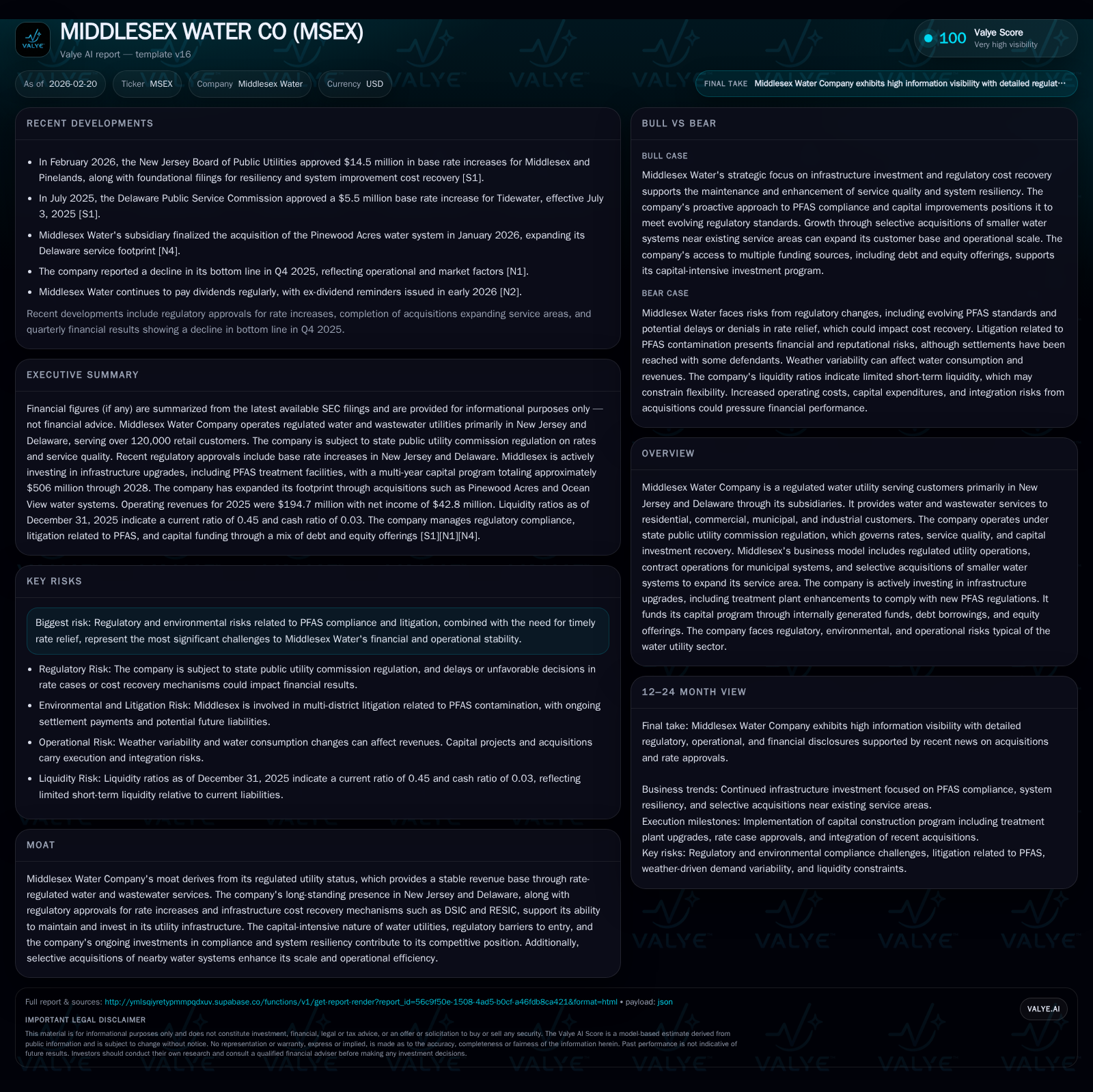
Middlesex Water Company leverages its regulated utility position in New Jersey and Delaware to achieve significant revenue growth driven by acquisitions and approved rate increases. The company is investing heavily in infrastructure upgrades, including PFAS treatment at its Carl J. Olson Plant and water main replacements under the RENEW program. Regulatory mechanisms such as DSIC and RESIC enable timely cost recovery, though large capital expenditures have resulted in negative free cash flow in 2025. Funding is balanced through long-term debt, including low-cost State Revolving Fund loans, expanded credit facilities, and equity raised via an ATM offering. Key risks include regulatory timing for rate relief, environmental litigation outcomes, and operational cost management.
Company Overview and Business Mix
Founded in 1897, Middlesex Water Company (ticker: MSEX) is a regulated water utility providing essential water and wastewater services primarily in New Jersey (Middlesex system) and Delaware (Tidewater Utilities). The company serves residential, commercial, municipal, industrial, and fire protection customers under state public utility commission regulation. It also operates municipal systems under contract via subsidiaries such as Utility Service Affiliates (USA), alongside pursuing selective acquisitions to increase operational scale.
Historical Financial Performance
Middlesex experienced a substantial financial expansion from FY2024 to FY2025 driven by acquisitions of utility assets (including Ocean View and Pinewood Acres) alongside regulatory-approved base rate increases across its service territories.
Historical performance (annual)
| FY | Rev ($mm) | Net ($mm) | CFO ($mm) | OpInc ($mm) | Rev YoY | Net YoY |
|---|---|---|---|---|---|---|
| 2025 | 195 | 43 | 63 | 54 | +313.3% | +386.4% |
| 2024 | 47 | 9 | 59 | 11 | -72.1% | |
| 2023 | 32 | 53 | 8 | -25.7% | ||
| 2022 | 42 | 61 | 47 |
Note: Omitted columns lack sufficient annual XBRL coverage in the provided tags (need ≥2 annual points): Capex, Div. Source: SEC companyfacts cache [F1].
Capital returns and efficiency (annual)
| FY | Buybacks ($) | FCF ($mm) | ROE% |
|---|---|---|---|
| 2025 | 8.7 | ||
| 2024 | 1468000 | -16 | 2.0 |
| 2023 | 619000 | -37 | 7.5 |
| 2022 | -30 |
Source: SEC companyfacts cache [F1].
Note: Capex for FY2025 not available from tags; dividends historically modest; buybacks declined post-FY24.
Operating income growth outpaced revenue gains due to operating leverage despite higher operating costs including labor inflation, weather-related repairs, and new PFAS treatment expenses.
Drivers of Past Growth
Regulatory Rate Increases: NJBPU authorized $14.5 million combined base rate increases effective February 23, 2026 for Middlesex & Pinelands; Delaware PSC approved a $5.5 million increase for Tidewater effective July 3, 2025 [S14][S24]. DSIC & RESIC filings support accelerated cost recovery.
Strategic Acquisitions: Acquisition of smaller systems like Ocean View (April 2025) and Pinewood Acres (January 2026) expanded customer base incrementally while enhancing scale [N1][S14].
Contract Operations: Management contracts for municipal water/wastewater systems provide complementary unregulated revenues without significant capital requirements.
Infrastructure Investment: Programs like RENEW replace aging mains; capital projects improve reliability supporting regulatory approvals for higher rates.
Weather Impact: Unfavorable weather patterns have tempered consumption volumes despite rate hikes affecting revenue growth dynamics [S24].
Future Growth Prospects
Capital expenditures are forecasted at approximately $506 million over three years (2026–28), focused on:
~$255 million for PFAS removal technology upgrades at the Carl J Olson Surface Water Treatment Plant responding to USEPA's April 2024 regulations setting stringent maximum contaminant levels for PFAS compounds [S13][S15].
~$34 million allocated to the ongoing RENEW water main replacement initiative.
Additional investments include elevated storage tanks, booster station improvements, IT system enhancements, new water treatment facilities such as Bethany Bay in Delaware, plus distribution system upgrades [S13][S15].
Organic customer growth remains positive especially within Tidewater's expanding franchise area (~3% growth in FY25) complemented by targeted tuck-in acquisitions.
Constraints include timely regulatory approval of rate relief necessary to offset rising operating costs plus large capital spending commitments; execution risks managing complex infrastructure projects amid regulatory scrutiny; and environmental liabilities tied to PFAS contamination governance.
Financial Outlook and Key Milestones
While explicit forward guidance is limited beyond disclosed capital budgets and recent rate decisions [N2][S13], key milestones include:
Completion of phased PFAS treatment upgrades at the CJO plant scheduled through late decade.
Continued semiannual DSIC/RESIC filings facilitating more frequent recovery of qualifying infrastructure costs between general rate cases.
Monitoring compliance with newly finalized USEPA PFAS regulations requiring initial monitoring by April 2027 with treatment implementation deadlines potentially extended to April 2031 following anticipated rule changes [S15].
Integration effects from recent Delaware acquisitions will be critical for near-term accretion analysis.
Investors should watch quarterly filings closely for evolving O&M expense impacts from regulation as well as changes in unbilled revenues affecting topline trends [S2][N2].
Returns and Capital Allocation Strategy
Estimated return on equity is approximately 8.7%, calculated as FY25 net income over shareholder equity of $494 million—consistent with typical regulated utility profiles emphasizing stability over rapid yield expansion [F1].
Operating cash flows grew modestly (+6.6%) to $62.6 million in FY25 despite high capex demands reflecting resilient underlying cash generation capacity [F1][S24].
Estimated free cash flow is negative around -$12 million due to aggressive capital spending (CFO minus capex not tagged but inferred from historical data), necessitating access to multiple liquidity sources including expanded credit lines now totaling $180 million post-February 2026 amendment [F1][S4].
Long-term debt includes cost-effective State Revolving Fund loans from NJ & DE with below-market interest rates supporting financing of compliance-driven projects such as lead service line replacements or elevated storage tanks [S4][S20].
Equity raised via an ATM offering program generated net proceeds of approximately $29.5 million during FY25 with remaining authorization for roughly $80 million gross sales demonstrating readiness for opportunistic equity issuance aligned with capital needs [S10].
Dividend payments continue at moderate levels relative to earnings; share repurchases have been minimal since FY24 reflecting disciplined capital return amid investment priorities [F1][S10].
Regulatory Framework and Moat Characteristics
Middlesex benefits from a durable economic moat rooted primarily in its regulated public utility status overseen by the New Jersey Board of Public Utilities (NJBPU) and Delaware Public Service Commission (DEPSC). These regulators approve rates including base increases plus surcharges such as Distribution System Improvement Charge (DSIC) and Resiliency & Environmental System Improvement Charge (RESIC), enabling accelerated recovery of infrastructure investment costs mitigating revenue lag risk.
The capital-intensive nature of water utilities combined with stringent regulatory barriers limit new market entrants enhancing competitive protection long term.
Recent investments targeting PFAS compliance exemplify environmental regulatory imperatives driving accelerated capex but unlocking recovery through RESIC filings validated by NJBPU early in calendar year 2026 [S14][S15].
Selective tuck-in acquisitions augment scale economies while contract operations provide stable fee-based revenue diversification beyond tariffs without incremental capital risk.
Risks Overview
Key risks include:
- Timing uncertainty regarding regulatory approvals impacting allowed returns/rate base adjustments affecting margin sustainability.
- Environmental liabilities linked to ongoing multi-district litigation against PFAS manufacturers; although settlements are currently refunded directly to customers minimizing immediate earnings impact [S14].
- Execution risk managing multiple concurrent infrastructure projects alongside weather-driven consumption variability creating volatility in volume assumptions.
- Interest rate environment pressures increasing debt servicing costs potentially elevating weighted average cost of capital constrained by mortgage covenants on utility assets collateralizing debt issuances.
Conclusion
Middlesex Water Company exemplifies a classic regulated utility profile characterized by steady revenue growth underpinning aggressive investments required by evolving environmental mandates notably related to PFAS remediation while expanding its footprint prudently across New Jersey and Delaware markets through acquisitions.
Although capex intensity depresses free cash flow presently requiring continued access to debt & equity markets, strong operating cash generation paired with tariff mechanisms designed explicitly for faster cost recovery mitigate financial strain risks somewhat.
Success depends on maintaining constructive regulator relationships ensuring timely rate relief aligning with capital outlays while navigating environmental litigation without compromising financial flexibility or service quality commitments intrinsic to its public utility charter.
Disclaimer: This report is based on data available up to February 20, 2026 per SEC filings and referenced news releases without investment advice or recommendations.
Disclaimer: This is research-only, informational analysis and not investment advice. It may include AI-generated interpretation and general industry context. Always verify important details using primary sources.

Comments