
M2i Global, Inc.: Navigating Critical Minerals Supply Amidst Financial and Operational Hurdles
M2i Global pursues a multi-pronged strategy to secure critical minerals for U.S. defense and economic security through mining, recycling, and government reserves, yet faces severe liquidity constraints and competitive pressures that challenge its path to sustainable operations.
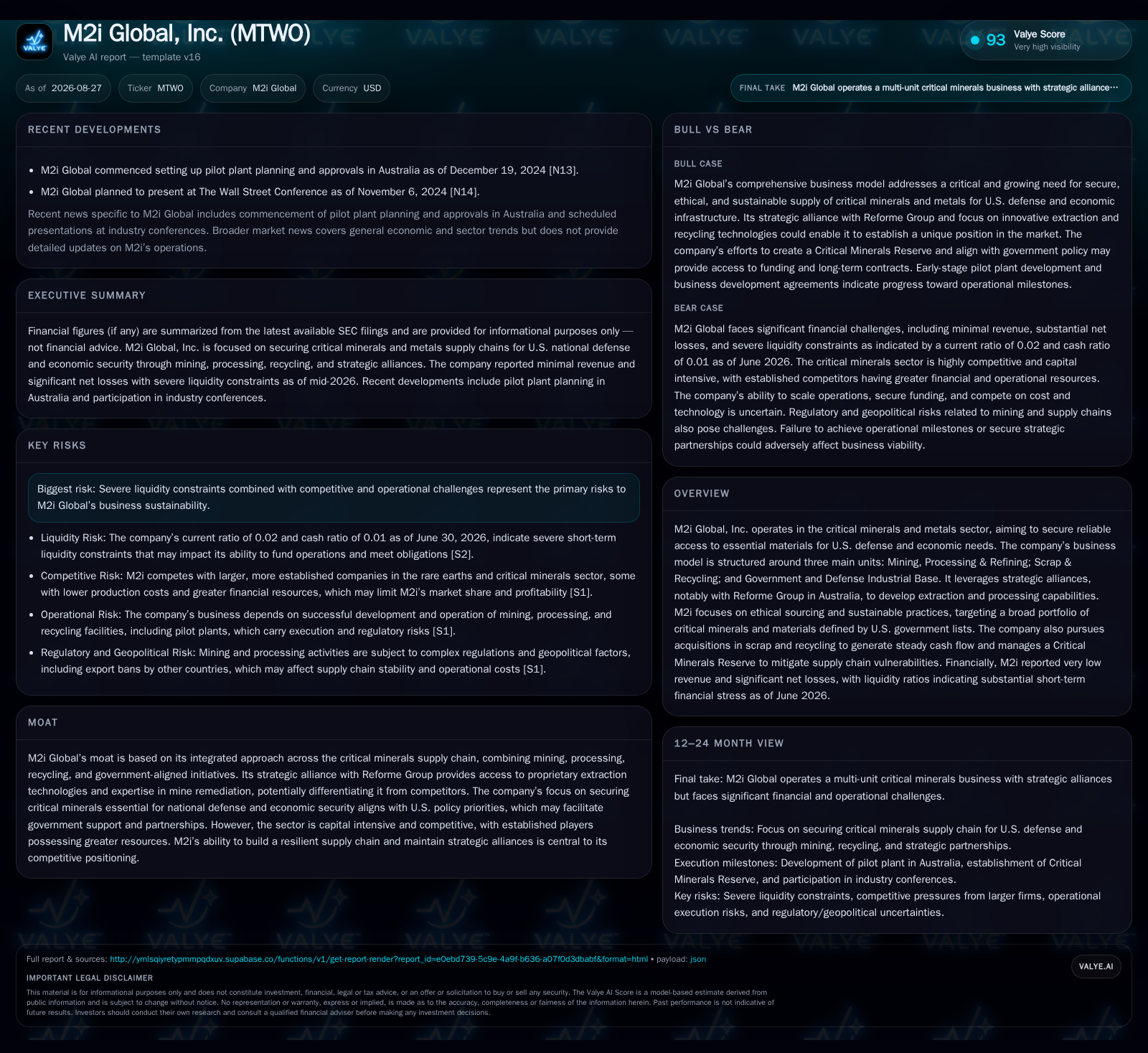
M2i Global, Inc. aims to address a vital and growing need for critical minerals essential to U.S. national security by integrating mining, processing, recycling, and government-aligned initiatives. Its strategic alliance with Reforme Group and pilot plant efforts in Australia highlight progress toward operational capability. However, minimal revenues, substantial losses, and acute liquidity shortages pose significant execution risks. The company’s competitive position depends on leveraging proprietary technologies, government partnerships, and scaling production efficiently. The key question is whether M2i can overcome financial constraints and operational complexities to capitalize on favorable policy trends and sector growth.
M2i Global, Inc. is positioned at the intersection of critical minerals supply and national security, targeting the U.S. and allied needs through a three-pronged approach encompassing mining, recycling, and government reserve management. Its strategic partnership with the Australian Reforme Group aims to leverage innovative extraction technologies and sustainable sourcing to address a notoriously complex and capital-intensive sector. While the company's strategic vision aligns with increasing government emphasis on supply chain resilience, M2i faces daunting financial and operational challenges, including negligible revenue generation, liquidity crises, and the need to scale pilot operations amid strong competition. The company’s future hinges on its ability to convert alliances and pilot initiatives into steady production and funding streams.
Latest Operating Snapshot
M2i Global reported extremely limited revenue of $3,400 for the fiscal year ending November 30, 2024, alongside a net loss nearing $1 million in the quarter ending June 30, 2026, underscoring nascent commercial traction [S2]. As of mid-2026, the company’s liquidity profile was severely strained, with a current ratio of 0.02 and cash ratio of 0.01, indicating short-term obligations far exceed available liquid assets [S2]. These figures highlight immediate financial risks that could constrain operational continuity absent successful capital raises or revenue ramp-up.
On the operational front, M2i initiated pilot plant planning and regulatory approvals in Australia by late 2024, leveraging its strategic alliance with the Reforme Group to access novel extraction and remediation technologies [S1]. Additionally, participation in industry conferences such as The Wall Street Conference signals efforts to raise visibility and attract investment. Together, these facts point to early-stage execution steps that, if successful, could validate technology and support scale-up.
Business Model and Unit Economics
M2i Global’s business model integrates three autonomous units focused on different segments of the critical minerals value chain: Mining, Processing & Refining; Scrap & Recycling; and Government and Defense Industrial Base management. Revenue generation depends on mining output volumes, recycling throughput, and government contracts for strategic reserves, each with distinct cost structures and capital intensity [S1]. Pricing dynamics likely hinge on prevailing critical mineral market prices, which can be volatile, and contract terms with government or industrial customers.
Capital requirements are substantial, especially for mining and refining operations, which entail high fixed costs for plant development and regulatory compliance. Operating leverage could emerge if pilot plants transition to commercial-scale production, improving fixed-cost absorption and margin expansion. In contrast, the Scrap & Recycling unit, through acquiring smaller scrap businesses, may offer steadier cash flows with lower capital intensity but limited scale. The government reserve unit could generate recurring revenue if government policies mandate stockpiling, but this depends on multi-year contracts and budget allocations, which are not yet disclosed.
Moat, Competition and Counterforces
M2i’s competitive advantage is rooted in its integrated approach across the critical minerals supply chain, from mining through recycling to government strategic reserves, coupled with a strategic alliance granting access to proprietary extraction technologies and mine remediation expertise through Reforme Group [S1]. Alignment with U.S. national defense priorities may facilitate preferential access to government contracts, grants, or strategic partnerships, creating switching frictions for customers dependent on secure and ethical supply.
However, the critical minerals sector is highly capital intensive and dominated by large, established firms with greater scale, financial resources, and operational efficiencies. These incumbents may leverage lower cost structures and established supply chains to outcompete smaller entrants like M2i. Moreover, geopolitical risks and regulatory complexities in mining can disrupt operations or increase costs. M2i’s thin financial runway and early-stage operations limit its ability to withstand competitive pressures or delays in pilot plant commercialization.
Bull Case
In a favorable scenario, M2i successfully develops its Australian pilot plant leveraging Reforme Group’s novel extraction technologies, demonstrating superior recovery rates and sustainable mining practices. This technological validation attracts government contracts for supplying critical minerals and managing strategic reserves, supported by U.S. policy prioritizing domestic and allied supply chain resilience. The Scrap & Recycling segment contributes steady cash flow from acquired businesses, helping to fund scaling operations. Strategic alliances broaden sourcing capabilities and secure raw material inputs at favorable terms.
Revenue growth accelerates as pilot plants transition to commercial operations, creating operating leverage that reduces unit costs and enhances margins. Subsequent rounds of capital raising or government funding alleviate liquidity constraints, enabling further expansion. Confirmation of recurring government contracts and multi-year agreements would validate long-term revenue visibility. Failure to achieve pilot plant milestones, technology setbacks, or loss of government support would falsify this positive outlook.
Base Case
M2i makes measured progress in pilot plant development and regulatory approvals but faces delays typical of capital-intensive mining ventures. The Scrap & Recycling unit grows slowly through acquisitions, providing limited but stable revenues insufficient to offset overall losses. Government efforts to establish a Critical Minerals Reserve proceed cautiously, with contracts awarded sporadically and contingent on political and budget dynamics. Liquidity challenges persist but are managed through intermittent fundraising and cost controls.
The company’s strategic alliance provides technical support but no material breakthrough or scale advantage. Competitive pressures keep pricing and margins under pressure, limiting profitability. The business model remains dependent on achieving operational scale to unlock leverage. Under this scenario, M2i remains a developmental company with uncertain path to break-even, requiring ongoing capital injections. Improved but not transformative government alignment and pilot plant progress would confirm this steady but challenging trajectory.
Bear Case
M2i encounters operational setbacks including regulatory hurdles, pilot plant failures, or inability to scale extraction technologies effectively. Financial constraints intensify as liquidity shortages force cutbacks in critical development activities. The Scrap & Recycling acquisitions fail to generate meaningful cash flow or encounter integration challenges. Government contracts and support do not materialize due to shifting policy priorities or budget constraints. Competition from well-capitalized incumbents further erodes market opportunity.
In this downside scenario, the company’s net losses widen, and funding becomes unavailable or prohibitively expensive, creating an existential risk. Failure to establish stable supply chains or secure strategic partnerships renders the business nonviable. Evidence falsifying this scenario would be successful capital raises, pilot plant commissioning, or material government contract awards within expected timelines. Persistent operational delays and worsening liquidity ratios would confirm downside risk.
What Matters Next
Key investor milestones include progress on Australian pilot plant approvals and commencement of commercial operations, which would demonstrate technological and regulatory feasibility. Securing multi-year government contracts for the Critical Minerals Reserve would provide revenue visibility and validate strategic alignment. Financially, monitoring quarterly liquidity ratios, cash burn rates, and successful capital raises is critical to assess operational runway.
Additional important KPIs are production volumes and recovery rates from pilot and recycling operations, acquisition success and integration metrics in the Scrap & Recycling segment, and progress in strategic alliances expanding sourcing and technology capabilities. Disclosure of contract terms and pipeline visibility would improve forecast confidence. External factors such as U.S. government policy shifts on critical minerals, geopolitical developments affecting supply chains, and competitor actions also materially impact prospects.
Disclaimer: This is research-only, informational analysis and not investment advice. It may include AI-generated interpretation and general industry context. Always verify important details using primary sources.

Comments