
MaxLinear Strengthens Infrastructure Semiconductor Position with Resilient Q2 Results and Strategic Growth
MaxLinear’s Q2 2026 results show operational resilience amid industry cyclicality, supported by a fabless business model focused on broadband, optics, and AI infrastructure segments.
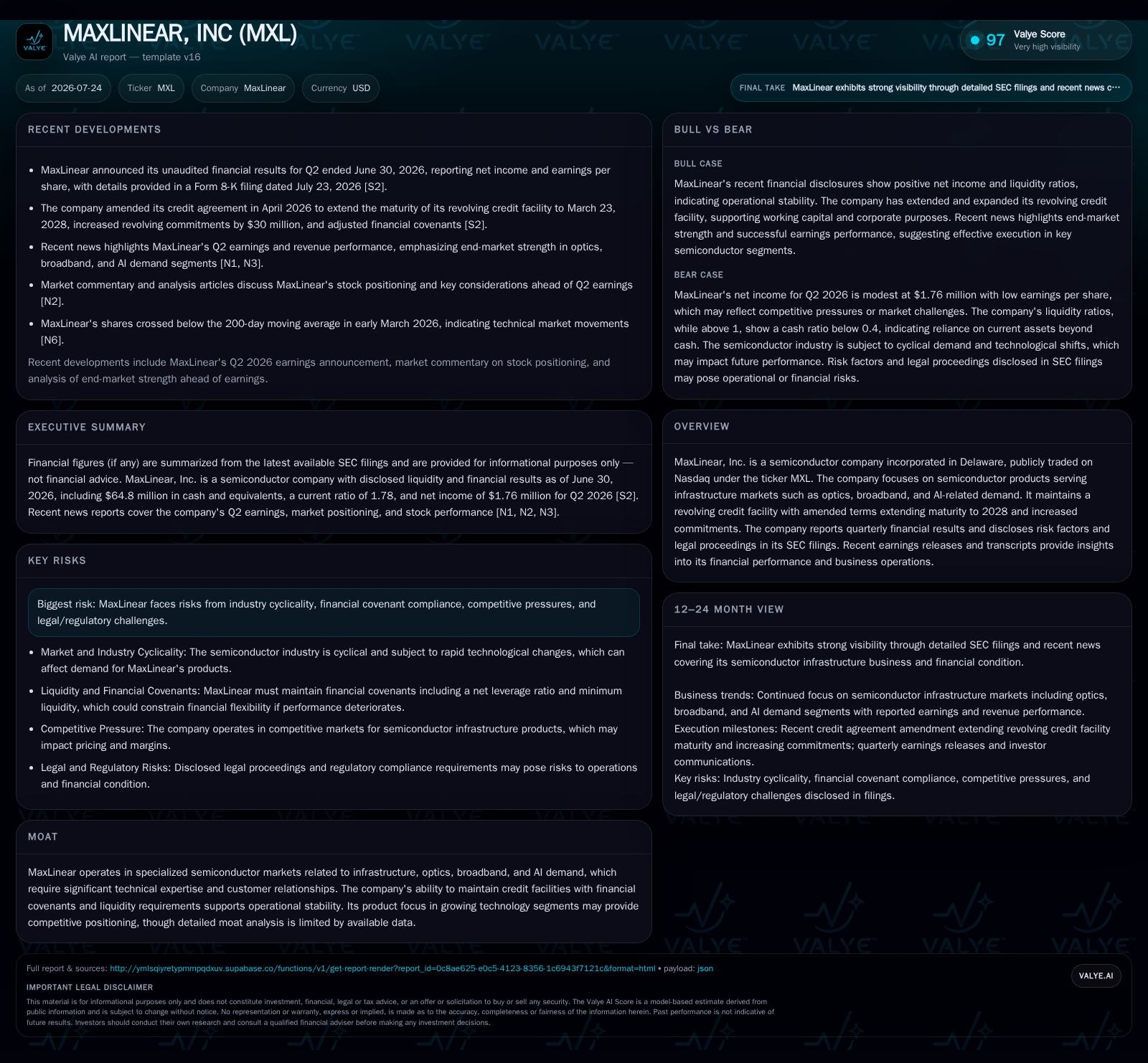
In its latest quarterly filing for Q2 2026, MaxLinear demonstrated stability in revenues and maintained liquidity despite ongoing semiconductor sector challenges [S2, S3]. The company operates as a fabless semiconductor provider targeting infrastructure markets such as broadband, optical transceivers, and AI accelerators [S1]. Competitive pressures and foundry dependencies constrain margin expansion, but growth catalysts like AI infrastructure demand and broadband upgrades create opportunities. Financially, the firm sustains a manageable debt profile with $64.8 million in cash against $125 million total debt as of June 30, 2026 [F1], supporting near-term flexibility.
Q2 Operational Momentum Shapes MaxLinear’s Near-Term Outlook
MaxLinear, Inc. reported resilient operational performance in the second quarter ended June 30, 2026, demonstrating stability amid ongoing semiconductor industry cyclicality [S2]. The company’s fabless semiconductor business model, which focuses on integrated circuits for broadband infrastructure, optical networking, and AI accelerator chipsets, continues to underpin its market positioning and revenue generation [S1]. Despite sector-wide challenges such as pricing pressure and foundry dependencies, MaxLinear’s strategic focus on infrastructure-related semiconductor segments supports a steady revenue trajectory and manageable financial leverage.
Fabless Model Anchors Market Focus on Broadband and Optical Solutions
MaxLinear operates as a fabless semiconductor company, designing and developing integrated circuits and system-on-chip (SoC) solutions primarily for broadband infrastructure operators, optical transceiver component suppliers, and AI accelerator chipset markets [S1]. This capital-efficient model outsources wafer fabrication to third-party foundries, enabling flexible capacity scaling aligned with demand cycles. The company’s revenue is predominantly derived from product sales to original equipment manufacturers (OEMs) and system integrators who incorporate MaxLinear’s chipsets into networking equipment and data-center appliances. Additionally, intellectual property (IP) licensing agreements contribute supplemental revenue streams, often structured around milestone payments and royalties tied to design wins and product lifecycle milestones.
Research and development (R&D) investment, representing a mid-to-high single-digit percentage of revenues, supports continuous innovation focused on advanced process nodes and power-efficient architectures. This R&D focus aligns with customer priorities for rapid time-to-market and compliance with evolving network standards such as next-generation DOCSIS broadband technologies and fiber optic network rollouts [N5]. The company’s ability to maintain competitive yield rates and manage supply chain risks related to foundry partnerships remains critical to sustaining product quality and delivery schedules.
Infrastructure Semiconductor Competition Pressures Margins and Growth Potential
MaxLinear competes in a specialized segment alongside larger fabless semiconductor peers such as Broadcom and Marvell Technology, which offer broader product portfolios spanning wireless communications, storage networking, and diversified connectivity solutions [S1]. Analog Devices operates in adjacent mixed-signal and RF semiconductor markets, overlapping partially with MaxLinear’s customer base. While MaxLinear’s narrower focus on broadband and optical infrastructure chipsets limits scale advantages, it benefits from deep customer relationships and targeted IP assets.
The cyclical nature of semiconductor demand affects capacity utilization at foundries, influencing unit shipments and average selling prices (ASP). Foundry reliance introduces risks related to yield variability and supply chain disruptions, which can compress operating margins given fixed R&D and development costs [S2]. These structural industry dynamics suggest that while revenue growth opportunities exist—particularly as cyclical troughs abate—margin expansion may remain constrained without significant design wins or shifts in product mix toward higher-value chipsets.
Growth Catalysts from AI Infrastructure, Broadband Upgrades, and Optical Expansion
MaxLinear’s product portfolio is well-positioned to benefit from several secular growth drivers. The rising integration of AI accelerators within data-center infrastructure fuels demand for specialized semiconductors optimized for high-speed optical interconnects, a core competency reflected in MaxLinear’s optics-related chipset offerings [N5]. Enhanced DOCSIS standards drive upgrades in cable broadband hardware, necessitating silicon architectures capable of delivering higher throughput with improved power efficiency.
Simultaneously, the expansion of fiber optic communications supports growth in optical transceiver chipsets embedded in networking equipment, facilitating enterprise-wide connectivity modernization amid ongoing digital transformation initiatives [N6]. These trends collectively underpin an expected increase in design wins—new customer engagements where OEMs select MaxLinear’s products—and support ASP improvements linked to advanced chipset features.
MaxLinear’s agile R&D cycles are critical to capitalizing on evolving protocol standards and securing early market entry before competitors establish dominant positions. The company’s product pipeline and development cadence currently sustain optimism for timely new product introductions aligned with these growth areas.
Challenges Include Cyclicality, Pricing Pressure, and Foundry Dependencies
MaxLinear’s filings highlight typical semiconductor industry risks, including demand cyclicality where end-customer spending volatility directly impacts order timing and volume [S2, S4]. Dependency on external foundries exposes the company to supply chain disruptions, geopolitical tensions, and wafer fabrication cost fluctuations. Yield rate variability can increase unit costs and erode profitability if defect rates rise unexpectedly.
Fixed R&D expenditures combined with revenue variability amplify operating leverage effects, meaning downturns can disproportionately impact margins absent flexible cost management. Pricing pressure from larger competitors and market commoditization further constrain margin expansion potential.
Benchmarks Against Fabless Peers Highlight Strategic Positioning Without Overstating Scale Advantage
Compared to Broadcom, which benefits from extensive scale and a diversified portfolio across wireless, storage, and enterprise networking, MaxLinear remains a more focused player addressing infrastructure semiconductor needs [S1]. Marvell Technology’s broader connectivity solutions, including storage networking chips, contrast with MaxLinear’s narrower broadband and optical focus. Analog Devices’ mixed-signal and RF specialization offers partial overlap but less direct competition.
These peer comparisons contextualize MaxLinear’s competitive niche, emphasizing strengths in optical transceivers and AI-related chipsets while illustrating structural constraints related to scale-driven pricing power and product breadth.
Key Milestones to Monitor: Design Wins, Capacity Utilization, and Revenue Trajectory
For stakeholders tracking MaxLinear’s progress, several operating KPIs merit close attention. The frequency and significance of new design wins serve as leading indicators of successful OEM platform penetration and future revenue streams. Capacity utilization trends at foundries provide insight into supply chain tightness or easing, affecting production volumes and delivery timelines. ASP trends reveal pricing sustainability and product mix shifts, reflecting competitive positioning and customer demand dynamics.
Order backlog levels offer near-term revenue visibility, helping assess execution effectiveness amid demand volatility [S2]. Monitoring these metrics enables evaluation of whether current operational momentum can sustain growth or if softness may necessitate strategic adjustments.
Financial Profile Discussion: Liquidity Buffer and Managed Debt Underpin Operational Flexibility
As of June 30, 2026, MaxLinear held $64.8 million in cash and equivalents against approximately $125 million in total debt, resulting in a net debt position near $60 million [F1]. The company’s current assets of $298.7 million exceed current liabilities of $168.1 million, yielding a current ratio of approximately 1.78, indicative of solid short-term liquidity [F1].
This financial positioning supports operational flexibility, enabling continued investments in R&D and emerging growth areas while providing a buffer against semiconductor sector cyclicality and supply chain disruptions. The company’s revolving credit facility, extended through 2028 with incremental commitments, further enhances liquidity and refinancing capacity [S14]
Maintaining compliance with financial covenants, including a net leverage ratio capped at 3.5x and minimum liquidity thresholds, remains a key aspect of MaxLinear’s capital structure management [S14]. This prudent financial stewardship underpins the company’s ability to navigate industry volatility without immediate refinancing pressures.
This analysis integrates recent SEC disclosures and market reports to present a comprehensive view of MaxLinear’s positioning within the semiconductor industry, emphasizing sector-specific dynamics and key performance indicators relevant to infrastructure-focused fabless semiconductor providers [S1, S2, S3, N5, N6].
Disclaimer: This document is for informational purposes only and does not constitute investment advice or research views. It synthesizes publicly available data and industry context without projecting future performance or outcomes.
Disclaimer: This is research-only, informational analysis and not investment advice. It may include AI-generated interpretation and general industry context. Always verify important details using primary sources.

Comments