
Northann Corp. Boosts Innovation Cycle Amid Supply and Cost Pressures
Northann’s Q1 2026 report highlights sharp raw material cost exposure and liquidity resilience as it scales proprietary 3D-printed vinyl flooring production.
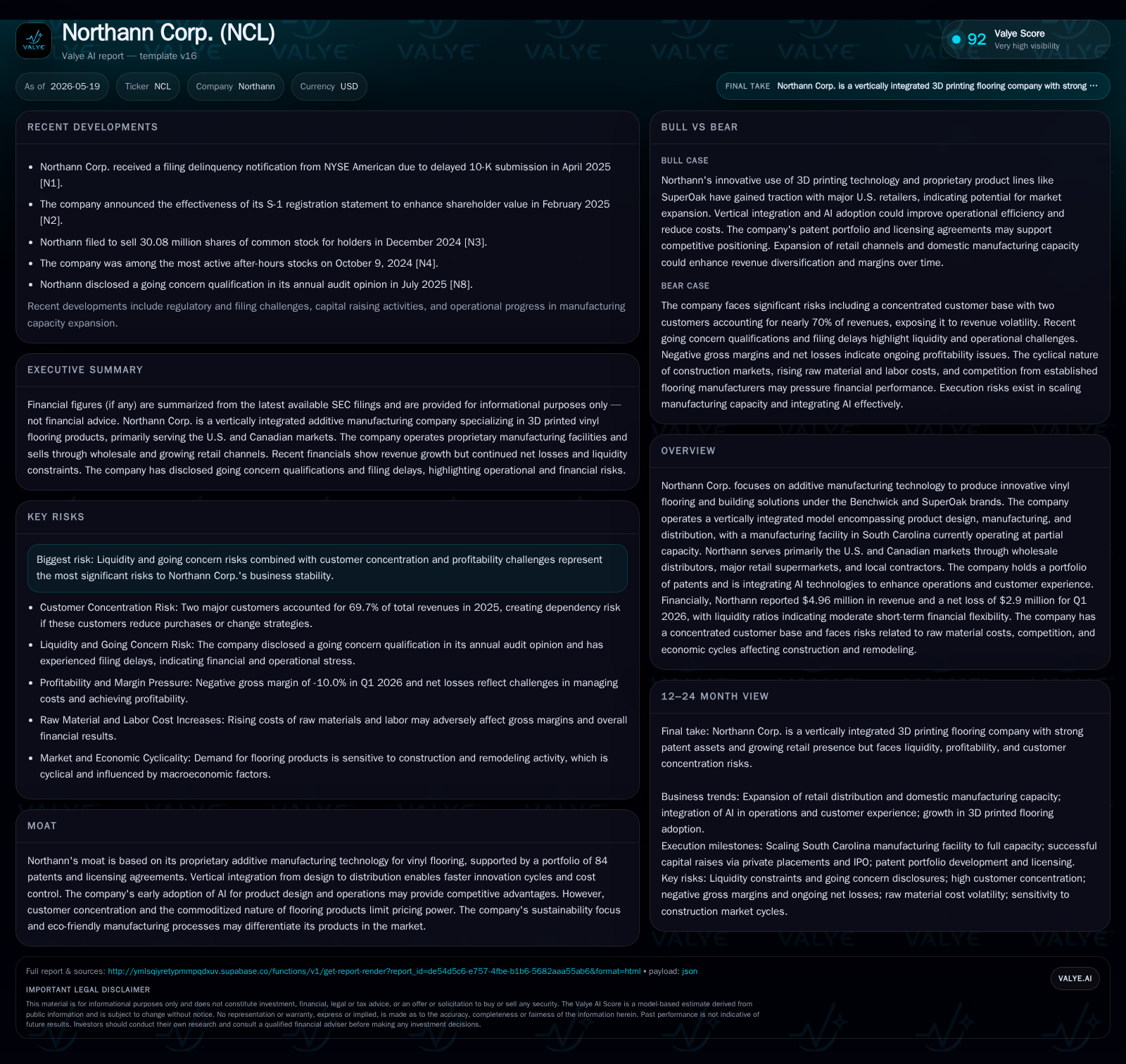
Northann Corp.’s latest quarterly filing reveals a pronounced margin squeeze driven by raw material costs comprising over 90% of cost of goods sold. The company operates at partial capacity from its South Carolina facility while expanding retail penetration for its SuperOak branded products. Vertical integration paired with an extensive patent portfolio supports rapid iterative innovation in additive manufacturing flooring solutions. Despite current liquidity sufficiency, customer concentration and input cost volatility present substantial execution risks. Growth hinges on scaling manufacturing capabilities, broadening retail distribution, and leveraging AI to enhance product design and operational efficiencies.
Direct materials—including ink, coating, resin, sound padding, and glue—account for more than 90% of the total cost of revenue [S2]. This outsized exposure materially compresses margins during inflationary pressures affecting commodity prices and tariffs on imports from China heightened since April 2025 [S1]. Consequently, Q1 revenue totaled approximately $4.96 million, but the company recorded a gross loss margin near -10%, a steep decline from positive gross margins the prior year [S5].
The localized disruption stems primarily from transitional vendor setup costs tied to the initial launch of Northann's SuperOak brand within large U.S. retail chains—incurring freight, compliance fees, and higher tariff charges totaling around $359K this quarter versus $105K in the prior year [S23]
Despite negative operating income and net losses exceeding $2.8 million in Q1 [S9], Northann confirms that existing cash reserves of approximately $240K alongside operational cash flows provide an adequate liquidity runway for at least twelve months [S2]. However, management acknowledges potential capital requirements ahead if pursuing further strategic investments or acquisitions, indicating readiness to access additional funding sources including debt or equity issuance [S2]. This cautious balance between ongoing cash burn and financing flexibility will shape Northann's near-term financial stability.
Business Model and Product Innovation: From Additive Manufacturing to Market
Northann's core business revolves around proprietary additive manufacturing technology—a sophisticated form of 3D printing—for producing vinyl flooring products through its Benchwick and newly established SuperOak brands [S1]. With a vertically integrated structure spanning product design (managed by Crazy Industry R&D hub), manufacturing (notably their South Carolina facility), import/export logistics (MARCO), wholesale distribution (Benchwick), and retail delivery (NDC), Northann controls the value chain end-to-end [S1].
This vertical integration accelerates innovation cycles by reducing reliance on OEMs—historically significant—and enhances control over costs and quality [S1]. The company's specialized product lineup includes distinct vinyl flooring solutions such as Infinite Glass, DSE, TruBevel, MattMaster alongside the premium SuperOak line fabricated via advanced 3D printing methods [S1]. These offerings emphasize customization capabilities for function and aesthetics that conventional manufacturing cannot easily match.
Northann leverages a substantial R&D investment framework supported by a robust intellectual property portfolio consisting of 84 patents across its subsidiaries, which underpin technical protections relating to materials science and manufacturing processes central to their additive manufacturing competitive edge [S1]. Customer reach focuses primarily on the United States and Canada through wholesale distributors, large supermarket retail chains—where SuperOak is gaining momentum—and local contractors emphasizing commercial builds [S21].
Industry Structure and Competitive Positioning: Vertical Integration and Patents
In an industry dominated largely by commoditized vinyl flooring products offering limited pricing power, Northann attempts differentiation through sustainable production methods facilitated by additive manufacturing that reduces material waste up to 40% compared with conventional processes—yielding lower environmental footprint claims [S1]. Their domestic manufacturing expansion reduces shipping complexities inherent with China-based suppliers amid tariffs that cumulatively top 65% since early 2025 [S1]. Vertical integration supports leaner operations versus fragmented competitors dependent on external OEMs or third-party supply chains.
However, Northann faces typical sector headwinds whereby two major customers accounted for nearly 70% of revenues in fiscal year 2025—a significant customer concentration risk with potential revenue disruption if these relationships falter or contract terms tighten materially [S20]. Channels include wholesale distribution partners and emerging direct-to-retail avenues requiring ongoing negotiation sophistication.
The company’s extensive patent portfolio restricts replication risk from peers in the additive manufacturing niche for vinyl flooring but broader market commoditization constrains pricing premiums absent sustained product innovation or brand development efforts [S1]. Thus far, early success in gaining shelf space within major US retail outlets for SuperOak enhances brand presence yet also involves initial vendor-specific onboarding expenses that pressure margins short term.
Key Growth Drivers: Technology, Market Penetration, and AI Integration
Northann’s growth thesis hinges principally on three intertwined vectors:
Scaling Manufacturing Capacity — The new South Carolina additive manufacturing plant currently operates at roughly 10% planned capacity but aims to reach full-scale production by mid-2027 [S17]. Incremental capacity should ease unit cost dilution effects while facilitating faster order fulfillment.
Retail Expansion — Early traction during Q1 with tier-one home improvement retailers includes a notable $2 million purchase order for SuperOak products reflecting growing mass-market acceptance beyond wholesale channels [S23]. Expanding this footprint promises volume growth accompanied by potential margin improvements once vendor setup costs normalize.
AI-Enabled Operations — The company has strategically integrated AI technologies in product design optimization and manufacturing workflow improvements. These initiatives seek to reduce material inefficiencies, accelerate R&D iterations, customize consumer-oriented designs more rapidly, and ultimately improve both top-line appeal and unit economics [N/A; analysis based on filings references S1/S2 AI mentions].
These drivers collectively aim to exploit Northann’s core additive-manufacturing strengths while addressing key limitations such as limited production scale today. Sustainability credentials inherent in waste reduction contribute positively to brand differentiation amid increasingly eco-conscious consumer preferences.
Risks and Challenges: Raw Material Costs, Customer Concentration, and Cash Flow
Several critical risks temper Northann’s strategic outlook:
- Raw Material Cost Volatility: Over 90% of cost of revenue relates directly to materials such as inks (UV-based) imported mainly from Japan plus powders sourced primarily from Chinese suppliers—subjects compounded risk from global inflation trends and geopolitical trade tensions [S20][S2][S23]. Inability to pass rising input prices fully onto customers compresses margins significantly.
- Customer Concentration: Two customers comprised nearly 70% of sales in FY2025 raising dependency concerns that could amplify revenue volatility should key contracts lapse or purchasing patterns change abruptly [S20]. This structurally limits bargaining power toward pricing enhancement.
- Profitability Pressure: Operating losses exceeding $2.8 million in Q1 reflect heavy upfront investments into market development activities including vendor setup fees at retail chains plus elevated tariff expenses impacting cost bases. Sustained losses stress cash flow despite inflows from financing lines [S9][S11].
- Liquidity Constraints: While current cash balance near $240K alongside positive working capital indicates modest financial flexibility with no outstanding debt as of latest filings [F1], ongoing cash burn necessitates vigilant capital management potentially entailing future equity or debt issuance which may dilute or leverage the capital structure further [S2].
- Regulatory & Environmental Compliance: Past penalties related to exhaust gas emissions at subsidiary facilities underscore operational compliance risks that may recur if environmental safeguards do not keep pace with production scale escalations [S14].
What to Watch Next: Execution Milestones, Cost Management, and Market Expansion
Investors should monitor several tangible forward indicators:
- Progress toward ramping up South Carolina facility capacity beyond current ~10%, particularly any equipment commissioning or labor training successes impacting throughput metrics [S17]
- Realization of AI integration benefits—manifested through reduced material waste ratios or faster new product introductions impacting revenue mix favorably
- Quarterly gross margin inflections reflecting successful mitigation of rising input costs either via pricing power gains or supplier negotiations [S23]
- Expansion of retail channel orders beyond the initial Midwest home improvement purchase order advancing scale economies in distribution logistics [S23]
- Capital allocation discipline highlighting controlled opex trajectory given prior elevated spending levels juxtaposed against measured R&D intensity maintaining product pipeline health [S9]
- Potential stock issuances or credit facilities drawn if internal cash generation falls short amid growth investments are also relevant signaling capitalization approach priorities going forward [S12][S18]
Financial Profile: Operating Losses Amid Investments and Moderate Liquidity
Financially speaking, Northann posted a net loss approaching $2.9 million during Q1 2026 compared to about $2.6 million a year earlier—a widening attributed largely to reduced gross profit resulting from steep input-cost escalation alongside increased amortization from recent intangible asset acquisitions tied to software platforms aimed at operational enhancements [S9][S11]
Cash position as of March end rests near $240K supplemented by working capital approximating $4.2 million translating into a current ratio around 1.51—indicative of basic coverage but limited cushion against unexpected cash demands [F1][S2]. The company carries no long-term debt as of the latest filings [F1].
Meanwhile net cash used in operations remains sizeable at about $1.4 million per quarter underscoring ongoing investment phase status rather than profitability maturity currently—highlighting investors’ need for evidence on scaling efficiencies over coming quarters before structural profit improvements are achievable [S11][S12]
This analysis is based solely on publicly available SEC filings as of May 19, 2026 ([S1],[S2],[F1], etc.). It does not constitute investment advice or research view.
Disclaimer: This is research-only, informational analysis and not investment advice. It may include AI-generated interpretation and general industry context. Always verify important details using primary sources.

Comments